



الصفحة 16
الصفحة 16

A Roadmap for Formal Property Verification
Develops the answers to these questions and fits them into a roadmap for formal property verification – a roadmap that shows how to glue FPV technology into the traditional validation flow. A Roadmap for Formal Property Verification explores the key issues in this powerful technology through simple examples – you do not need any background on formal methods to read most parts of this book.

A Practical Introduction to PSL
Practical Introduction to PSL is primarily targeted to hardware designers and verification engineers who plan to use PSL. This book is also of interest to students of temporal logic. The formal semantics of PSL are included as an appendix, and bibliographical notes include pointers to some of the main theoretical works.
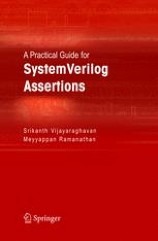
A Practical Guide for SystemVerilog Assertions
SystemVerilog language consists of three very specific areas of constructs - design, assertions and testbench. This guide shows how to use the language to solve real verification problems. It examines how to verify complex protocols and memories using SVA with seeral examples.

A journey of embedded and cyber-physical systems : Essays dedicated to Peter Marwedel on the occasion of his 70th birthday
This book celebrates Professor Peter Marwedel's outstanding achievements in compilers, embedded systems, and cyber-physical systems. The contributions in the book summarize the content of invited lectures given at the workshop “Embedded Systems” held at the Technical University Dortmund in early July 2019 in honor of Professor Marwedel's seventieth birthday.
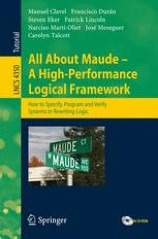
A High-Performance Logical Framework -- All About Maude : How to Specify, Program, and Verify Systems in Rewriting Logic
This book gives a comprehensive account of Maude, a language and system based on rewriting logic. Many examples are used throughout the book to illustrate the main ideas and features of Maude, and its many possible uses. Maude modules are rewrite theories. Computation with such modules is - cient deduction by rewriting. Because of its logical basis and its initial model semantics,aMaude module defines a precise mathematical model.This means that Maude and its formal tool environment can be used in three, mutually reinforcing ways: • as a declarative programming language; • as an executable formal specification language; and • as a formal verification system. Maude’s rewriting logic is simple, yet very expressive. This gives Maude good representational capabilities as a semantic framework to formally represent a wide range of systems, including models of concurrency, distributed al- rithms, network protocols, semantics of programming languages, and models of cell biology. Rewriting logic is also an expressive universal logic,making Maude a fiexible logical framework in which many difierent logics and - ference systems can be represented and mechanized. This makes Maude a useful metatool to build many other tools, including those in its own formal tool environment. Thanks to the logic’s simplicity and the use of advanced semi-compilation techniques, Maude has a high-performance implementation, making it competitive with other declarative programming languages.
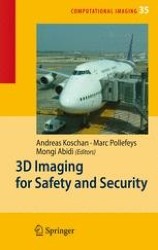
3D Imaging for Safety and Security
This book is so far the first that covers the current state of the art in 3D imaging for safety and security. Special attention was given to advanced 3D imaging technologies in the context of safety and security applications. Comparative evaluation studies showing advantages of 3D imaging over traditional 2D imaging for a given computer vision or pattern recognition task were emphasized. Moreover, additional experts in the field of 3D imaging for safety and security were invited by the editors for a contribution to this book.
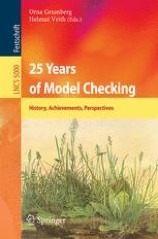
25 Years of Model Checking : History, Achievements, Perspectives
Model checking technology is among the foremost applications of logic to computer science and computer engineering. The model checking community has achieved many breakthroughs, bridging the gap between theoretical computer science and hardware and software engineering, and it is reaching out to new challenging areas such as system biology and hybrid systems. Model checking is extensively used in the hardware industry and has also been applied to the verification of many types of software. Model checking has been introduced into computer science and electrical engineering curricula at universities worldwide and has become a universal tool for the analysis of systems.
