



الصفحة 16
الصفحة 16

Ergativity : Emerging Issues
This volume presents a collection of papers on the enticing and complex theme of Ergativity. The papers exemplify theoretical depth applied to a wide range of languages, with the majority of papers based on original fieldwork. Ergativity refers to a grammatical pattern in which the logical subject of intransitive clauses and the logical object of transitive clauses share some grammatical features, and in this respect differ from transitive subjects. The shared features are often case and/or agreement, but a variety of other relevant features have also been isolated in the literature.

Equity markets, valuation, and analysis
The primary purpose of this scholarly book is to provide an objective look into the dynamic world of equity markets, valuation, and analysis. The coverage extends from discussing basic concepts and their application to increasingly intricate and real-world situations. This volume spans the gamut from theoretical to practical while attempting to offer a useful balance of detailed and user-friendly coverage.

Environmental Policy Instruments for Conserving Global Biodiversity
If you can believe, all things are possible to him who believes. —Mark 9:23 The current, unprecedented loss of global biodiversity as a result of anthropo genic interference in the world's ecosystems is affecting human well-being across the globe with increasing severity. It therefore represents a major chal lenge in international environmental policymaking. With the Convention on Biological Diversity (CBD), the community of states has recognized the in creasing importance of preserving biodiversity. Given the extensive context of biodiversity loss and preservation, this study focuses on two issues, which are at the center of the public discussion regarding the objectives of conservation and the sustainable use of biodiversity, and that are addressed by specific policy instruments. The first issue is the regulation of cross-border trade in genetic information and genetic resources. Here, the question is whether the commercial use of genetic information derived from bio diversity can create incentives for its preservation. The second issue involves the conservation of biodiversity through the protection of ecologically valuable eco systems from human use.

Enterprise interoperability : New challenges and approaches
Interoperability: the ability of a system or a product to work with other systems or products without special effort from the user is a key issue in manufacturing and industrial enterprise generally. It is fundamental to the production of goods and services quickly and at low cost at the same time as maintaining levels of quality and customisation. Interoperability is achieved if internal and external collaborators can interact on at least three levels: data, applications and business enterprise (through the architecture of an enterprise model and making allowance for the semantics of both partners). Not only a problem of software and IT technologies, it implies support for communication and transactions between different organisations that must be based on shared business references. Today, a new and important consideration must be taken into account – economic business evaluation and the definition of dissemination policy.

Engineering and Managing Software Requirements
This book provides an exploration of key issues in requirements engineering, the book is organized in three parts. Part 1 presents surveys of state-of-the art requirements engineering process research along with critical assessments of existing models, frameworks and techniques. Part 2 addresses key areas in requirements engineering, such as market-driven requirements engineering, goal modeling, requirements ambiguity, and others. Part 3 concludes the book with articles that present empirical evidence and experiences from practices in industrial projects. Its broader perspective gives this book its distinct appeal and makes it of interest to both researchers and practitioners, not only in software engineering but also in other disciplines such as business process engineering and management science.

Energy minimization methods in computer vision and pattern recognition ; 5th International Workshop, EMMCVPR 2005, St. Augustine, FL, USA, November 9-11, 2005, Proceedings
Constitutes the refereed proceedings of the 5th International Workshop on Energy Minimization Methods in Computer Vision and Pattern Recognition, EMMCVPR 2005, in St Augustine, FL, USA, in November 2005. This book consists of 24 papers and 18 poster papers organized in topical sections on different approaches.

Encyclopaedia of the History of Science, Technology, and Medicine in Non-Western Cultures
The second edition of this landmark encyclopaedia will contain approximately 1000 entries dealing in depth with the history of the scientific, technological and medical accomplishments of cultures outside of the United States and Europe. The entries consist of fully updated articles together with hundreds of entirely new topics.This unique reference work includes: Intercultural articles on broad topics such as Mathematics and Astronomy Philosophical articles on concepts and ideas related to the study of non-Western Science, such as Rationality, Objectivity, and Method, Religion and Science, East and West, and Magic and Science Articles on topics such as Native American Mathematics, Polynesian Navigation, Korean Maps, and African Metallurgy Biographical articles for those cultures where individual scientists are known to us, such as China and the Islamic world.

Enabling things to talk : Designing IoT solutions with the IoT architectural reference model
The Internet of Things (IoT) is an emerging network superstructure that will connect physical resources and actual users. It will support an ecosystem of smart applications and services bringing hyper-connectivity to our society by using augmented and rich interfaces. Whereas in the beginning IoT referred to the advent of barcodes and Radio Frequency Identification (RFID), which helped to automate inventory, tracking and basic identification, today IoT is characterized by a dynamic trend toward connecting smart sensors, objects, devices, data and applications. The next step will be “cognitive IoT,” facilitating object and data re-use across application domains and leveraging hyper-connectivity, interoperability solutions and semantically enriched information distribution.

Emerging Web Services Technology ; Vol. II
This book contains papers from the 2007 European Conference on Web Services and the Workshop on Emerging Web Services Technology. Coverage includes grid-based computing, mobility issues for web services, dynamic web services, and model driven engineering.

Emerging Technologies in Knowledge Discovery and Data Mining ; PAKDD 2007 International Workshops, Nanjing, China, May 22-25, 2007, Revised Selected Papers
The objective of this volume is to offer the excellent presentations to the public, and to promote the study exchange among researchers worldwide.The first part of this volume contains industrial track. This track was organized to attract papers on new technology trends and real-world solutions in different industry sectors. The succeeding chapters include Data Mining for Biomedical Applications aimed at attracting top researchers, practitioners and students from around the world to discuss data mining applications in the field of bioinformatics

Effective Computational Geometry for Curves and Surfaces
Computational geometry emerged as a discipline in the seventies and has had considerable success in improving the asymptotic complexity of the solutions to basic geometric problems including constructions of data structures,convex hulls, triangulations, Voronoi diagrams and geometric arrangements as well as geometric optimisation. The goal of this book is to take into consideration the multidisciplinary nature of the problem and to provide solid mathematical and algorithmic foundations for effiective computational geometry fo rcurves and surfaces. This book covers two main approaches. In a first part, we discuss exact geometric algorithms for curves and s- faces. We revisit two prominent data structures of computational geometry, namely arrangements (Chap. 1) and Voronoi diagrams (Chap. 2) in order to understand how these structures, which are well-known for linear objects, behave when de?ned on curved objects.

Education for the 21st Century - Impact of ICT and Digital Resources ; IFIP 19th World Computer Congress, TC-3 Education, August 21-24, 2006, Santiago, Chile
The IFIP series publishes state-of-the-art results in the sciences and technologies of information and communication. The scope of the series includes: foundations of computer science; software theory and practice; education; computer applications in technology; communication systems; systems modeling and optimization; information systems; computers and society; computer systems technology; security and protection in information processing systems; artificial intelligence; and human-computer interaction. Proceedings and post-proceedings of referred international conferences in computer science and interdisciplinary fields are featured.

ECOOP’ 87 European Conference on Object-Oriented Programming ; Paris, France, June 15-17, 1987. Proceedings
In October 1983 an informal meeting was organized in Le Cap d'Agde with the help of the BIGRE bulletin. Sixty people turned out to hear more than ten presentations on object-oriented programming. More important was their unanimous demand for other, more structured encounters. So, about one year later, the Object group was created by AFCET.

ECOOP 2008 - Object-Oriented Programming ; 22nd European Conference Paphos, Cyprus, July 7-11, 2008 Proceedings
This book constitutes the refereed proceedings of the 22nd European Conference on Object-Oriented Programming, ECOOP 2008, held in Paphos, Cyprus, in July 2008.
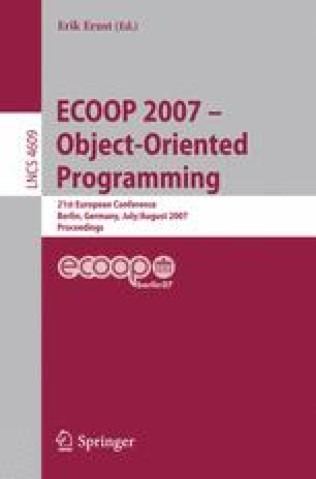
ECOOP 2007 – Object-Oriented Programming ; 21th European Conference, Berlin, Germany, July 30 - August 3, 2007, Proceedings
This book contains sections on runtime implementation, empirical studies, programs and predicates, language design, inheritance and derivation, aspects, as well as language about language.

ECOOP 2006 - Object-Oriented Programming ; 20th European Conference, Nantes, France, July 3-7, 2006, Proceedings
This book constitutes the refereed proceedings of the 20th European Conference on Object-Oriented Programming, ECOOP 2006, held in Nantes, France in July 2006.20 revised full papers, together with 3 keynote papers were carefully reviewed and selected.

ECOOP 2005 - object-oriented programming ; 19th European Conference, Glasgow, UK, July 25-29, 2005. Proceedings
The 19th Annual Meeting of the European Conference on Object-Oriented Programming—ECOOP 2005—took place during the last week of July in Glasgow, Scotland, UK. This volume includes the refereed technical papers p- sented at the conference, and two invited papers. It is traditional to preface a volume of proceedings such as this with a note that emphasizes the importance of the conference in its respective ?eld. Although such self-evaluations should always be taken with a large grain of salt, ECOOP is undisputedly the pre- inent conference on object-orientation outside of the United States. In its turn, object-orientationis today’s principaltechnology not only for programming,but also for design, analysisand speci?cation of softwaresystems.

ECOOP 2002 - Object-Oriented Programming ; 16th European Conference Malaga, Spain, June 10-14, 2002 Proceedings
Constitutes the proceedings of the 16th European Conference on Object-Oriented Programming held in Spain in 2002. The 25 papers cover aspect-oriented software development, Java virtual machines, distributed systems, patterns and architectures, languages, optimization and more.

Economic Impact of the Container Traffic at the Port of Algeciras Bay
In this book we study the economic impact of the container traffic at one of the most important port in the Mediterranean: the Port of Algeciras Bay (PAB). In order to meet this general objective we analyse in detail the global framework of the containerisation business and the characteristics that currently condition this process.

Economic evaluation of sustainable development
This book presents methods to evaluate sustainable development using economic tools. The focus on sustainable development takes the reader beyond economic growth to encompass inclusion, environmental stewardship and good governance. Sustainable Development Goals (SDGs) provide a framework for outcomes. In illustrating the SDGs, the book employs three evaluation approaches: impact evaluation, cost-benefit analysis and objectives-based evaluation.
