



الصفحة 16
الصفحة 16

Handbook of Multilevel Analysis
Multilevel analysis is the statistical analysis of hierarchically and non-hierarchically nested data. The simplest example is clustered data, such as a sample of students clustered within schools. Multilevel data are especially prevalent in the social and behavioral sciences and in the bio-medical sciences. The models used for this type of data are linear and nonlinear regression models that account for observed and unobserved heterogeneity at the various levels in the data. This book presents the state of the art in multilevel analysis, with an emphasis on more advanced topics. These topics are discussed conceptually, analyzed mathematically, and illustrated by empirical examples. The authors of the chapters are the leading experts in the field.

Handbook of K-Theory
This handbook offers a compilation of techniques and results in K-theory.Many chapters present historical background; some present previously unpublished results, whereas some present the first expository account of a topic; many discuss future directions as well as open problems. The overall intent of this handbook is to offer the interested reader an exposition of our current state of knowledge as well as an implicit blueprint for future research.

Handbook of Generalized Convexity and Generalized Monotonicity
Generalized convex functions are the many nonconvex functions which share at least one of the valuable properties of convex functions. Apart from their theoretical interest, they are often more suitable than convex functions to describe real-word problems in disciplines such as economics, engineering, management science, probability theory and in other applied sciences. More recently, generalized monotone maps which are closely related to generalized convex functions have also been studied extensively.The Handbook offers a systematic and thorough exposition of the theory and applications of the various aspects of generalized convexity and generalized monotonicity. It is aimed at the non-expert, for whom it provides a detailed introduction, as well as at the expert who seeks to learn about the latest developments and references in his research area.

Handbook of Epidemiology
Represents a comprehensive reference source on practical epidemiology. the handbook covers a very wide spectrum of problems and is a very good reference material.bridging the gap between standard textbooks of epidemiology and publications for specialists with a narrow focus on specific areas. It reviews the key issues, methodological approaches and statistical concepts pertinent to the field for which the reader seeks a detailed overview.

Handbook of Data Visualization
This new volume in the series Springer Handbooks of Computational Statistics gives an overview of modern data visualization methods, both in theory and practice. There are definitive chapters on modern graphical tools such as mosaic plots, parallel coordinate plots and linked views. There are chapters dedicated to graphical methodology for particular areas of statistics, for example Bayesian analysis, genomic data and cluster analysis, as well as chapters on software for graphics.

Handbook of Continued Fractions for Special Functions
Special functions are pervasive in all fields of science and industry. The most well-known application areas are in physics, engineering, chemistry, computer science and statistics. Because of their importance, several books and websites (see for instance http: functions.wolfram.com) and a large collection of papers have been devoted to these functions. Of the standard work on the subject, namely the Handbook of Mathematical Functions with formulas, graphs and mathematical tables edited by Milton Abramowitz and Irene Stegun, the American National Institute of Standards claims to have sold over 700 000 copies!

Handbook of Combinatorial Optimization : Supplement ; Vol. B
It presents chapters dealing with various aspects of the subject, including optimization problems and algorithmic approaches for discrete problems.

Hamiltonian Reduction by Stages
In this volume readers will find for the first time a detailed account of the theory of symplectic reduction by stages, along with numerous illustrations of the theory. Special emphasis is given to group extensions, including a detailed discussion of the Euclidean group, the oscillator group, the Bott-Virasoro group and other groups of matrices. Ample background theory on symplectic reduction and cotangent bundle reduction in particular is provided. Novel features of the book are the inclusion of a systematic treatment of the cotangent bundle case, including the identification of cocycles with magnetic terms, as well as the general theory of singular reduction by stages.

Hamiltonian Dynamics - Theory and Applications : Lectures given at the C.I.M.E. Summer School held in Cetraro, Italy, July 1-10, 1999
This volume collects three series of lectures on applications of the theory of Hamiltonian systems, contributed by some of the specialists in the field. The aim is to describe the state of the art for some interesting problems, such as the Hamiltonian theory for infinite-dimensional Hamiltonian systems, including KAM theory, the recent extensions of the theory of adiabatic invariants and the phenomena related to stability over exponentially long times of Nekhoroshev's theory. The books may serve as an excellent basis for young researchers, who will find here a complete and accurate exposition of recent original results and many hints for further investigation.

Hamiltonian dynamical systems and applications
This volume is the collected and extended notes from the lectures on Hamiltonian dynamical systems and their applications that were given at the NATO Advanced Study Institute in Montreal in 2007. Many aspects of the modern theory of the subject were covered at this event, including low dimensional problems as well as the theory of Hamiltonian systems in infinite dimensional phase space; these are described in depth in this volume. Applications are also presented to several important areas of research, including problems in classical mechanics, continuum mechanics, and partial differential equations. These lecture notes cover many areas of recent mathematical progress in this field, including the new choreographies of many body orbits, the development of rigorous averaging methods which give hope for realistic long time stability results, the development of KAM theory for partial differential equations in one and in higher dimensions, and the new developments in the long outstanding problem of Arnold diffusion.

Guida alla teoria degli insiemi = Guide to set theory
Teachers are in difficulty with regard to the space and emphasis to be given to set theory topics, in their preparation and in their work, because they have not been provided with adequate knowledge at the university. It is safe to say, on the basis of much experience, that the average mathematician, even the researcher, does not know what set theory is. Two prejudices stand in the way of a good knowledge of the theory: one, of a minimalist type, is its identification with an unspecified "set theory", an austere language that is too demanding if one wants to impose it prematurely; the other is of a maximalist type and consists in the supposed and effective link with the more subtle questions of the foundations of mathematics. But the theory has an important mathematical content, and with many implications of didactic interest.

Gruppi : Una introduzione a idee e metodi della Teoria dei Gruppi = Groups : An introduction to the ideas and methods of Group Theory
Born from the university courses of Group Theory held by the author for several years, this book deals with the fundamental arguments of the theory: abelian, nilpotent and solvable groups, free groups, permutations, representations and cohomology. After the first notions, Hölder's program for the classification of finite groups is exposed. A long chapter is dedicated to the action of a group on a set and to the permutations, both under the algebraic and combinatorial aspects, with references to the theory of equations. Some questions of a logical nature are also considered, such as the decidability of the word problem for certain classes of groups. An essential aspect of the book is the presence of a great variety of exercises, about 400, mostly solved.

Groupes et algèbres de Lie : Chapitres 7 et 8 = Lie groups and algebras : Chapters 7 and 8
The Mathematics Elements of Nicolas BOURBAKI aim to provide a rigorous, systematic presentation without prerequisites of mathematics from their foundations.

Groupes et algèbres de Lie : Chapitres 4 à 6 = Lie groups and algebras : Chapters 4 to 6
Nicolas BOURBAKI's Elements of Mathematics aim to provide a rigorous, systematic presentation without prerequisites of mathematics from their foundations.This third volume of the Book on Groups and Lie Algebras, ninth Book of the treatise, is devoted to the structures of root systems , Coxeter groups and Tits systems, which appear naturally in the study of analytic or algebraic Lie groups

Groupes et algèbres de Lie : Chapitres 2 et 3 = Lie groups and algebras : Chapters 2 and 3
Nicolas BOURBAKI's Elements of Mathematics aim to provide a rigorous, systematic and prerequisite presentation of mathematics from their foundations. Chapter 2 continues the presentation of the fundamental notions of Lie algebras with the introduction of free Lie algebras and the series by Hausdorff. Chapter 3 is devoted to the basic concepts for the groups of Lies on an Archimedean or ultrametric body.

Groupes et algèbres de Lie : Chapitre 9, Groupes de Lie réels compacts = Lie groups and algebras : Chapter 9, Compact real Lie groups
Nicolas BOURBAKI's Elements of Mathematics aim to provide a rigorous, systematic and un-prerequisite presentation of mathematics from their foundations. This ninth chapter of the Book on Groups and Lie Algebras, ninth Book of the treatise, includes the paragraphs, Compact Lie Algebras ; Maximum tori of compact Lie groups; Compact fromes of complex semi-simple Lie algebras; Root system associated with a compact group; Conjugation classes; Integration into compact Lie groups; Irreducible representations of connected compact Lie groups; Fourier transformation; Operation of compact Lie groups on manifolds.

Groupes et algèbres de Lie : Chapitre 1 = Lie groups and algebras : Chapter 1
Nicolas BOURBAKI's Elements of Mathematics aim to provide a rigorous, systematic and un-prerequisite presentation of mathematics from their foundations. This ninth chapter of the Book on Groups and Lie Algebras, ninth Book of the treatise, includes the paragraphs, Compact Lie Algebras ; Maximum tori of compact Lie groups; Compact fromes of complex semi-simple Lie algebras; Root system associated with a compact group; Conjugation classes; Integration into compact Lie groups; Irreducible representations of connected compact Lie groups; Fourier transformation; Operation of compact Lie groups on manifolds.
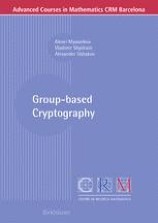
Group-based Cryptography
This book is about relations between three different areas of mathematics and theoretical computer science: combinatorial group theory, cryptography, and complexity theory. It is explored how non-commutative (infinite) groups, which are typically studied in combinatorial group theory, can be used in public key cryptography. It is also shown that there is a remarkable feedback from cryptography to combinatorial group theory because some of the problems motivated by cryptography appear to be new to group theory, and they open many interesting research avenues within group theory.

Graphs, networks and algorithms ; 3rd ed.
The third edition of this standard textbook contains additional material: two new application sections (on graphical codes and their decoding) and about two dozen further exercises (with solutions, as throughout the text). Moreover, recent developments have been discussed and referenced, in particular for the travelling salesman problem. The presentation has been improved in many places (for instance, in the chapters on shortest paths and on colorings), and a number of proofs have been reorganized, making them more precise or more transparent.

Graphs, networks and algorithms ; 2nd ed.
This book have a chapter on the network simplex algorithm and a section on the five color theorem; this also necessitated some changes in the previous order of the presentation (so that the numbering differs from that of the first edition,beginning with Chapter 8). In addition to this, numerous smaller changes and corrections have been made and several recent developments have been discussed and referenced. There are also several new exercises.
