



الصفحة 16
الصفحة 16
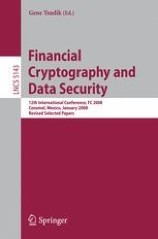
Financial cryptography and data security ; 12th International Conference, FC 2008, Cozumel, Mexico, January 28-31, 2008. Revised Selected Papers
This book constitutes the thoroughly refereed post-conference proceedings of the 12th International Conference on Financial Cryptography and Data Security, FC 2008, held in Cozumel, Mexico, in January 2008.The 16 revised full papers and 9 revised short papers presented together with 5 poster papers, 2 panel reports, and 1 invited lecture were carefully reviewed and selected from 86 submissions. The papers are organized in topical sections on attacks and counter measures, protocols, theory, hardware, chips and tags, signatures and encryption, as well as anonymity and e-cash.

Fieldwork for Design : Theory and Practice
Fieldwork for Design looks at why ethnographic approaches have been turned to in the design of computing devices for the workplace, for the home and elsewhere. It presents a history of ethnography, both as it was practiced before computer science picked it up and since, most especially in the CSCW and HCI domains. It examines, further, the various ethnographic or ‘fieldwork’ frameworks currently popular, explaining and examining what each claims and entails. The focus of the book throughout is on the practical relationship between theory and practice, a relationship that is often misunderstood yet fundamental to successful design.

Field Guide to Meteors and Meteorites
Imagine the unique experience of being the very first person to hold a newly-found meteorite in your hand – a rock from space, older than Earth! "Weekend meteorite hunting" with magnets and metal detectors is becoming ever more popular as a pastime, but of course you can’t just walk around and pick up meteorites in the same way that you can pick up seashells on the beach. Those fragments that survived the intense heat of re-entry tend to disguise themselves as natural rocks over time, and it takes a trained eye – along with the information in this book – to recognize them.
Fiber Concrete : In Construction
Helps the user to correctly use fiber-reinforced concrete as a building material in accordance with its properties in order to create a long-lasting building for the client at low cost. Fiber-reinforced concrete as an extension of concrete offers considerable advantages for building practice, which, based on the material properties, enable a very long service life.Fiber-reinforced concrete is particularly suitable for an aggressive environment such as salt exposure, since corrosion can be completely avoided. Particular attention is also paid to the shrinkage cracks that occur in the concrete and how they can be and how these can be avoided when using fibers.

Fault-Tolerance Techniques for SRAM-Based FPGAs
This book discusses fault-tolerance techniques for SRAM-based Field Programmable Gate Arrays (FPGAs). It starts by showing the model of the problem and the upset effects in the programmable architecture. In the sequence, it shows the main fault tolerance techniques used nowadays to protect integrated circuits against errors. A large set of methods for designing fault tolerance systems in SRAM-based FPGAs is described. Some presented techniques are based on developing a new fault-tolerant architecture with new robustness FPGA elements. Other techniques are based on protecting the high-level hardware description before the synthesis in the FPGA.

Fault-Diagnosis Systems : An Introduction from Fault Detection to Fault Tolerance
This book gives an introduction into the field of fault detection, fault diagnosis and fault-tolerant systems with methods which have proven their performance in practical applications. It guides the reader in a structured tutorial style: supervision methods, reliability, safety, system integrity and related terminology; fault detection with signal-based methods for periodic and stochastic signals; fault detection with process model-based methods like parameter estimation, state estimation, parity equations and principal component analysis; fault diagnosis with classification and inference methods; fault-tolerant systems with hardware and analytical redundancy; many practical simulation examples and experimental results for processes like electrical motors, pumps, actuators, sensors and automotive components; end-of-chapter exercises for self testing or for practice.
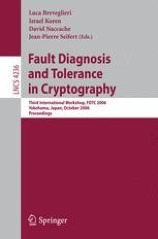
Fault Diagnosis and Tolerance in Cryptography ; 3rd International Workshop, FDTC 2006, Yokohama, Japan, October 10, 2006, Proceedings
The sophistication of the underlying cryptographic algorithms, the high complexity of the implementations, and the easy access and low cost of cryptographic devices resulted in increased concerns regarding the reliability and security of crypto-devices. The effectiveness of side channel attacks on cryptographic devices, like timing and power-based attacks, has been known for some time. Several recent investigations have demonstrated the need to develop methodologies and techniques for designing robust cryptographic systems (both hardware and software) to protect them against both accidental faults and maliciously injected faults with the purpose of extracting the secret key. This trend has been particularly motivated by the fact that the equipment needed to carry out a successful side channel attack based on fault injection is easily accessible at a relatively low cost (for example, laser beam technology), and that the skills needed to use it are quite common.

Farewell to the Party Model? : Independent Local Lists in East and West European Countries
Local independent lists are a general phenomenon on the local level in many European countries – in established Western countries as well as in new democracies in Middle and Eastern Europe. The research is linked to the much-discussed phenomenon of the growing disenchantment with political parties and the sceptical evaluation of political parties on the local level. The edited book aims first at developing a theoretical and conceptual framework for these non-partisan lists. Second, the contributions describe and analyse for the first time comparatively presence, success, organisational structure, behaviour and performance of these local actors in twelve West and East European countries.
Factories of the Future : The Italian Flagship Initiative
This book presents results relevant in the manufacturing research field, that are mainly aimed at closing the gap between the academic investigation and the industrial application, in collaboration with manufacturing companies. Several hardware and software prototypes represent the key outcome of the scientific contributions that can be grouped into five main areas, representing different perspectives of the factory domain
Extreme NXT : Extending the LEGO MINDSTORMS NXT to the Next Level
Extreme NXT: Extending the LEGO MIDSTORMS NXT to the Next Level is for intermediate-level users of NXT who would like to advance their capabilities by learning some of the basics of electronics. Plenty of examples are provided, and easy-to-follow instructions are included for building over 15 different sensors.

Exploring C for Microcontrollers : A Hands on Approach
The market is flooded with numbers of good books on Embedded Systems designed especially with the most popular MCS51 family. These books are traditional in nature i.e. they start with the routine architectural features of 8051, description of registers, ports, interrupts etc. Most of these things are already covered in the device data sheet and application notes. In this book all such routine things are skipped. The focus is on programming microcontrollers, to be specific MCS-51 family in ‘C’ using Keil IDE. Exploring C for Microcontrollers presents seventeen live case studies apart from the many basic programs organized around every on-chip resource like port, time/counter, interrupt , serial I/O etc. Rather than introducing the underpinning theory or reproducing lengthy data sheets, our approach is "learning-through-doing" and one that appeals to busy electronics designers. The ‘C’ codes given are well supported by easy to understand comments wherever required.

Experimental analysis of nano and engineering materials and structures ; Proceedings of the 13th international conference on experimental mechanics, Alexandroupolis, Greece, July 1-6, 2007
ICEM13 focused on all aspects of experimental mechanics of solids with emphasis on mechanical characterization and testing at the micro and nano scale levels. The technical program of ICEM13 was the product of hard work and devotion of more than 100 world leading experts. This volume contains two-page abstracts of the 482 papers presented at ICEM13. The accompanying CD contains the full length papers. The abstracts of the fifteen plenary lectures are included in the beginning of the book. The remaining 467 abstracts are arranged in 23 tracks and 28 special symposia/sessions with 225 and 242 abstracts, respectively. The papers of the tracks have been contributed from open call, while the papers of the symposia/sessions have been solicited by the respective organizers.

Examples & explanations for criminal law
Offers hypothetical questions complemented by detailed explanations that allow you to test your knowledge of the topics in your courses and compare your own analysis. Here's why you need an E & E to help you study throughout the semester: Clear explanations of each class topic.

Examples & explanations : criminal law
Combines textual material with well-written and comprehensive examples, explanations, and questions to test students' comprehension of the materials and to provide practice in applying information to fact patterns. The questions, which often raise a variety of issues in one fact situation, are similar to those on a law school or bar examination. New to the eighth edition: discussion of self-defense and police use of force issues; impact of #MeToo movement on rape law; interesting hypothetical situations based on real cases in the last few years

Evolvable systems : From biology to hardware ; 8th International Conference, ICES 2008, Prague, Czech Republic, September 21-24, 2008. Proceedings
This book constitutes the refereed proceedings of the 8th International Conference on Evolvable Systems, ICES 2008, held in Prague, Czech Republic, in September 2008.The 28 revised full papers and 14 revised poster papers presented were carefully reviewed and selected from 52 submissions. The papers are organized in topical sections on evolution of analog circuits, evolution of digital circuits, hardware-software codesign and platforms for adaptive systems, evolutionary robotics, development, real-world applications, evolutionary networking, evolvable artificial neural networks, and transistor-level circuit evolution.

Evolvable systems : From biology to hardware ; 7th International Conference, ICES 2007, Wuhan, China, September 21-23, 2007, Proceedings
The 41 revised full papers collected in this volume are organized in topical sections on digital hardware evolution, analog hardware evolution, bio-inspired systems, mechanical hardware evolution, evolutionary design, evolutionary algorithms in hardware design, and hardware implementation of evolutionary algorithms.

Evolvable systems : From biology to hardware ; 6th International Conference, ICES 2005, Sitges, Spain, September 12-14, 2005, Proceedings
The flying machines proposed by Leonardo da Vinci in the fifteenth century, the se- reproducing automata theory proposed by John von Neumann in the middle of the twentieth century and the current possibility of designing electronic and mechanical systems using evolutionary principles are all examples of the efforts made by humans to explore the mechanisms present in biological systems that permit them to tackle complex tasks. These initiatives have recently given rise to the emergent field of b- inspired systems and evolvable hardware. The inaugural workshop, Towards Evolvable Hardware, took place in Lausanne in October 1995, followed by the successive events of the International Conference on Evolvable Systems: From Biology to Hardware, held in Tsukuba (Japan) in October 1996, in Lausanne (Switzerland) in September 1998, in Edinburgh (UK) in April 2000, in Tokyo (Japan) in October 2001, and in Trondheim (Norway) in March 2003. Following the success of these past events the sixth international conference was aimed at presenting the latest developments in the field, bringing together researchers who use biologically inspired concepts to implement real systems in artificial intelligence, artificial life, robotics, VLSI design, and related domains. The sixth conference consolidated this biennial event as a reference meeting for the community involved in bio-inspired systems research. All the papers received were reviewed by at least three independent reviewers, thus guaranteeing a high-quality bundle for ICES 2005.

Evolvable Machines : Theory & Practice
Methods for the artificial evolution of active components, such as programs and hardware, are rapidly developing branches of adaptive computation and adaptive engineering. "Evolvable Machines" reports innovative and significant progress in automatic and evolutionary methodology applied to machine design. This book presents theoretical as well as practical chapters concentrating on Evolvable Robots, Evolvable Hardware Synthesis, as well as Evolvable Design.

Evolvable Hardware
The contributions in this book provide the basics of reconfigurable devices so that readers will be fully prepared to understand what EHW is, why it is necessary and how it is designed. The book also discusses the leading research in digital, analog and mechanical EHW. Selections from leading international researchers offer examples of cutting-edge research and applications, placing particular emphasis on their practical usefulness.

Evidence-Based Medicine : How to Practice and Teach EBM
An evidence-based approach to dietary and lifestyle medicine is taken. An approach known as “epidemiology-based health promotion,” which compiles and presents available evidence that could help physicians, other healthcare professionals and members of the general public make wiser decision about healthcare, is also explored.
