



الصفحة 153
الصفحة 153

Genome editing in drug discovery
In Genome Editing in Drug Discovery, a team of distinguished biologists delivers a comprehensive exploration of genome editing in the drug discovery process, with coverage of the technology’s history, current issues and techniques, and future perspectives and research directions. The book discusses techniques for disease modeling, target identification with CRISPR, safety studies, therapeutic editing, and intellectual property issues.

Génetique statistique = Statistical genetics
Presents the main statistical tools useful in genetics: significance tests, analysis methods based on the likelihood function, EM algorithm, modeling, analysis of variance, hierarchical classifications, multiple comparisons, etc. All of them shed light on a number of biological phenomena such as carcinogenesis, population genetics, Hardy-Weinberg equilibrium, natural selection, mutations, heredity, coalescence processes, and even evolution. This book is intended for mathematicians and biologists alike. Written with a great concern for clarity, it is also accessible to non-specialists who will be able, thanks to it, to strengthen their theoretical base and above all to develop their know-how through very concrete applications.

Genetic Systems Programming : Theory and Experiences
This book is devoted to reporting innovative and significant progress about the contribution of genetic programming in systems programming. The contributions of this book clearly demonstrate that genetic programming is very effective in solving hard and yet-open problems in systems programming. Followed by an introductory chapter, in the remaining contributed chapters, the reader can easily learn about systems where genetic programming can be applied successfully. These include but are not limited to, information security systems, compilers, data mining systems, stock market prediction systems, robots and automatic programming.

Genetic Programming Theory and Practice V
Genetic Programming Theory and Practice V was developed from the fifth workshop at the University of Michigan’s Center for the Study of Complex Systems to facilitate the exchange of ideas and information related to the rapidly advancing field of Genetic Programming (GP). Contributions from the foremost international researchers and practitioners in the GP arena examine the similarities and differences between theoretical and empirical results on real-world problems. The text explores the synergy between theory and practice, producing a comprehensive view of the state of the art in GP application.

Genetic Programming Theory and Practice IV
Genetic Programming Theory and Practice IV was developed from the fourth workshop at the University of Michigan’s Center for the Study of Complex Systems to facilitate the exchange of ideas and information related to the rapidly advancing field of Genetic Programming (GP). Contributions from the foremost international researchers and practitioners in the GP arena examine the similarities and differences between theoretical and empirical results on real-world problems.

Genetic programming : Theory and practice II
This volume explores the emerging interaction between theory and practice in the cutting-edge, machine learning method of Genetic Programming (GP). The contributions developed from a second workshop at the University of Michigan's Center for the Study of Complex Systems where leading international genetic programming theorists from major universities and active practitioners from leading industries and businesses met to examine how GP theory informs practice and how GP practice impacts GP theory. Chapters include such topics as financial trading rules, industrial statistical model building, population sizing, the roles of structure in problem solving by computer, stock picking, automated design of industrial-strength analog circuits, topological synthesis of robust systems, algorithmic chemistry, supply chain reordering policies, post docking filtering, an evolved antenna for a NASA mission and incident detection on highways.

Genetic Engineering : Principles and Methods
Genetic Engineering: Principles and Methods presents state-of-the-art discussions in modern genetics and genetic engineering. Recent volumes have covered gene therapy research, genetic mapping, plant science and technology, transport protein biochemistry, and viral vectors in gene therapy, among many other topics.

Genetic Engineering
Genetic Engineering: Principles and Methods presents state-of-the-art discussions in modern genetics and genetic engineering. Recent volumes have covered gene therapy research, genetic mapping, plant science and technology, transport protein biochemistry, and viral vectors in gene therapy, among many other topics.

Genetic Democracy : Philosophical Perspectives
GENETIC DEMOCRACY involves an in-depth analysis of the ethical, social and philosophical issues related to modern genetic research and gene technology. The aim of the book is to introduce systematic research on the social and ethical impacts of the use and development of genetically modified organisms (GMOs) as well as the acquisition, use and storage of human genetic information (HGI). The book contributes into enhancing public discussion and reaching fair and democratic decision-making practices in GMO and HGI use and development both on local and global level.

Generative programming and component engineering ; 4th International conference, GPCE 2005, Tallinn, Estonia, September 29 - October 1, 2005, Proceedings
Generative Programming and Component Engineering (GPCE) is a leading - searchconferenceonautomaticprogrammingandcomponentengineering.These approaches to software engineering have the potential to revolutionize software development as automation and components revolutionized manufacturing. The conference brings together researchers and practitioners interested in adva- ing automation for software development. It is also a premier forum for cro- fertilization between the programming language and software engineering - search communities. GPCEaroseasajointconference, mergingthepriorconferenceonGenerative and Component-Based Software Engineering (GCSE) and the Workshop on - mantics, Applications, andImplementationofProgramGeneration(SAIG). The proceedingsofthepreviousGPCEconferenceswerepublishedintheLNCSseries of Springer as volumes2487,2830, and 3286.In 2005 GPCE wasco-locatedwith the International Conference on Functional Programming (ICFP) and the s- posium on Trends in Functional Programming (TFP), re?ecting the vigorous interaction between the functional programming and generative programming research communities. GPCE and ICFP are both sponsored by the Association for Computing Machinery. The quality and breadth of the papers submitted to GPCE 2005 was impr- sive. All 86 papers, including 5 papers for tool demonstrations, were rigorously reviewed by 17 highly quali?ed Program Committee members. The members of the Program Committee ?rst provided in-depth individual reviews of the s- mitted papers, and then debated the merits of the papers through an extended electronicProgramCommitteemeeting.After much(friendly) argument,25r- ular papers and 2 tool demonstration papers were selected for publication. The ProgramCommittee provided extensive technical feedback to the authors of the submittedpapers.Theconferenceprogramwascomplementedwiththreeinvited talks, three extended tutorials, and three all-day workshops.
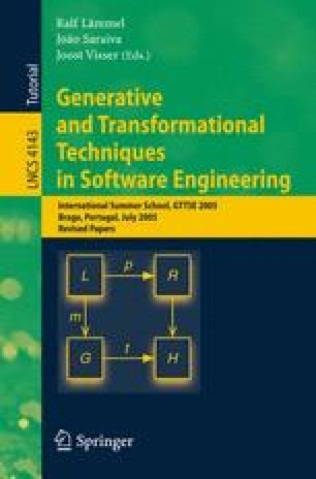
Generative and transformational techniques in software engineering ; International Summer School, GTTSE 2005, Braga, Portugal, July 4-8, 2005. Revised Papers
This tutorial book presents an augmented selection of material presented at the International Summer School on Generative and Transformational Techniques in Software Engineering, GTTSE 2005. The book comprises 7 tutorial lectures presented together with 8 technology presentations and 6 contributions to the participants workshop.

Generative adversarial text to image synthesis
Synthesizing high-quality images from text descriptions is a challenging problem in computer vision and has many practical applications. Samples generated by existing text-to-image approaches can roughly reflect the meaning of the given descriptions, but they fail to contain necessary details and vivid object parts. In order to make the project more specialized, it was approved that the project be dedicated to fashion image generation, we present an effective approach for generating new clothing through generative adversarial learning. Generative Adversarial Networks (GANs) successfully show the capability of synthesizing sharper images compared to other generative models.
Generalized Plasticity
The book is divided into five major parts: 1. Yield function and choice; 2. Constitutive relation; 3. Slip-line Field Theory for plane strain problems, Characteristics Field Theory for plane stress problems and Characteristics Field Theory for spatial axisymmetrical problems; 4. Plastic zone analysis at crack tip and fracture criterion for mixed mode crack; 5. Limit loads and shakedown loads for pressure vessel. Examples of applications and problems are given for most chapters.
Generalized collocations methods : Solutions to nonlinear problems
This book examines various mathematical tools—based on generalized collocation methods—to solve nonlinear problems related to partial differential and integro-differential equations. Covered are specific problems and models related to vehicular traffic flow, population dynamics, wave phenomena, heat convection and diffusion, transport phenomena, and pollution. Based on a unified approach combining modeling, mathematical methods, and scientific computation, each chapter begins with several examples and problems solved by computational methods; full details of the solution techniques used are given. The last section of each chapter provides problems and exercises giving readers the opportunity to practice using the mathematical tools already presented.

Generalized Bounds for Convex Multistage Stochastic Programs
The auther was involved in several industry projects in the field of power management, on the occasion of which I was repeatedly c- fronted with complex decision problems under uncertainty. Although usually hard to solve, I quickly learned to appreciate the benefit of stochastic progr- ming models and developed a strong interest in their theoretical properties. Motivated both by practical questions and theoretical concerns, I became p- ticularly interested in the art of finding tight bounds on the optimal value of a given model. The present work attempts to make a contribution to this important branch of stochastic optimization theory. In particular, it aims at extending some classical bounding methods to broader problem classes of practical relevance.

General Theory of Information Transfer and Combinatorics
This book constitutes the thoroughly refereed research papers contributed to a research project on the `General Theory of Information Transfer and Combinatorics' that was hosted from 2001-2004 at the Center for Interdisciplinary Research (ZIF) of Bielefeld University and also papers of several incorporated meetings thereof. The 63 revised full papers presented were carefully reviewed and selected for inclusion in the book. The papers are organized in topical sections on probabilistic models, cryptology, pseudo random sequences, quantum models, statistics, probability theory, information measures, error concepts, performance criteria, search, sorting, ordering, planning, language evolution, pattern discovery, reconstructions, network coding, combinatorial models, and a problem section.

General Concepts in Integrated Pest and Disease Management
The first volume of the Integrated Management of Plant Pests and Diseases book series presents general concepts on integrated pest and disease management, organized in three sections. Section one (modeling, management, environment) includes chapters on infection models, resurgence and replacement. The second section (emerging technologies) includes remote sensing and information technology. In the third section (molecular aspects) the management of insect-borne viruses with transmission interference.

Gene Therapy and Gene Delivery Systems
Advances in Biochemical Engineering/Biotechnology reviews actual trends in modern biotechnology. Its aim is to cover all aspects of this interdisciplinary technology where knowledge, methods and expertise are required for chemistry, biochemistry, micro-biology, genetics, chemical engineering and computer science
Gene Expression Programming : Mathematical Modeling by an Artificial Intelligence
This monograph provides all the implementation details of GEP so that anyone with elementary programming skills will be able to implement it themselves. The book also includes a self-contained introduction to this new exciting field of computational intelligence, including several new algorithms for decision tree induction, data mining, classifier systems, function finding, polynomial induction, times series prediction, evolution of linking functions, automatically defined functions, parameter optimization, logic synthesis, combinatorial optimization, and complete neural network induction. The book also discusses some important and controversial evolutionary topics that might be refreshing to both evolutionary computer scientists and biologists.
Gas Transport in Porous Media
This book presents a compilation of state-of-the art studies on gas and vapor transport processes in porous and fractured media. A broad set of models and processes is presented, including advection/diffusion, the Dusty Gas Model, enhanced vapor diffusion, phase change, coupled processes, solid/vapor sorption, and vapor-pressure lowering. Numerous applications are also presented that illustrate these processes and models in current problems facing the scientific community.
