



الصفحة 15
الصفحة 15
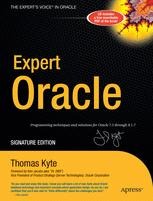
Expert Oracle
Thomas Kyte has a simple philosophy: You can treat Oracle as a black box and shove data inside of it, or you can learn how Oracle works and exploit it as a powerful computing environment. If you choose the latter, you will see there are few information management problems you cannot solve quickly and elegantly. Kyte has selected the most important features and techniques to discuss in Expert One-on-One Oracle, which he teaches in a proof-by-example manner. He discusses available features, implementing software using these features, and avoiding potential pitfalls.

Expert F#
Expert F# is about practical programming in a beautiful language that puts the power and elegance of functional programming into the hands of .NET developers. In combination with .NET, F# achieves unrivaled levels of programmer productivity and program clarity. This books serves as: The authoritative guide to F# by the designer of F#. A comprehensive reference of F# concepts, syntax, and features. A treasury of expert F# techniques for practical, real–world programming.
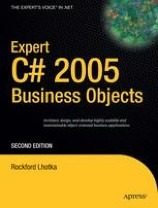
Expert C# 2005 Business Objects
Rockford Lhotka started writing his Business Objects books in 1996, and over the years, he's become one of the world's foremost authorities on building distributed object-oriented systems. His industry-standard VB .NET Business Objects book not only addresses changes in .NET 2.0 and Visual Studio 2005, but also reflects substantial enhancements and improvements to the CSLA .NET Framework and how it can be used to create enterprise-level .NET applications. The depth of Rockford's thinking now influences developers across language boundaries. With this book, you can learn directly from the expert whose framework has become universally accepted and respected.

Experimental Unsaturated Soil Mechanics
These proceedings are a continuation of the series of International Conferences in Germany entitled "Mechanics of Unsaturated Soils." The primary objective is to discuss and understand unsaturated soil behaviour such that engineered activities are made better with times in terms of judgement and quality. We all realise by now that in addition to the knowledge on the classical concepts, it becomes an enormous challenging task to adapt convincing new concepts and present them in such a way that it could be used in engineering practices. The experimental studies reported primarily focus on the role of microstructure and fabric for the complex coupled hydro-mechanical behaviour of cohesive frictional materials. Several papers consider the relevance of temperature affecting the constitutive behaviour of clays. Common features of state of the art theoretical and numerical approaches, including theory of porous media and mixture theory, intend to describe the complex multi-field problems of fully coupled thermo-hydraulic-mechanical-chemical initial - boundary value problems.

Evolutionary Synthesis of Pattern Recognition Systems
Evolutionary Synthesis of Pattern Recognition Systems presents novel effective approaches based on evolutionary computational techniques, such as genetic programming (GP), linear genetic programming (LGP), coevolutionary genetic programming (CGP) and genetic algorithms (GA) to automate the synthesis and analysis of object detection and recognition systems. The book’s concepts, principles, and methodologies will enable readers to automatically build robust and flexible systems—in a systematic manner—that can provide human-competitive performance and reduce the cost of designing and maintaining these systems. Its content covers all key aspects of object recognition: object detection, feature selection, feature discovery, object recognition, domain knowledge. Basic knowledge of programming and data structures, and some calculus, is presupposed.ing the book’s novel ideas

Evolutionary Scheduling
Evolutionary scheduling is a vital research domain at the interface of two important sciences - artificial intelligence and operational research. Scheduling problems are generally complex, large scale, constrained, and multi-objective in nature, and classical operational research techniques are often inadequate at solving them effectively. With the advent of computation intelligence, there is renewed interest in solving scheduling problems using evolutionary computational techniques. These techniques, which include genetic algorithms, genetic programming, evolutionary strategies, memetic algorithms, particle swarm optimization, ant colony systems, etc, are derived from biologically inspired concepts and are well-suited to solve scheduling problems since they are highly scalable and flexible in terms of handling constraints and multiple objectives. This edited book gives an overview of many of the current developments in the large and growing field of evolutionary scheduling, and demonstrates the applicability of evolutionary computational techniques to solve scheduling problems, not only to small-scale test problems, but also fully-fledged real-world problems.

Evolutionary Multiobjective Optimization : Theoretical Advances and Applications
Evolutionary Multiobjective Optimization is a rare collection of the latest state-of-the-art theoretical research, design challenges and applications in the field of multiobjective optimization paradigms using evolutionary algorithms. It includes two introductory chapters giving all the fundamental definitions, several complex test functions and a practical problem involving the multiobjective optimization of space structures under static and seismic loading conditions used to illustrate the various multiobjective optimization concepts.
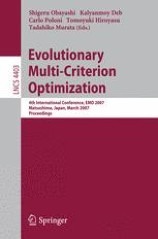
Evolutionary Multi-Criterion Optimization ; 4th International Conference, EMO 2007, Matsushima, Japan, March 5-8, 2007, Proceedings
Multicriterion optimization refers to problems with two or more objectives (normally in conflict with each other) which must be simultaneously satisfied. Evolutionary algorithms have been used for solving multicriterion optimization problems for over two decades, gaining an increasing attention from industry. This book included four keynote speakers: Hirotaka Nakayama on aspiration level methods, Kay Chen Tan on large and computationally intensive real-world MO optimization problems, Carlos Fonseca on decision making, and Gary B. Lamont on design of large-scale network centric systems.

Evolutionary Multi-Criterion Optimization ; 3rd International Conference, EMO 2005, Guanajuato, Mexico, March 9-11, 2005, Proceedings
Constitutes the refereed proceedings of the Third International Conference on Evolutionary Multi-Criterion Optimization, EMO 2005, held in Guanajuato, Mexico, in March 2005.

Evolutionary computation, machine learning and data mining in bioinformatics ; 6th European Conference, EvoBIO 2008, Naples, Italy, March 26-28, 2008. Proceedings
The feld of bioinformatics has two main objectives: the creation and main- nance of biological databases, and the discovery of knowledge from life sciences data in order to unravel the mysteries of biological function, leading to new drugs and therapies for human disease. Life sciences data come in the form of biological sequences, structures, pathways, or literature. One major aspect of discovering biological knowledge is to search, predict, or model specifc infortioninagivendatasetinorderto generate new in teresting knowledge.Computer science methods such as evolutionary computation, machine learning, and data mining all have a great deal to ofer the feld of bioinformatics.

Evolutionary Algorithms for Solving Multi-Objective Problems
This book for Solving Multi-Objective Problems, significantly augmented with contemporary knowledge and adapted for the classroom. All the various features of multi-objective evolutionary algorithms (MOEAs) are presented in an innovative and student-friendly fashion, incorporating state-of-the-art research results. The diversity of serial and parallel MOEA structures are given, evaluated and compared. The book provides detailed insight into the application of MOEA techniques to an array of practical problems. The assortment of test suites are discussed along with the variety of appropriate metrics and relevant statistical performance techniques.

Event-Based Programming : Taking Events to the Limit
This book teaches you how to develop software based on parts that interact primarily through an event mechanism. You'll learn how to use events in many different situations, to solve recurring development problems without coupling. The book introduces Signal Wiring Diagram, a novel form of software diagram similar to the circuit diagrams used by hardware designers. The book concludes with a series of case studies, incorporating all featured concepts.

Event Structure and the Left Periphery : Studies on Hungarian
This book provides substantial new results in a novel field of research examining the syntactic and semantic consequences of event structure. The studies of this volume examine the hypothesis that event structure correlates with word order, the presence or absence of the verbal particle, the [+/- specific] feature of the internal argument, aspect, focusing, negation, and negative quantification, among others. The results reported concern the telicising vs. perfectivizing role of the verbal particle; the syntactic and semantic differences of verbs denoting a delimited change, and those denoting creation or coming into being; evidence of viewpoint aspect in a language with no morphological viewpoint marking; the aspectual role of non-thematic objects; the source of the ‘exhaustive identification’ function of structural focus; the interaction of negation and aspect etc.

Évaluation des troubles neuropsychologiques en vie quotidienne = Assessment of neuropsychological disorders in daily life
Neurological diseases such as stroke, head trauma, Alzheimer's disease pose a public health problem. They affect all ages, from children to the elderly. They affect the possibilities of autonomy in daily life, the possibilities of social or professional integration. In these pathologies, neuropsychological disorders: disorders of language, memory, attention, etc., are the source of crucial difficulties. Cognitive tests performed by psychologists are essential for their diagnosis, but do not on their own make it possible to prejudge the difficulties encountered by people in their everyday life. This book presents an original approach to neuropsychological disorders, by describing specific assessments describing difficulties in daily life, in order to better understand them and to quantify their impact. The second part of the book develops the consequences in clinical practice in particular populations - children and the elderly - or the social objective of the evaluation, in particular school integration, professional integration and driving. Finally, the relevance of these assessments in the context of recent laws on disabled people as well as the development of compensation for bodily injury after an accident are also discussed.

Evaluating clinical research : All that glitters is not gold
The objective of this book is to make its readers better informed and more critical consumers of clinical research to help them recognize the strengths and the weaknesses of scientific publications. In doing so, the reader will be able to distinguish patient-important and methodologically sound studies from those having limitations in design, conduct and interpretation.
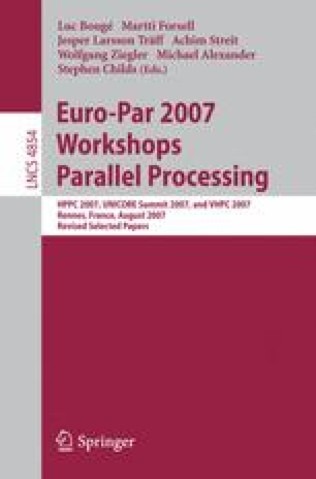
Euro-Par 2007 Workshops : Parallel Processing ; HPPC 2007, UNICORE Summit 2007, and VHPC 2007, Rennes, France, August 28-31, 2007, Revised Selected Papers
Parallel and distributed processing , although within the focus of computer science research for along time ,is gainingmore and more importance in awidespectrum of applications. These proceedings aim to demonstrate the use of parallel and distributed processing concepts in diferent application felds, and attempt to spark interest in novel research directions to advance the embracing model of high-performance computing research in general. The objective of these workshops is to specifcally address researchers c- ing from university, industry and governmental research organizations and application-oriented companies, in order to close the gap between purely sentifc research and the applicability of the research ideas to real-life problems.

E-Training Practices for Professional Organizations
E-Training Practices for Professional Organizations is an essential reference for anyone interested in the integration of e-business, e-work and e-learning processes. The book collects, for the first time, the proceedings from the 2003 IFIP eTrain Conference held in Pori, Finland. The text serves as a multi-disciplinary resource for information on the research, development and applications of all topics related to e-Learning. The first half of the book discusses theories, paradigms and their applications in academia and industry. The last half of the book examines learning environments, design issues and collaboration among the corporate, governmental and academic sectors. With academic and professional contributors, E-Training Practices for Professional Organizations reflects the multi-faceted and exciting nature of e-training studies. This volume presents the balanced view of past developments and current research necessary to truly reach the potential of this burgeoning field.

Essentials of business law
A practical, concise, and broad-based introduction to the vibrant field of business law. Both the traditional areas of law, such as contracts and property, and the emerging areas of law, such as e-commerce and environmental, are covered in short, informative chapters written to capture the essence of each topic. The objective of the text throughout its coverage is ease of use, ease of teaching, ease of assessment, and ease of understanding.

Essential practical prescribing
Designed to support lecture series or themes on core topics within the health sciences. See www.wileyessential.com for further details. Contains a range of learning methods within each chapter including: key topics, learning objectives, case studies, DRUGS checklists, ‘Top-Tips’, advice on guidelines and evidence, and key learning points Uses patient histories to set the scene and enhance the clinical emphasis Offers examples of correctly completed drug charts throughout Is an ideal companion for Prescribing Safety Assessment (PSA) preparation

ESR Spectroscopy in Membrane Biophysics
Membrane proteins offer the greatest challenge in structural biology, and there is an urgent need to develop and apply new biophysical methodologies that are able to generate detailed structural information. Among modern biophysical techniques, site-directed spin-labeling electron spin resonance (SDSL-ESR) appears to show the highest potential to further develop the field. The objective of this book is to provide in-depth information about new advances of SDSL-ESR in membrane biophysics, emphasizing recent developments in the application to membrane proteins.
