



الصفحة 143
الصفحة 143

Analytical Methods in Anisotropic Elasticity : with Symbolic Computational Tools
This comprehensive textbook /reference focuses on the mathematical techniques and solution methodologies required to establish the foundations of anisotropic elasticity and provides the theoretical background for composite material analysis. Specific attention is devoted to the potential of modern symbolic computational tools to support highly complex analytical solutions and their contribution to the rigor, analytical uniformity and exactness of the derivation.
Analytical Methods for Problems of Molecular Transport
"This book is designed to serve a dual function. It is intended that it be capable of serving as a teaching instrument, either in a classroom environment or independently, for the study of basic analytical methods and mathematical techniques that may be used in the Kinetic Theory of Gases and is primarily suitable for use in graduate level physics and engineering courses on the subject. This book should also be useful as a reference for scientists and engineers working in the fields of Rarefied Gas Dynamics and Aerosol Mechanics. In addition, the material in this book may be of interest to individuals working in such areas as Physical Chemistry, Chemical Engineering, or any other applied discipline in which gas-surface interactions should play a significant role."-
Analytical Dynamics : Theory and Applications
This book takes a traditional approach to the development of the methods of analytical dynamics, using two types of examples throughout: simple illustrations of key results and thorough applications to complex, real-life problems

Analytical approaches for reinforced concrete
Applies deductive reasoning, logic and mathematics to RC. Laying out, deductively, the principles of RC, it encourages researchers to re-imagine and innovate using a solid conceptual framework. Sections consider the reasoning behind key theories, as well as problems that remain unsolved.
Analytical and Numerical Approaches to Mathematical Relativity
This book contains a representative collection of surveys by experts in mathematical relativity writing about the current status of, and problems in, their fields. There are four contributions for each of the following mathematical areas: differential geometry and differential topology, analytical methods and differential equations, and numerical methods. This book addresses graduate students and specialist researchers alike.

Analytic Number Theory : Lectures given at the C.I.M.E. Summer School held in Cetraro, Italy, July 11-18, 2002
The four contributions collected in this volume deal with several advanced results in analytic number theory. Friedlander’s paper contains some recent achievements of sieve theory leading to asymptotic formulae for the number of primes represented by suitable polynomials. Heath-Brown's lecture notes mainly deal with counting integer solutions to Diophantine equations, using among other tools several results from algebraic geometry and from the geometry of numbers. Iwaniec’s paper gives a broad picture of the theory of Siegel’s zeros and of exceptional characters of L-functions, and gives a new proof of Linnik’s theorem on the least prime in an arithmetic progression. Kaczorowski’s article presents an up-to-date survey of the axiomatic theory of L-functions introduced by Selberg, with a detailed exposition of several recent results.
Analytic Methods for Design Practice
In the competitive world of modern engineering, rigorous and definite design methodologies are needed. However, many parts of engineering design are performed in either an ad-hoc manner or based on the intuition of the engineer.Analytic Methods for Design Practice is the first book to look at both stages of the design process – conceptual design and detailed design – and detail design methodologies for every step of the entire design process. The book introduces the following analytic design methodologies and explores their usefulness with many mathematical and practical examples: Axiomatic design; Optimization; Design of experiments; Robust design; Structural optimization; Dynamic response optimization; and Multidisciplinary optimization. A chapter of the book is devoted to case studies showing how practical design problems can be solved with analytic design methods based on Professor Park’s experiences of teaching design engineering over the past ten years.
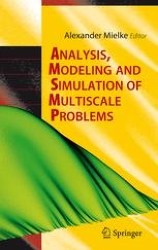
Analysis, Modeling and Simulation of Multiscale Problems
This book reports recent mathematical developments in the Programme "Analysis, Modeling and Simulation of Multiscale Problems", which started as a German research initiative in 2006. Multiscale problems occur in many fields of science, such as microstructures in materials, sharp-interface models, many-particle systems and motions on different spatial and temporal scales in quantum mechanics or in molecular dynamics. The book presents current mathematical foundations of modeling, and proposes efficient numerical treatment.
Analysis of variance for random models, Vol. 2 : Unbalanced data : Theory, methods, applications, and data analysis
Analysis of variance (ANOVA) models have become widely used tools and play a fundamental role in much of the application of statistics today. In particular, ANOVA models involving random effects have found widespread application to experimental design in a variety of fields requiring measurements of variance, including agriculture, biology, animal breeding, applied genetics, econometrics, quality control, medicine, engineering, and social sciences. This two-volume work is a comprehensive presentation of different methods and techniques for point estimation, interval estimation, and tests of hypotheses for linear models involving random effects. Both Bayesian and repeated sampling procedures are considered. Volume I examines models with balanced data (orthogonal models); Volume II studies models with unbalanced data (nonorthogonal models).
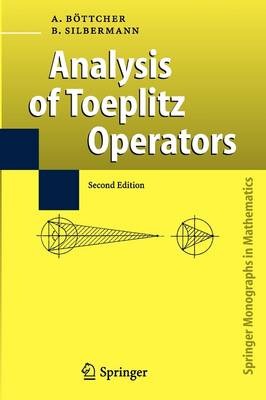
Analysis of Toeplitz Operators
Since the late 1980s, Toeplitz operators and matrices have remained a feld of extensive research and the development during the last nearly twenty years is impressive. One encounters Toeplitz matrices in plenty of applications on the one hand, and Toeplitz operators con?rmed their role as the basic elementary building blocks of more complicated operators on the other. Several monographs on Toeplitz and Hankel operators were written d- ing the last decade. These include Peller’s grandiose book on Hankel ope- tors and their applications and Nikolski’s beautiful easy reading on operators, functions, and systems, with emphasis on topics connected with the names of Hardy, Hankel, and Toeplitz.

Analysis of Structures by Matrix Methods
Deals with the analysis of engineering structures made of skeletal members and covers the type of structures that are commonly used in practice. It builds up on the subject matter dealing with matrix algebra, analysis of bar elements, special forms of members, stability and vibration of structures, and pin-connected, rigid-plane, and 3D frames. It treats the important step of formulating the overall stiffness matrix of a structure in a systematic and straightforward manner and uses simple mathematical approaches wherever possible.

Analysis of phylogenetics and evolution with R
This book integrates a wide variety of data analysis methods into a single and flexible interface: the R language. This open source language is available for a wide range of computer systems and has been adopted as a computational environment by many authors of statistical software. Adopting R as a main tool for phylogenetic analyses will ease the workflow in biologists' data analyses, ensure greater scientific repeatability, and enhance the exchange of ideas and methodological developments.
Analysis of integrated and cointegrated time series with R
The analysis of integrated and co-integrated time series can be considered as the main methodology employed in applied econometrics. This book not only introduces the reader to this topic but enables him to conduct the various unit root tests and co-integration methods on his own by utilizing the free statistical programming environment R. The book encompasses seasonal unit roots, fractional integration, coping with structural breaks, and multivariate time series models. The book is enriched by numerous programming examples to artificial and real data so that it is ideally suited as an accompanying text book to computer lab classes.
Analysis of failure in fiber polymer laminates : the theory of Alfred Puck
This book presents for the first time comprehensively the Theory of Alfred Puck on failure in Fiber Polymer Laminates. After a brief introduction into the failure analysis of laminates and its history, the text focuses first on Puck’s fracture criteria and gives detailed information on their physical background, mathematical derivation and application. Another core part of Puck’s Theory is his concept for Post Failure Analysis. Here, too, the physical background and the analytical procedure are presented. The theoretical chapters are completed by the presentation of the latest developments, namely the consideration of residual stresses and probabilistic effects. The second main part of the book deals with the extensive experimental verification program which has been accomplished since the mid 1990’s. As a result of this work, the Puck Theory can be regarded as better verified than any other theory. All experimental set ups and the major results are presented and explained.
Analysis of Computer and Communication Networks
Analysis of Computer and Communication Networks presents the academic and research communities with mathematical theory and techniques necessary for analyzing and modeling high-performance global networks, such as the Internet.

Analysis II : Differential and Integral Calculus, Fourier Series, Holomorphic Functions
Functions in R and C, including the theory of Fourier series, Fourier integrals and part of that of holomorphic functions.It is suitable for both teaching and self-study. In his familiar, personal style, the author emphasizes ideas over calculations and, avoiding the condensed style frequently found in textbooks, explains these ideas without parsimony of words.
Analysis II
As with the first, the second volume contains substantially more material than can be covered in a one-semester course. Such courses may omit many beautiful and well-grounded applications which connect broadly to many areas of mathematics. We of course hope that students will pursue this material independently; teachers may find it useful for undergraduate seminars. For an overview of the material presented, consult the table of contents and the chapter introductions. As before, we stress that doing the numerous exercises is indispensable for understanding the subject matter, and they also round out and amplify the main text. In writing this volume, we are indebted to the help of many.
Analysis I
Logical thinking, the analysis of complex relationships, the recognition of und- lying simple structures which are common to a multitude of problems — these are the skills which are needed to do mathematics, and their development is the main goal of mathematics education. Of course, these skills cannot be learned ‘in a vacuum’. Only a continuous struggle with concrete problems and a striving for deep understanding leads to success. A good measure of abstraction is needed to allow one to concentrate on the essential, without being distracted by appearances and irrelevancies. The present book strives for clarity and transparency. Right from the beg- ning, it requires from the reader a willingness to deal with abstract concepts, as well as a considerable measure of self-initiative. For these e?orts, the reader will be richly rewarded in his or her mathematical thinking abilities, and will possess the foundation needed for a deeper penetration into mathematics and its applications.
Analysis by Its History
This book presents first-year calculus roughly in the order in which it first was discovered. The first two chapters show how the ancient calculations of practical problems led to infinite series, differential and integral calculus and to differential equations. The establishment of mathematical rigour for these subjects in the 19th century for one and several variables is treated in chapters III and IV. The text is complemented by a large number of examples, calculations and mathematical pictures and will provide stimulating and enjoyable reading for students, teachers, as well as researchers.
Analysis and Synthesis of Logics : How to Cut and Paste Reasoning Systems
Starting with simple examples showing the relevance of cutting and pasting logics, the monograph develops a mathematical theory of combining and decomposing logics, ranging from propositional and first-order based logics to higher-order based logics as well as to non-truth functional logics. The theory covers mechanisms for combining semantic structures and deductive systems either of the same or different nature (for instance, two Hilbert calculi or a Hilbert calculus and a tableau calculus). The important issue of preservation of properties is extensively addressed. For instance, sufficient conditions are provided for a combined logic to be sound and complete when the original component logics are known to be sound and complete.
