



الصفحة 14
الصفحة 14
Arguing on the Toulmin model : New essays in argument analysis and evaluation
In The Uses of Argument Stephen Toulmin proposed a new model for the layout of arguments, with six components: claim, data, warrant, qualifier, rebuttal, backing. Toulmin’s model has been appropriated, adapted and extended by researchers in the fields of speech communications, philosophy and artificial intelligence. The volume aims to bring together the best contemporary reflection in these fields on the Toulmin model and its current appropriation.

Architecture constructed : Notes on a discipline
In this book, acclaimed architectural theorist Mark Jarzombek examines this tension head-on, and uses it to rethink the nature of the history of architecture. He reveals architecture to be a troubled, interconnected realm, incomplete and unstable, where labor, craft, and occupation are the ‘invisible’ complements to the work of the architect.

Architectural colossi and the human body buildings and metaphors
Architectural Colossi and the Human Body discusses the role of Platonic and Cartesian philosophy and how philosophers such as Heidegger and Merleau-Ponty, and theoreticians such as Frascari and Pallasmaa, have seen, described and analysed the human body and the role of architecture and perception. Drawing upon three key case studies and by employing theoretical ideas of Venturi and others, this book will provide an understanding of the role of anthromorphism and the relation and use of the human body with reference to selected architects and artists.
Approaches to Metaphysics
Today, when systematic philosophy - and reason itself - are challenged both outside of and within philosophy, is it still possible to do metaphysics? This volume provides a broad perspective on contemporary approaches to the nature and the fundamental questions of metaphysics. Drawing on scholars from continental Europe, Asia, Canada, the United States, and Great Britain, and representing a variety of philosophical cultures and traditions, this volume surveys and extends work in metaphysics and its implications for broader philosophical concerns (e.g., in ethics and social philosophy, in mathematics and logic, and in epistemology). It also addresses such questions as the role of history and historicity in undertaking metaphysics, the nature of metaphysics, the priority of metaphysics over epistemology, and the challenges of empiricism and postmodernism.
Apprehension and Argument : Ancient Theories of Starting Points for Knowledge
This book offers the first synoptic study of how the primary elements in knowledge structures were analysed in antiquity from Plato to late ancient commentaries, the main emphasis being on the Platonic-Aristotelian tradition. It argues that, in the Platonic-Aristotelian tradition, the question of starting points was treated from two distinct points of view: from the first perspective, as a question of how we acquire basic knowledge; and from the second perspective, as a question of the premises we may immediately accept in the line of argumentation. It was assumed that we acquire some general truths rather naturally and that these function as starting points for inquiry. In the Hellenistic period, an alternative approach was endorsed: the very possibility of knowledge became a central issue when sceptics began demanding that true claims should always be distinguishable from false ones.
Applying reflective equilibrium : Towards the justification of a precautionary principle
This book provides the first explicit case study for an application of the method of reflective equilibrium (RE), using it to develop and defend a precautionary principle. It thereby makes an important and original contribution to questions of philosophical method and methodology. The book shows step-by-step how RE is applied, and develops a methodological framework which will be useful for everyone who wishes to use reflective equilibrium. With respect to precautionary principles, the book demonstrates how a rights-based precautionary principle can be constructed and defended.
Anti-vivisection and the profession of medicine in Britain : A social history
This book explores the social history of the anti-vivisection movement in Britain from its nineteenth-century beginnings until the 1960s. It discusses the ethical principles that inspired the movement and the socio-political background that explains its rise and fall. Opposition to vivisection began when medical practitioners complained it was contrary to the compassionate ethos of their profession. Christian anti-cruelty organizations took up the cause out of concern that callousness among the professional classes would have a demoralizing effect on the rest of society. As the nineteenth century drew to a close, the influence of transcendentalism, Eastern religions and the spiritual revival led new age social reformers to champion a more holistic approach to science, and dismiss reliance on vivisection as a materialistic oversimplification.
Animals in Our Midst : The Challenges of Co-existing with Animals in the Anthropocene
This book brings together authoritative voices in animal and environmental ethics, who address the many different facets of changing human-animal relationships in the Anthropocene. As we are living in complex times, the issue of how to establish meaningful relationships with other animals under Anthropocene conditions needs to be approached from a multitude of angles. This book offers the reader insight into the different discussions that exist around the topics of how we should understand animal agency, how we could take animal agency seriously in farms, urban areas and the wild, and what technologies are appropriate and morally desirable to use regarding animals. This book is of interest to both animal studies scholars and environmental ethics scholars, as well as to practitioners working with animals, such as wildlife managers, zookeepers, and conservation biologists.

Animal Welfare : Competing Conceptions and Their Ethical Implications
The thesis of this book is that members of what I shall call the “animal welfare science community,”3 which includes both scientists and philosophers, have illegitimately appropriated the concept of animal welfare by claiming to have given a scientific account of it that is more objectively valid than the more sentimental” account given by animal liberationists.
Ancient Philosophy of the Self
This volume explores the various ways in which selfhood was approached and conceptualised in antiquity. They also describe how the ancient philosophers understood human agents as capable of causing changes and being affected in and by the world. The themes of persistence, identity, self-examination and self-improvement recur in many of these essays. The articles of the collection combine systematic and historical approaches to ancient sources that range from Socrates to Plotinus and Augustine.

Analogy in Indian and western philosophical thought
This book was assembled from numerous excerpts, notes, and fragments according to his initial plans. Zilberman’s legacy still awaits its true discovery and this book is a second installment to it after The Birth of Meaning in Hindu Thought (Kluwer, 1988). Zilberman’s treatment of analogy is unique in its approach, scope, and universality for Western philosophical thought.
An Introduction to Ethics in Robotics and AI
This book provides an introduction into the ethics of robots and artificial intelligence. The book was written with university students, policy makers, and professionals in mind but should be accessible for most adults. The book is meant to provide balanced and, at times, conflicting viewpoints as to the benefits and deficits of AI through the lens of ethics. As discussed in the chapters that follow, ethical questions are often not cut and dry. Nations, communities, and individuals may have unique and important perspectives on these topics that should be heard and considered. While the voices that compose this book are our own, we have attempted to represent the views of the broader AI, robotics, and ethics communities.

An introduction to architectural conservation : Philosophy, legislation and practice
An Introduction to Architectural Conservation introduces non-specialist architects to the principles behind legislation concerning historic buildings. It is a practical guide to good working practice.
An annotated timeline of operations research: An informal history
An Annotated Timeline of Operations Research: An Informal History recounts the evolution of Operations Research (OR) as a new science - the science of decision making. Arising from the urgent operational issues of World War II, the philosophy and methodology of OR has permeated the resolution of decision problems in business, industry, and government. The Timeline chronicles the history of OR in the form of self-contained, expository entries. Each entry presents a concise explanation of the events and people under discussion, and provides key sources where further relevant information can be obtained. In addition, books and papers that have influenced the development of OR or helped to educate the first generations of OR academics and practitioners are cited throughout the book.

Alvar Aalto and the future of architecture
Exposes dialogue between history, theory, design, construction, technology, and sensory experience by means of digital simulations that enhance the assessment and values of our material choices. It offers a critical look to the past to inspire the future. This new edition looks to Alvar Aalto as the primary protagonist for channeling discussions related to these topics. Architects like ALA, Shigeru Ban, 3XN, Peter Zumthor, and others also play the role of contemporary guides in this review. The work of Aalto and selected contemporary architects, along with computer modeling software, showcase the importance of comprehensive design.
Altering nature ; Vol.2 : Religion, Biotechnology, and Public Policy
The two volumes of Altering Nature consider the complex ways that concepts of 'nature' and 'the natural' are understood and the relevance of those understandings to discussions of biotechnology.Volume Two, Religion, Biotechnology, and Public Policy, reviews recent religious and ethical analyses of four specific areas of biotechnology: assisted reproduction, genetic therapy and enhancement, human-machine incorporation, and biodiversity. It identifies and explores the richer normative themes that inform particular debates and suggests ways that policy choices in biotechnology may be illuminated by devoting greater attention to religious perspectives.

Altering nature ; Vol.1 : Concepts of ‘Nature’ and ‘The Natural’ in Biotechnology Debates
Volume One, Concepts of 'Nature' and 'The Natural' in Biotechnology Debates, offers nuanced accounts of the ways that nature is invoked and interpreted, both descriptively and prescriptively, by different disciplines, including perspectives from spirituality and religion, philosophy, science and medicine, law and economics, and aesthetics. In the context of that broad discussion.
Agency and causal explanation in economics
This book provides an exploration of the consequences of the ontological differences between natural and social objects (sometimes described as objects of nature and objects of thought) in the workings of causal and agency relationships.
Aesthetics and philosophy of art ; Vol. 9
The present volume is a continuation of the series Contemporary Philosophy (International Institute of Philosophy). As with the earlier volumes in the series, the present chronicles purport to give a survey of significant trends in contemporary philosophy. This volume on Aesthetics, containing nineteen surveys, shows the variety of approaches to Aesthetics in various cultures. The close connection between aesthetics and religion and between aesthetics and ethics is emphasized in several contributions.
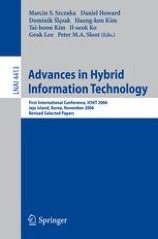
Advances in Hybrid Information Technology ; 1st International Conference, ICHIT 2006, Jeju Island, Korea, November 9-11, 2006, Revised Selected Papers
As information technologies (IT) become specialized and fragmented, it is easy to lose sight that many topics in IT have common threads and because of this, advances in one sub-discipline may transmit to another. The presentation of results between di?erent sub-disciplines of IT encourages this interchange for the advancement of IT as a whole. Of particular interest is the hybrid approach or combining ideas from one discipline with those of another to achieve a result that is more signi?cant than the sum of the individual parts. Through this hybrid philosophy, a new or common principle can be discovered which has the propensity to propagate throughout this multifaceted discipline.
