



الصفحة 13
الصفحة 13

Foundations of generic optimization ; Vol.2 : Applications of fuzzy control, genetic algorithms and neural networks
This is a comprehensive overview of the basics of fuzzy control, which also brings together some recent research results in soft computing, in particular fuzzy logic using genetic algorithms and neural networks. This book offers researchers not only a solid background but also a snapshot of the current state of the art in this field.

Foundation Mathematics for Computer Science : A Visual Approach
In this second edition of Foundation Mathematics for Computer Science, John Vince has reviewed and edited the original book and written new chapters on combinatorics, probability, modular arithmetic and complex numbers. These subjects complement the existing chapters on number systems, algebra, logic, trigonometry, coordinate systems, determinants, vectors, matrices, geometric matrix transforms, differential and integral calculus. During this journey, the author touches upon more esoteric topics such as quaternions, octonions, Grassmann algebra, Barrycentric coordinates, transfinite sets and prime numbers.
Formal Techniques for Networked and Distributed Systems - FORTE 2006 ; 26th IFIP WG 6.1 International Conference, Paris, France, September 26-29, 2006, Proceedings
This book constitutes the refereed proceedings of the 26th IFIP WG 6.1 International Conference on Formal Techniques for Networked and Distributed Systems, FORTE 2006, held in Paris, France, in September 2006. The 26 revised full papers and 4 short papers presented together with 3 invited lectures were carefully reviewed and selected from 177 submissions. The papers focus on the construction of middleware and services using formalised and verified approaches.
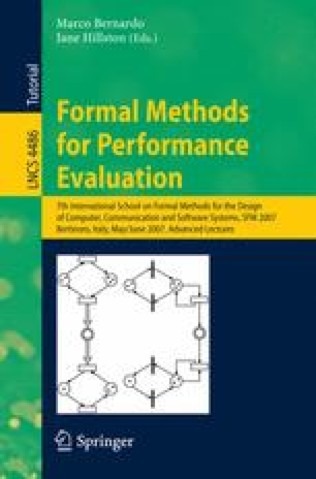
Formal Methods for Performance Evaluation ; 7th International School on Formal Methods for the Design of Computer, Communication, and Software Systems, SFM 2007, Bertinoro, Italy, May 8-June 2, 2007, Advanced Lectures
This book presents a set of 11 papers accompanying the lectures of leading researchers given at the 7th edition of the International School on Formal Methods for the Design of Computer, Communication and Software Systems, SFM 2007.

Formal Methods for Open Object-Based Distributed Systems ; 9th IFIP WG 6.1 International Conference, FMOODS 2007, Paphos, Cyprus, June 6-8, 2007, Proceedings
This book constitutes the refereed proceedings of the 9th IFIP WG 6.1 International Conference on Formal Methods for Open Object-Based Distributed Systems, FMOODS 2007, held in Paphos, Cyprus in June 2007. The papers are organized in topcical sections on model checking rewriting logic components and services algebraic calculi specification, verification and refinenment, and quality of service.

Formal Methods for Industrial Critical Systems ; 12th International Workshop, FMICS 2007, Berlin, Germany, July 1-2, 2007, Revised Selected Papers
This book constitutes the thoroughly refereed post-workshop proceedings of the 12th International Workshop on Formal Methods for Industrial Critical Systems, FMICS 2007, held in Berlin, Germany, in July 2007 - colocated with CAV 2007, the 19th International Conference on Computer Aided Verification.

Formal Methods for Computational Systems Biology ; 8th International School on Formal Methods for the Design of Computer, Communication, and Software Systems, SFM 2008 Bertinoro, Italy, June 2-7, 2008 Advanced Lectures
This volume presents the set of papers accompanying the lectures of the eighth International School on Formal Methods for the Design of Computer, Com- nication, and Software Systems (SFM). This series of schools addresses the use of formal methods in computer science asaprominent approach to theri gorousdesign of computer, communication, and software systems. The main aim of the SFM series is to ofer a good spectrum of current research in foundations as well as applications of formal methods, which can be of help for graduate students and young researchers who intend to approach the feld.
Formal Methods and Stochastic Models for Performance Evaluation ; 4th European Performance Engineering Workshop, EPEW 2007, Berlin, Germany, September 27-28, 2007, Proceedings
This book constitutes the refereed proceedings of the 4th European Performance Engineering Workshop, EPEW 2007, held in Berlin, Germany, September 27-28, 2007.The 20 revised full papers presented were carefully reviewed and selected from 53 submissions.
Formal Methods and Stochastic Models for Performance Evaluation ; 3rd European Performance Engineering Workshop, EPEW 2006, Budapest, Hungary, June 21-22, 2006, Proceedings
This volume contains the proceedings of the third EPEW workshop held at the Technical University of Budapest, Budapest, Hungary, June 21-22, 2006. These proceedings comprise the 16 accepted contributed papers of EPEW 2006.Toensurethehigh-qualityevaluationofthesubmittedpapersweextended the ProgramCommittee of EPEW 2006 with international experts from all over the world. The ?nal workshop program, as well as this volume, are made up of ?ve thematic sessions: – Stochastic process algebra – Workloads and benchmarks – Theory of stochastic processes – Formal dependability and performance evaluation – Queues, theory and practice These sessions cover a wide range of performance evaluation methods and c- pose an overview of the current research directions in performance evaluation.
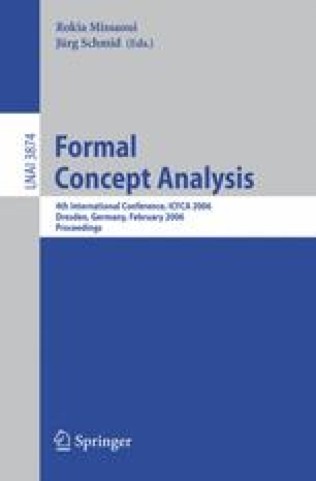
Formal concept analysis ; Vol. 3874 ; 4th International Conference, ICFCA 2006, Dresden, Germany, Feburary 13-17, 2006, Proceedings
This book constitutes the refereed proceedings of the 4th International Conference on Formal Concept Analysis, held in February 2006. The 17 revised full papers presented together with four invited papers were carefully reviewed and selected for inclusion in the book. The papers show advances in applied lattice and order theory and in particular scientific advances related to formal concept analysis and its practical applications: data and knowledge processing including data visualization, information retrieval, machine learning, data analysis and knowledge management.
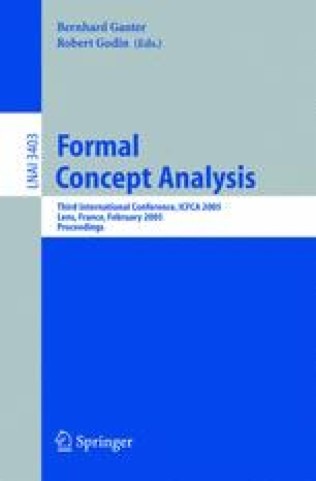
Formal concept analysis ; Vol. 3403 ; 3rd International Conference, ICFCA 2005, Lens, France, February 14-18, 2005, Proceedings
This book constitutes a comprehensive and systematic presentation of the state of the art of formal concept analysis and its applications. The first part of the book is devoted to foundational and methodological topics. The contributions in the second part demonstrate how formal concept analysis is successfully used outside of mathematics, in linguistics, text retrieval, association rule mining, data analysis, and economics. The third part presents applications in software engineering.

Forecasting with Exponential Smoothing : The State Space Approach
Exponential smoothing methods have been around since the 1950s, and are the most popular forecasting methods used in business and industry. Recently, exponential smoothing has been revolutionized with the introduction of a complete modeling framework incorporating innovations state space models, likelihood calculation, prediction intervals and procedures for model selection. In this book, all of the important results for this framework are brought together in a coherent manner with consistent notation. In addition, many new results and extensions are introduced and several application areas are examined in detail.

Fixed point theory for decomposable sets
This book attempts to show the present stage of "decomposable analysis" from the point of view of fixed point theory. The book is split into three parts, beginning with the background of functional analysis, proceeding to the theory of multifunctions and lastly, the decomposability property.Mathematicians and students working in functional, convex and nonlinear analysis, differential inclusions and optimal control should find this book of interest. A good background in fixed point theory is assumed as is a background in topology.
Finite Mixture and Markov Switching Models
The prominence of finite mixture modelling is greater than ever. Many important statistical topics like clustering data, outlier treatment, or dealing with unobserved heterogeneity involve finite mixture models in some way or other. The area of potential applications goes beyond simple data analysis and extends to regression analysis and to non-linear time series analysis using Markov switching models.It is the first time that the Bayesian perspective of finite mixture modelling is systematically presented in book form. It is argued that the Bayesian approach provides much insight in this context and is easily implemented in practice. Although the main focus is on Bayesian inference, the author reviews several frequentist techniques, especially selecting the number of components of a finite mixture model, and discusses some of their shortcomings compared to the Bayesian approach. The aim of this book is to impart the finite mixture and Markov switching approach to statistical modelling to a wide-ranging community. This includes not only statisticians, but also biologists, economists, engineers, financial agents, market researcher, medical researchers or any other frequent user of statistical models. This book should help newcomers to the field to understand how finite mixture and Markov switching models are formulated, what structures they imply on the data, what they could be used for, and how they are estimated.

Finite Element Mathematics
Is a comprehensive guide that explores the versatility and affordability of the finite element method (FEM) as a powerful tool for solving engineering problems across various industries. This book provides a practical introduction to FEM analysis, covering applications in mechanical engineering, civil engineering, electrical engineering, and physics. It presents a balanced blend of theory and applications, catering to both beginners and those seeking to enhance their FEM skills.

Finite element design of concrete structures : Practical problems and their solutions
In Finite Element Design of Concrete Structures: practical problems and their solutions the author addresses this 'blind belief' in computer results by offering a useful critique that 'important details are overlooked due to the flood of information' from the output of computer calculations. Indeed, errors in the numerical model may lead in extreme cases to structural failures as the collapse of the so-called Sleipner platform has demonstrated.
Finite Difference Computing with Exponential Decay Models
This text provides a very simple, initial introduction to the complete scientific computing pipeline: models, discretization, algorithms, programming, verification, and visualization. The pedagogical strategy is to use one case study – an ordinary differential equation describing exponential decay processes – to illustrate fundamental concepts in mathematics and computer science. The book is easy to read and only requires a command of one-variable calculus and some very basic knowledge about computer programming. Contrary to similar texts on numerical methods and programming, this text has a much stronger focus on implementation and teaches testing and software engineering in particular.
Financial Modeling Under Non-Gaussian Distributions
Practitioners and researchers who have handled financial market data know that asset returns do not behave according to the bell-shaped curve, associated with the Gaussian or normal distribution. Indeed, the use of Gaussian models when the asset return distributions are not normal could lead to a wrong choice of portfolio, the underestimation of extreme losses or mispriced derivative products. Consequently, non-Gaussian models and models based on processes with jumps are gaining popularity among financial market practitioners.
Financial Markets in Continuous Time
In modern financial practice, asset prices are modelled by means of stochastic processes, and continuous-time stochastic calculus thus plays a central role in financial modelling. This approach has its roots in the foundational work of the Nobel laureates Black, Scholes and Merton. Asset prices are further assumed to be rationalizable, that is, determined by equality of demand and supply on some market. This approach has its roots in the foundational work on General Equilibrium of the Nobel laureates Arrow and Debreu and in the work of McKenzie. This book has four parts.

Field Measurements for Forest Carbon Monitoring : A Landscape-Scale Approach
This volume is a comprehensive guide to the methods and techniques employed in forest carbon inventory and monitoring. Since forest carbon research is interdisciplinary, it is unlikely that any one investigator will possess expertise in all of the types of measurements needed to conduct forest carbon research at scales larger than a forest stand. Techniques used to characterize standing stocks of carbon in a forest, measure key carbon fluxes, and collect related data (such as forest canopy nitrogen concentrations and meteorological measurements) that are required to drive process models, develop predictive relationships, and link to remote sensing data are described in detail. In addition to the measurement methods, the chapters include background information, necessary calculations, and equipment requirements.
