



الصفحة 12
الصفحة 12

Fruits and Nuts
Genome Mapping and Molecular Breeding in Plants presents the current status of the elucidation and improvement of plant genomes of economic interest. The focus is on genetic and physical mapping, positioning, cloning, monitoring of desirable genes by molecular breeding and the most recent advances in genomics. The series comprises seven volumes: Cereals and Millets; Oilseeds; Pulses, Sugar and Tuber Crops; Fruits and Nuts; Vegetables; Technical Crops; and Forest Trees. Fruits and nuts form the largest group among crop plants. Several constraints such as long life cycle, heterozygosity and large plant size caused comparatively slow research progress in the past. The chapters on 20 fruit and nut crops authored by 56 renowned scientists from 12 countries include for the first time comprehensive reviews on mango, banana, olive, pineapple, pistachio, persimmon and papaya. Other crops covered are apple, grape, cherry, plum, peach, pear, apricot, strawberry, raspberry, blueberry, almond, citrus and avocado.
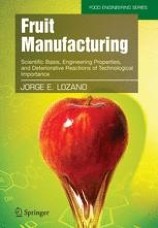
Fruit Manufacturing : Scientific Basis, Engineering Properties, and Deteriorative Reactions of Technological Importance
The fruit processing industry is a major global business. While basic principles of fruit processing have shown only minor changes over the last years, major improvements continually occur. More efficient equipment is capable of converting huge quantities of fruits into pulp, juice, dehydrated, frozen and refrigerated products, etc. that make possible the preservation of products for year-round consumption. Fruit processing and storage involve physical and chemical changes that negatively modify fruit quality. The industry’s ability to provide a nutritious and healthful fruit product to the consumer is highly dependent on the knowledge of the quality modifications that occur during the processing.

Frontiers in Computing Technologies for Manufacturing Applications
Frontiers in Computing Technologies for Manufacturing Applications presents an overview of the state-of-the-art intelligent computing in manufacturing. Modeling, data processing, algorithms and computational analysis of difficult problems found in advanced manufacturing are discussed. It is the first book to bring together combinatorial optimization, information systems and fault diagnosis and monitoring in a consistent manner. Techniques are presented in order to aid decision makers needing to consider multiple, conflicting objectives in their decision processes. In particular, the use of metaheuristic optimization techniques for multi-objective problems is discussed. Readers will learn about computational technologies that can improve the performance of manufacturing systems ranging from manufacturing equipment to supply chains.

From industry 4.0 to Quality 4.0 : An innovative TQM guide for sustainable digital age businesses
Describes the development of quality over various stages, from product inspection, through quality control to the present ISO 9000 systems. It also highlights the advantages of the quality management system (QMS) standards and the need for certification by organizations and enterprises/firms interested in taking advantage of the various benefits of these standards to improve their systems and aid their survival in a globally competitive market.

Fractional order systems and applications in engineering
Covers the fundamentals of fractional calculus together with some analytical and numerical techniques, and provides MATLAB® codes for the simulation of fractional-order control (FOC) systems. The use of fractional calculus can improve and generalize well-established control methods and strategies. Many different FOC schemes are presented for control and dynamic systems problems. These extend to the challenging control engineering design problems of robust and nonlinear control. Practical material relating to a wide variety of applications including, among others, mechatronics, civil engineering, irrigation and water management, and biological systems is also provided.
Foundations of software science and computation structures ; 11th International conference, FOSSACS 2008, Held as part of the joint European conferences on theory and practice of software, ETAPS 2008, Budapest, Hungary, March 29 - April 6, 2008. proceedings
The fve main conferences received 571 submissions, 147 of which were accepted, giving an overall acceptance rate of less than 26%, with each conference below 27%.Congratulations there foretoall the authorswhomadeittothe fnalprogramme! I hope that most of the other authors will still have found a way of participating in this exciting event, and that you will all continue submitting to ETAPS and contributing to make of it the best conference in the area. The events that comprise ETAPS address various aspects of the system velopment process, including specifcation, design, implementation, analysis and improvement

Foundations of information and knowledge systems ; 5th International Symposium, FoIKS 2008, Pisa, Italy, February 11-15, 2008. Proceedings
This book constitutes the refereed proceedings of the 5th International Symposium on Foundations of Information and Knowledge Systems, FoIKS 2008 held in Pisa, Italy, in February 2008. The 13 revised full papers presented together with 9 revised short papers and 3 invited lectures were carefully selected during two rounds of reviewing and improvement from from 79 submissions. The papers deal with any foundational aspect of information and knowledge systems, including submissions from researchers working in fields such as discrete mathematics, logic and algebra, model theory, information theory, complexity theory, algorithmics and computation, geometry, analysis, statistics and optimisation who are interested in applying their ideas, theories and methods to research on information and knowledge systems.

Foundation Expression Blend 2 : Building applications in WPF and silverlight
This book shows you how to take full advantage of Blend's interface, together with and Silverlight's vastly improved designer-developer workflow, guiding you through every step of development from downloading and installing of the development environment through creating finished, functional projects. You'll learn how to create simple drawing applications with the InkCanvas, make tabbed and scrollable interfaces, as well as build fully featured media players, photo galleries, and interactive 3D designs. Each chapter discusses major WPF and Silverlight features, provides a hands-on tutorial, and explains how that feature is implemented in the real world. In the end, you will have a collection of impressive WPF and Silverlight applications that can be added to your portfolio.
Foundation ActionScript 3.0 with Flash CS3 and Flex
If you want to create exciting dynamic web sites that will amaze your online audience, then the Flash platform is a great way to go, with it's many features, including powerful graphical and sound and video capabilities. To really harness the power of Flash though, you need to make use of ActionScript to provide dynamic effects, enable user interaction, and manipulate data. ActionScript 3.0, the Flash Platform's scripting language, offers a lot of new and powerful features. ActionScript is now a full-fledged programming language, with complete object-oriented capabilities, improved event handling, sound and video support, drawing capabilities, support for regular expressions, and much more. This book covers all the essential techniques from the ground up, allowing you to get up and running quickly and easily. Starting with the fundamentals, you'll learn about using ActionScript objects, manipulating sound and video, and harnessing the power of regular expressions and XML.
Formalizing the Shadow Economy in Serbia : Policy Measures and Growth Effects
The main objective of this book is to develop a strategy and policy measures to enhance the formalization of the shadow economy in order to improve the competitiveness of the economy and contribute to economic growth; it explores these issues with special reference to Serbia. The size and development of the shadow economy in Serbia and other Central and Eastern European countries are estimated using two different methods (the MIMIC method and household-tax-compliance method). Micro-estimates are based on a special survey of business entities in Serbia, which for the first time allows us to explore the shadow economy from the perspective of enterprises and entrepreneurs.
Formal Modelling in Electronic Commerce
Advances in automation for electronic commerce require improved understanding and formalization of the objects, processes, and policies of commerce itself. These include business objects such as bills of lading and contracts; processes such as workflows and trade procedures; and policies covering such problems as contract or procedure validation and strategic behaviour. This book is about theory, formalization, and proof-of-concept implementation of these and related matters. In addition to presenting state-of-the-art results, the book places this work in the context of nearly twenty years of developments in formal modelling for electronic commerce. A comprehensive bibliography and index are provided.

Formal approaches to software testing and runtime verification ; 1st Combined International Workshops FATES 2006 and RV 2006, Seattle, WA, USA, August 15-16, 2006, Revised Selected Papers
Software validation is one of the most cost-intensive tasks in modern software production processes. The objective of FATES/RV 2006 was to bring sci- tists from both academia and industry together to discuss formal approaches to test and analyze programs and monitor and guide their executions. Formal approaches to test may cover techniques from areas like theorem proving, model checking, constraint resolution, static program analysis, abstract interpretation, Markov chains, and various others. Formal approaches to runtime veri?cation use formal techniques to improve traditional ad-hoc monitoring techniques used in testing, debugging, performance monitoring, fault protection, etc.
Forest Trees
Genome Mapping and Molecular Breeding in Plants presents the current status of the elucidation and improvement of plant genomes of economic interest. The focus is on genetic and physical mapping, positioning, cloning, monitoring of desirable genes by molecular breeding and the most recent advances in genomics. The series comprises seven volumes: Cereals and Millets; Oilseeds; Pulses, Sugar and Tuber Crops; Fruits and Nuts; Vegetables; Technical Crops; and Forest Trees. Forest trees cover one third of the global land surface, constitute many ecosystems and play a pivotal role in the world economy. Despite their importance in the economy, ecology and environment, genetic analysis and breeding efforts have lagged behind. Presented here are chapters on Populus trees, pines, Fagaceae trees, eucalypts, spruces, Douglas fir and black walnut, and a first-ever detailed review of Cryptomeria japonica. Innovative strategies to address the inherent problems of genome analysis of tree species are thoroughly discussed.
Foresight and Design: Composing Future Places
Every plan, pro-forma, design, building contract, and construction schedule is a proposal about future places. To help improve such proposals, Foresight and Design: Composing Future Places presents conceptual tools to inform design and outline the need for designers to rigorously think about potential futures. Our built compositions are constantly transforming due to continuing urbanization, demographic shifts, climate change, the evolution of virtual worlds, economic and health disparities, and other unforeseen trends. Five brief case studies interspersed between the chapters serve as examples of practitioners exercising foresight through these practices. Contributions include a description of a regional design process in Afghanistan by Anthony Fettes of Sasaki Architects, and an exploration into the Indigenous Futurism model-making competition by Anjelica Gallegos.

Forefoot Reconstruction
For a long time, forefoot surgery had many disadvantages including a painful postoperative period and recurrence of deformities. New techniques – notably Scarf, the first metatarsal osteotomy and the Weil osteotomy of the lesser metatarsal – provide a significant improvement in the treatment of static forefoot disorders. The great toe osteotomy has also been greatly improved. Since 1991, the author has introduced these techniques in many countries, while developing and studying the corresponding implants and the postoperative period. He has also developed surgical management techniques that bridge these different osteotomies. More than 1000 surgeons around the world are using these techniques, which are now widely taught. In this second edition of the book the general presentation is clearer and more pleasant and many pictures have been replaced. Several topics are emphasized, notably the great toe proximal phalanx osteotomy, the joint preservative surgery in severe forefoot disorders, including revision after failed bunionectomy and rheumatoid forefoot following the "ms” point for an accurate and effective metatarsal shortening. Lastly, new procedures are exposed, particularly in Claw toe and hammer with the PIP plantar release and the surgery of the middle phalanx and also the Weil osteotomy of the first metatarsal in hallux limitus.

Forecasting Innovations : Methods for Predicting Numbers of Patent Filings
This is a practical guide to solutions for a case study of forecasting demand for services and products in international markets - and so much more than just another listing of dry theoretical methods. Leading experts present studies on improvements to methods for forecasting numbers of incoming patent filings at the European Patent Office. Studies are presented from econometric, survey and systems theory viewpoints.

Food Safety Culture : Creating a Behavior-Based Food Safety Management System
Food safety awareness is at an all time high, new and emerging threats to the food supply are being recognized, and consumers are eating more and more meals prepared outside of the home. Accordingly, retail and foodservice establishments, as well as food producers at all levels of the food production chain, have a growing responsibility to ensure that proper food safety and sanitation practices are followed, thereby, safeguarding the health of their guests and customers. Achieving food safety success in this changing environment requires going beyond traditional training, testing, and inspectional approaches to managing risks. It requires a better understanding of organizational culture and the human dimensions of food safety. To improve the food safety performance of a retail or foodservice establishment, an organization with thousands of employees, or a local community, you must change the way people do things. You must change their behavior. In fact, simply put, food safety equals behavior.

Food nanotechnology
Nanotechnology is increasingly being utilized within the food industry to create innovative products with new or improved properties. This book introduces the history of nanotechnology applications in the food industry. It then discusses the key physicochemical and structural characteristics of the different kinds of nanoparticles found in foods, as well as showing how these characteristics lead to their unique functional attributes. Applications of nanotechnology in the food and agricultural industries are then covered, including the creation of nanopesticides, nanofertilizers, nutrient delivery systems, functional ingredients, smart packaging materials, nanofilters, and sensors, as well as for the conversion of waste materials into value-added products. Finally, the potential toxicity of both organic and inorganic nanoparticles found in foods is critically assessed. The author is a Distinguished Professor of food science who uses physics, chemistry, and biology to improve the quality, safety, and healthiness of foods. He has published over a thousand scientific articles and numerous books in this area and is currently the most highly cited food scientist in the world. He has won numerous awards for his scientific achievements.

Food lens = فود لينس
Food lens is an innovative application designed to revolutionize dietary management by leveraging advanced image recognition and nutritional analysis. The primary objective of this senior project is to develop a user-friendly tool that identifies various foods through a camera interface and provides detailed nutritional information. This application not only enhances the user's understanding of their dietary intake but also assists in achieving personalized health and fitness goals. The core functionality of Food Lens involves the integration of a robust image recognition system capable of accurately identifying a wide range of foods. Upon identification, the application retrieves comprehensive nutritional data, including calorie content, macronutrient distribution (proteins, fats, carbohydrates), and essential micronutrients (vitamins and minerals). This data is then seamlessly integrated into the user's dietary profile. Food Lens is designed to track the user's daily caloric intake and compare it against personalized recommendations based on age, gender, weight, height, and activity level. By maintaining a dynamic record of consumed foods, the application provides real-time feedback on the user’s nutritional progress. This feature is particularly beneficial for individuals aiming to manage weight, address dietary restrictions, or improve overall health.

Food irradiation
Treatment of food by specific ionizing radiations to improve microbiological safety and storability is one of the most extensively studied technology of the XXth century. However, much of the research has been carried out in laboratories and it is still relatively underutilized commercially. Its application potential is very diverse, from inhibition of sprouting of tubers and bulbs to production of commercially sterile food products. The safety of consumption and wholesomeness of irradiated food have been extensively studied in international cooperations. Numerous international expert groups set up jointly by the FAO, the IAEA and the WHO, or the Scientific Committee on Food of the European Commission concluded that foods irradiated with appropriate technologies are both safe and nutritionally adequate. A Codex General Standard for Irradiated Foods and a Recommended International Code of Practice for Radiation Processing of Food have been developed.
