



الصفحة 12
الصفحة 12
Gesture in Human-Computer Interaction and Simulation ; 6th International Gesture Workshop, GW 2005, Berder Island, France, May 18-20, 2005, Revised Selected Papers
The international Gesture Workshops have become the leading interdisciplinary events for dissemination of the latest results on gesture-based communication. The goal of these workshops is to bring together researchers who want to meet and share ideas on advanced research on gesture related to multidisciplinary scienti?c ?elds. Depending on the ?elds, the objectives can be very di?erent. While physiology and biomechanics aim to extract fundamental knowledge of physical gesture, computer sciences try to capture di?erent aspects of gesture and extract features that help to identify, interpret or rebuild the underlying mechanisms of communication gestures. Other approaches and methodologies are followed by cognitive sciences and linguistics, bringing a complementary - derstanding of motor control and gesture meaning. The results can be enhanced by technological applications or demonstrations.
Geostatistics Banff 2004
The five major sections are: theory, mining, petroleum, environmental and other applications. The first section showcases new and innovative ideas in the theoretical development of geostatistics as a whole; these ideas will have large impact on (1) the directions of future geostatistical research, and (2) the conventional approaches to heterogeneity modelling in a wide range of natural resource industries. The next four sections are focused on applications and innovations relating to the use of geostatistics in specific industries. Historically, mining, petroleum and environmental industries have embraced the use of geostatistics for uncertainty characterization, so these three industries are identified as major application areas. The last section is open for innovative geostatistical application to address the issues and impact of uncertainty in other industries.
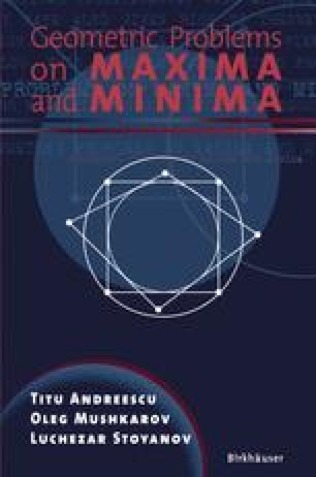
Geometric Problems on Maxima and Minima
Questions of maxima and minima have great practical significance, with applications to physics, engineering, and economics; they have also given rise to theoretical advances, notably in calculus and optimization. Indeed, while most texts view the study of extrema within the context of calculus, this carefully constructed problem book takes a uniquely intuitive approach to the subject: it presents hundreds of extreme-value problems, examples, and solutions primarily through Euclidean geometry.

Geometric and Topological Methods for Quantum Field Theory
This volume offers an introduction, in the form of four extensive lectures, to some recent developments in several active topics at the interface between geometry, topology and quantum field theory. The first lecture is by Christine Lescop on knot invariants and configuration spaces, in which a universal finite-type invariant for knots is constructed as a series of integrals over configuration spaces. This is followed by the contribution of Raimar Wulkenhaar on Euclidean quantum field theory from a statistical point of view. The author also discusses possible renormalization techniques on noncommutative spaces. The third lecture is by Anamaria Font and Stefan Theisen on string compactification with unbroken supersymmetry. The authors show that this requirement leads to internal spaces of special holonomy and describe Calabi-Yau manifolds in detail. The last lecture, by Thierry Fack, is devoted to a K-theory proof of the Atiyah-Singer index theorem and discusses some applications of K-theory to noncommutative geometry. These lectures notes, which are aimed in particular at graduate students in physics and mathematics, start with introductory material before presenting more advanced results. Each chapter is self-contained and can be read independently.
Geometric Algebra for Computer Graphics
The first five chapters review the algebras of real numbers, complex numbers, vectors, and quaternions and their associated axioms, together with the geometric conventions employed in analytical geometry. As well as putting geometric algebra into its historical context, John Vince provides chapters on Grassmann’s outer product and Clifford’s geometric product, followed by the application of geometric algebra to reflections, rotations, lines, planes and their intersection. The conformal model is also covered, where a 5D Minkowski space provides an unusual platform for unifying the transforms associated with 3D Euclidean space.

Geography and Drug Addiction
لإhis book contains drug addiction contributes to better understanding the etiology of addiction, its diffusion, its interaction with geographically variable environmental, social, and economic factors, and the strategies for its treatment and prevention. This book explores links between geography and drug abuse and identifies research ideas, connections, and research pathways which point to some promising avenues for future work in this area
Geographic Hypermedia : Concepts and Systems
This book introduces a new paradigm, Geographic Hypermedia, which emerges from the convergence of Geographic Information Science and - permedia technology. Both GI Science and hypermedia have been rapidly evolving fields. The initial idea of Geographic Hypermedia was born in 2004 when the editors had been invited to organize a workshop in conju- tion with the ‘Hypertext’ conference organized annually by the Special - terest Group of the Association for Computing Machinery. The purpose of the workshop was to examine how hypermedia concepts and tools may be applied in geographical domains. The workshop was eventually held in conjunction with the Maps and the Internet Commission of the International Cartographic Association at the annual meeting of the Association of American Geographers in Denver, Colorado, in April 2005. The Denver workshop was a successful event, bringing together mul- disciplinary researchers and professionals in the area of Geographic - permedia.

Genetic Programming Theory and Practice V
Genetic Programming Theory and Practice V was developed from the fifth workshop at the University of Michigan’s Center for the Study of Complex Systems to facilitate the exchange of ideas and information related to the rapidly advancing field of Genetic Programming (GP). Contributions from the foremost international researchers and practitioners in the GP arena examine the similarities and differences between theoretical and empirical results on real-world problems. The text explores the synergy between theory and practice, producing a comprehensive view of the state of the art in GP application.

Genetic Programming Theory and Practice IV
Genetic Programming Theory and Practice IV was developed from the fourth workshop at the University of Michigan’s Center for the Study of Complex Systems to facilitate the exchange of ideas and information related to the rapidly advancing field of Genetic Programming (GP). Contributions from the foremost international researchers and practitioners in the GP arena examine the similarities and differences between theoretical and empirical results on real-world problems.
Genetic Programming Theory and Practice III
Genetic Programming Theory and Practice III explores the emerging interaction between theory and practice in the cutting-edge, machine learning method of Genetic Programming (GP). This contributed volume was developed from the third workshop at the University of Michigan’s Center for the Study of Complex Systems to facilitate the exchange of ideas and information related to this rapidly advancing field. The text provides a cohesive view of the issues facing both practitioners and theoreticians and examines the synergy between GP theory and application.

Generator remote controlling using internet connection
The traditional technique of monitoring the electricity generated through regular checks on the alternator variables: oil, temperature, voltage and current on a daily basis. Therefore, maintaining a normal performance cycle requires hard work and is often imprecise. The idea is to create an application that monitors wireless generators using the popular smartphone Android operating system. Implemented sensors deliver analog signals that provide real-time data on the status of the generator. This data is converted and programmed through the Node MCU microcontroller, which reads the results from the sensors and then converts into a signal, which is transmitted to the android phone, through a router. Thus live feedback of the generator status is ensured. In addition, this project provides a control button that can actually turn this generator on and off. This project is the first step towards bringing systems and control together as it revolutionizes the ideology of monitoring and displaying real-time data that can be implemented in different fields according to different needs. These fields include electricity, mechanics, and communications.
Generalized Curvatures
The central object of this book is the measure of geometric quantities describing N a subset of the Euclidean space (E ,), endowed with its standard scalar product. Let us state precisely what we mean by a geometric quantity. Consider a subset N S of points of the N-dimensional Euclidean space E , endowed with its standard N scalar product. LetG be the group of rigid motions of E . We say that a 0 quantity Q(S) associated toS is geometric with respect toG if the corresponding 0 quantity Q[g(S)] associated to g(S) equals Q(S), for all g?G . For instance, the 0 diameter ofS and the area of the convex hull ofS are quantities geometric with respect toG . But the distance from the origin O to the closest point ofS is not, 0 since it is not invariant under translations ofS. It is important to point out that the property of being geometric depends on the chosen group. For instance, ifG is the 1 N group of projective transformations of E , then the property ofS being a circle is geometric forG but not forG , while the property of being a conic or a straight 0 1 line is geometric for bothG andG . This point of view may be generalized to any 0 1 subsetS of any vector space E endowed with a groupG acting on it.

General Relativity
this book is a short and concise exposition of the central ideas of general relativity. Although the original audience was made up of mathematics students, the focus is on the chain of reasoning that leads to the relativistic theory from the analysis of distance and time measurements in the presence of gravity, rather than on the underlying mathematical structure. The geometric ideas - which are central to the understanding of the nature of gravity - are introduced in parallel with the development of the theory, the emphasis being on laying bare how one is led to pseudo-Riemannian geometry through a natural process of reconciliation of special relativity with the equivalence principle.

General Relativity
This book offers an alternative to other textbooks on the subject, providing a more specific discussion of numerous general relativistic effects for readers who have knowledge of classical mechanics and electrodynamics, including special relativity. Coverage includes gravitational lensing, signal retardation in the gravitational field of the Sun, the Reissner-Nordström solution, selected spin effects, the resonance transformation of an electromagnetic wave into a gravitational one, and the entropy and temperature of black holes. The book includes numerous problems at various levels of difficulty, making it ideal also for independent study by a broad readership of advanced students and researchers.

Gender Designs IT : Construction and Deconstruction of Information Society Technology
The book not only offers a gender analysis of information society technologies, it also shows practical examples of how IT can be different. A gender perspective on IT design can serve as an eye-opener for what tends to be overlooked and left out. It yields innovative ideas and high quality software systems that may empower a large diversity of users for an active participation in our information society.

Game-Theoretical Semantics : Essays on Semantics by Hintikka, Carlson, Peacocke, Rantala and Saarinen
This book is a collection of studies applying game-theoretical concepts and ideas to analysing the semantics of natural language and some formal languages. The bulk of the book consists of several papers by Hintikka, Carlson and Saarinen and discusses several of the central problems of the semantics of natural language.The topics covered are the semantics of natural language quantifiers, conditionals, pronouns and anaphora more generally. Hintikka’s famous essay presenting examples of "branching quantifier structures" in English, as well as one formulating his "any-every thesis", are included. The book also includes Hintikka’s closely argued philosophical discussion of the relationships between the new semantical games with the language games of Wittgenstein.

Galactose Regulon of Yeast : From Genetics to Systems Biology
The galactose regulon of yeast is one of the best studied regulons. It is an ideal paradigm for demonstrating fundamental and evolving concepts in biology and is used in this book as a model system to explain various facets of conventional and modern biology. The book starts with a brief historical overview on yeast research, i.e. early observations in enzyme adaptation, classical genetics, formulating hypotheses based on genetic inference. This is followed by molecular genetics of the galactose regulon, isolation of genes and testing of the hypotheses. The power of mutational analysis in deciphering molecular mechanisms is conveyed. Further, contemporary topics such as genomics, evolution, single cell analysis of transcriptional switching, binary and graded responses, biological consequences of feed back regulation in genetic circuits, and stochasticity are addressed.

Fuzzy Information and Engineering ; Proceedings of the Second International Conference of Fuzzy Information and Engineering (ICFIE)
The Second International Conference on Fuzzy Information and Engineering (ICFIE2007), built on the success of previous conferences, the ICIKE2002 (Dalian China), is a major symposium for scientists, engineers and practitioners in China as well as the world to present their latest results, ideas, developments and applications in all areas of fuzzy information and knowledge engineering. It aims to strengthen relations between industry research laboratories and universities, and to create a primary symposium for world scientists in fuzzy fields such as Fuzzy Information, Fuzzy Sets and Systems, Soft Computing, Fuzzy Engineering, Fuzzy Operation Research and Management, Artificial Intelligence, Rough Sets and Its Application, Application in Fuzzy Mathematics and Systems, etc.

Fuzzy Engineering Economics with Applications
This book handles the fuzzy cases of classical engineering economics topics. It contains 15 original research and application chapters including different topics of fuzzy engineering economics. This book will provide a useful resource of ideas, techniques, and methods for present and further research in the applications of fuzzy sets in engineering economics.
Fuzzy Chaotic Systems : Modeling, Control, and Applications
"Fuzzy Chaotic Systems" provides original heuristic research achievements and insightful ideas on the interactions or intrinsic relationships between fuzzy logic and chaos theory. It presents the fundamental concepts of fuzzy logic and fuzzy control, chaos theory and chaos control, as well as thedefinition of chaos on the metric space of fuzzy sets. This monograph discusses and illustrates fuzzy modeling and fuzzy control of chaotic systems, synchronization, anti-control of chaos, intelligent digital redesign, spatiotemporal chaos and synchronization in complex fuzzy systems; as well as a practical application example of fuzzy-chaos-based cryptography. Like other very good books, this book may raise more questions than it can provide answers. It therefore generates a great potential to attract more attention to combine fuzzy systems with chaos theory and contains important seeds for future scientific research and engineering applications.
