



الصفحة 117
الصفحة 117

Evolvable Hardware
The contributions in this book provide the basics of reconfigurable devices so that readers will be fully prepared to understand what EHW is, why it is necessary and how it is designed. The book also discusses the leading research in digital, analog and mechanical EHW. Selections from leading international researchers offer examples of cutting-edge research and applications, placing particular emphasis on their practical usefulness.

Evolutionary Synthesis of Pattern Recognition Systems
Evolutionary Synthesis of Pattern Recognition Systems presents novel effective approaches based on evolutionary computational techniques, such as genetic programming (GP), linear genetic programming (LGP), coevolutionary genetic programming (CGP) and genetic algorithms (GA) to automate the synthesis and analysis of object detection and recognition systems. The book’s concepts, principles, and methodologies will enable readers to automatically build robust and flexible systems—in a systematic manner—that can provide human-competitive performance and reduce the cost of designing and maintaining these systems. Its content covers all key aspects of object recognition: object detection, feature selection, feature discovery, object recognition, domain knowledge. Basic knowledge of programming and data structures, and some calculus, is presupposed.ing the book’s novel ideas

Evolutionary Swarm Robotics : Evolving Self-Organising Behaviours in Groups of Autonomous Robots
In this book the use of ER techniques for the design of self-organising group behaviours, for both simulated and real robots is introduced. This research has a twofold value. From an engineering perspective, an automatic methodology for synthesising complex behaviours in a robotic system is described.

Evolutionary Multiobjective Optimization : Theoretical Advances and Applications
Evolutionary Multiobjective Optimization is a rare collection of the latest state-of-the-art theoretical research, design challenges and applications in the field of multiobjective optimization paradigms using evolutionary algorithms. It includes two introductory chapters giving all the fundamental definitions, several complex test functions and a practical problem involving the multiobjective optimization of space structures under static and seismic loading conditions used to illustrate the various multiobjective optimization concepts.
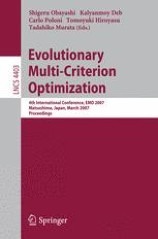
Evolutionary Multi-Criterion Optimization ; 4th International Conference, EMO 2007, Matsushima, Japan, March 5-8, 2007, Proceedings
Multicriterion optimization refers to problems with two or more objectives (normally in conflict with each other) which must be simultaneously satisfied. Evolutionary algorithms have been used for solving multicriterion optimization problems for over two decades, gaining an increasing attention from industry. This book included four keynote speakers: Hirotaka Nakayama on aspiration level methods, Kay Chen Tan on large and computationally intensive real-world MO optimization problems, Carlos Fonseca on decision making, and Gary B. Lamont on design of large-scale network centric systems.

Evolutionary Computation in Practice
This book is loaded with examples in which computer scientists and engineers have used evolutionary computation—programs that mimic natural evolution—to solve real problems. They aren’t abstract, mathematically intensive papers, but accounts of solving important problems, including tips from the authors on how to avoid common pitfalls, maximize the effectiveness and efficiency of the search process, and many other practical suggestions.
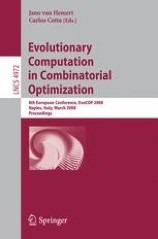
Evolutionary computation in combinatorial optimization ; 8th European Conference, EvoCOP 2008, Naples, Italy, March 26-28, 2008. Proceedings
Metaheuristics have been shown to be e?ective for di?cult combinatorial - timization problems appearing in various industrial, economical, and scientifc domains. Prominent examples of metaheuristics are evolutionary algorithms, tabu search, simulated annealing, scatter search, memetic algorithms, variable neighborhood search, iterated local search, greedy randomized adaptive search procedures, ant colony optimization and estimation of distribution algorithms. Problems solved successfully include scheduling, timetabling, network design, transportation and distribution, vehicle routing, the travelling salesman pr- lem, packing and cutting, satisfability and general mixed integer programming.

Evolutionary Computation for Modeling and Optimization
Evolutionary Computation for Optimization and Modeling is an introduction to evolutionary computation, a field which includes genetic algorithms, evolutionary programming, evolution strategies, and genetic programming. The text is a survey of some application of evolutionary algorithms. It introduces mutation, crossover, design issues of selection and replacement methods, the issue of populations size, and the question of design of the fitness function. It also includes a methodological material on efficient implementation. Some of the other topics in this book include the design of simple evolutionary algorithms, applications to several types of optimization, evolutionary robotics, simple evolutionary neural computation, and several types of automatic programming including genetic programming. The book gives applications to biology and bioinformatics and introduces a number of tools that can be used in biological modeling, including evolutionary game theory. Advanced techniques such as cellular encoding, grammar based encoding, and graph based evolutionary algorithms are also covered.

Evolution of the Web in Artificial Intelligence Environments
The material in this book is designed to be drawn from different Web application areas so as to provide an overview of important contributions in the development of the Web applications. These are mainly in the areas of Web personalisation, semantic Web and Web services.

Evidence-Based Oral Surgery : A Clinical Guide for the General Dental Practitioner
This book is designed to guide the dental practitioner in the medical and surgical management of the oral surgery patient. It provides dentists and dental professionals with up-to-date, evidence-based information on how to handle any oral surgical problem and how to work up a patient.

Evidence-Based Implant Dentistry
Covers all aspects of implant dentistry, presenting up-to-date information that reflects the highest level of scientific evidence as presented in the specialized literature. Among the topics addressed by expert authors are the prognosis of natural tooth versus implant restorations, bone response to implant treatment, placement and loading time, implant design and length, platform design, implant abutments, prosthodontic treatment, reconstructive surgery, and periimplantitis.

Everyday Innovators: Researching the Role of Users in Shaping ICTs
Everyday Innovators explores the active role of people, collectively and individually, in shaping the use of information and communication technologies. It examines issues around acquiring and using that knowledge of users, how we should conceptualise the role of users and understand the forms and limitations of their participation.

Event-Driven Mobile Financial Information Services : Design of an Intraday Decision Support System
In recent years, mobile applications and technologies have become valuable for many companies and their customers. This ongoing trend has affected both businesses and everyday life.Jan Muntermann presents an intraday event study that is conducted within the German capital market, and provides evidence that investors could exploit intraday stock price effects following critical market events. He then develops the concept for a corresponding mobile decision support system that assists investors in identifying those events. Based on the design science research paradigm, he uses this concept in the design of a novel mobile decision support system, which can provide ubiquitous information access to private investors.

Event-Based Programming : Taking Events to the Limit
This book teaches you how to develop software based on parts that interact primarily through an event mechanism. You'll learn how to use events in many different situations, to solve recurring development problems without coupling. The book introduces Signal Wiring Diagram, a novel form of software diagram similar to the circuit diagrams used by hardware designers. The book concludes with a series of case studies, incorporating all featured concepts.

Evaluation of text summaries based on linear optimization of content metrics
Covers both theoretical contributions and practical applications in security system design by applying the Internet of Things (IoT) and CI. It further explains the application of IoT in the design of modern security systems and how IoT blended with computational intel- ligence can make any security system improved and realizable. Key features: Focuses on the computational intelligence techniques of security system design Covers applications and algorithms of discussed computational intelligence techniques Includes convergence-based and enterprise integrated security systems with their applications Explains emerging laws, policies, and tools affecting the landscape of cyber security Discusses application of sensors toward the design of security systems This book will be useful for graduate students and researchers in electrical, computer engineering, security system design and engineering

Evaluation Methods in Biomedical Informatics
This book is a general reference designed for individuals from a broad range of professional backgrounds at various stages of learning about medical information systemsIt attempts to explain why medical information resources should be studied, and why this is a challenging process. It explores the options for conducting such studies, and specifically deciding what topic to study. It also explains how to design, carry out, and interpret a study using a particular set of techniques, how to conduct studies in the context of health care organizations, and how to communicate study designs and study results to the proper audience.

Evaluating competencies : Forensic assessments and instruments
As in its first edition, this book offers a conceptual model for understanding the nature of legal competencies. The model is interpreted to assist mental health professionals in designing and performing assessments for legal competencies defined in criminal and civil law, and to guide research that will improve the practice of evaluations for legal competencies. A special feature is the book's evaluative review of specialized forensic assessment instruments for each of several legal competencies. Three-fourths of the 37 instruments reviewed in the second edition are new and thus were not reviewed in the first edition.

Evaluating clinical research : All that glitters is not gold
The objective of this book is to make its readers better informed and more critical consumers of clinical research to help them recognize the strengths and the weaknesses of scientific publications. In doing so, the reader will be able to distinguish patient-important and methodologically sound studies from those having limitations in design, conduct and interpretation.

European Traditions in Didactics of Mathematics
This book discusses several didactic traditions in mathematics education in countries across Europe, including France, the Netherlands, Italy, Germany, the Czech and Slovakian Republics, and the Scandinavian states. It shows that while they all share common features both in the practice of learning and teaching at school and in research and development, they each have special features due to specific historical and cultural developments. The book also presents interesting historical facts about these didactic traditions, the theories and examples developed in these countries.

Euro-Par 2019 : Parallel Processing Workshops ; Euro-Par 2019 International Workshops, Göttingen, Germany, August 26–30, 2019, Revised Selected Papers
Euro-Par is an annual, international conference in Europe, covering all aspects of parallel and distributed processing. These range from theory to practice, from small to the largest parallel and distributed systems and infrastructures, from fundamental computational problems to full-edged applications, from architecture, compiler, language and interface design and implementation to tools, support infrastructures, and application performance aspects.
