



الصفحة 11
الصفحة 11
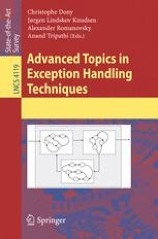
Advanced Topics in Exception Handling Techniques
Modern software systems are becoming more complex in many ways and are having to cope with a growing number of abnormal situations which, in turn, are increasingly complex to handle.This book is composed of five parts; the first four deal with topics related to exception handling in the context of programming languages, concurrency and operating systems, pervasive computing systems, and requirements and specifications. The last part focuses on case studies, experimentation and qualitative comparisons. The 16 coherently written chapters by leading researchers competently address a wide range of issues in exception handling.

Advanced oral surgery
For advanced practitioners who frequently perform oral surgery procedures in their practices and want to update and develop their skills. The book is also aimed at current and prospective specialists in oral and maxillofacial surgery.
Advanced Linear Algebra
The first part of the book contains a careful but rapid discussion of the basics of linear algebra, including vector spaces, linear transformations, quotient spaces, and isomorphism theorems. The author then proceeds to modules, emphasizing a comparison with vector spaces. A thorough discussion of inner product spaces, eigenvalues, eigenvectors, and finite dimensional spectral theory follows, culminating in the finite dimensional spectral theorem for normal operators. The second part of the book is a collection of topics, including metric vector spaces, metric spaces, Hilbert spaces, tensor products, and affine geometry. The last chapter discusses the umbral calculus, an area of modern algebra with many important applications.

Adaptive Techniques for Mixed Signal System on Chip
Adaptive Techniques for Mixed Signal Sytem on Chip discusses the concept of adaptation in the context of analog and mixed signal design along with different adaptive architectures used to control any system parameter. The first part of the book gives an overview of the different elements that are normally used in adaptive designs including tunable elements as well as voltage, current, and time references with an emphasis on the circuit design of specific blocks such as voltage-controlled transconductors, offset comparators, and a novel technique for accurate implementation of on chip resistors. While the first part of the book addresses adaptive techniques at the circuit and block levels, the second part discusses adaptive equalization architectures employed to minimize the impact of ISI (Intersymbol Interference) on the quality of received data in high-speed wire line transceivers. It presents the implementation of a 125Mbps transceiver operating over a variable length of Category 5 (CAT-5) Ethernet cable as an example of adaptive equalizers.
Abstract Computing Machines : A Lambda Calculus Perspective
The book addresses ways and means of organizing computations, highlighting the relationship between algorithms and the basic mechanisms and runtime structures necessary to execute them using machines. It completely abstracts from concrete programming languages and machine architectures, taking instead the lambda calculus as the basic programming and program execution model to design various abstract machines for its correct implementation. The emphasis is on fully normalizing machines based on full-fledged beta-reductions as essential prerequisites for symbolic computations that treat functions and variables truly as first-class objects. Their weakly normalizing counterparts are shown to be functional abstract machines that sacrifice the flavors of full beta-reductions for decidedly simpler runtime structures and improved runtime efficiency. Further downgrading of the lambda calculus leads to classical imperative machines that permit side-effecting operations on the runtime environment.
Abnormal Skeletal Phenotypes : From Simple Signs to Complex Diagnoses
This book focuses on the radiographic changes of malformation syndromes and skeletal dysplasias. It is structured such that the reader can identify the radiographic changes and relate them to specific disease entities. The aim is to provide an essential, practical guideline to the recognition of the key radiographic signs for diagnosing malformation syndromes and skeletal dysplasias.

A History of Parametric Statistical Inference from Bernoulli to Fischer, 1713-1935
This is a history of parametric statistical inference, written by one of the most important historians of statistics of the 20th century, Anders Hald. This book can be viewed as a follow-up to his two most recent books, although this current text is much more streamlined and contains new analysis of many ideas and developments. And unlike his other books, which were encyclopedic by nature, this book can be used for a course on the topic, the only prerequisites being a basic course in probability and statistics.

3D Segmentation for medical images (OsteoVision) = التقطيع ثلاثي الأبعاد للصور الطبية
With the increasing integration of AI across various sectors, artificial intelligence (AI) is already playing a significant role in the healthcare industry, and its use is expected to grow further. AI systems used in image processing and computer vision algorithms have shown a significant ability to perform many operations such as segmentation, classification, and detection. This project presents the application of computer vision algorithms in the field of medical imaging for diagnostic, therapeutic, and interventional purposes. This thesis explores the use of several computer vision algorithms to address different pathologies, specifically brain tumors (glioma) (see Appendix A) and knee osteoarthritis (OA), as well as tracking the progression of knee osteoarthritis using the Kellgren and Lawrence (KL) grading system, a common method for classifying the severity of OA into five grades. To achieve the desired impact, the project employs various techniques, including 3D segmentation for brain tumors, 2D segmentation for knee joints, and multinomial classification for determining the severity of knee OA injuries. The primary aims of the project are to enhance diagnostic accuracy, assist in creating treatment plans, provide an assistive tool for healthcare providers to make more informed decisions, leverage AI's capabilities to detect abnormalities that might escape the human eye, and streamline workflow. To facilitate these goals, the project incorporates a user-friendly UI, a website, and a Flutter-based mobile application, enabling healthcare providers to efficiently integrate these tools into their practice and improve patient care.
