



الصفحة 11
الصفحة 11

An Introduction to Echo Analysis : Scattering Theory and Wave Propagation
The use of various types of wave energy is an increasingly promising, non-destructive means of detecting objects and of diagnosing the properties of quite complicated materials. An analysis of this technique requires an understanding of how waves evolve in the medium of interest and how they are scattered by inhomogeneities in the medium. These scattering phenomena can be thought of as arising from some perturbation of a given, known system and they are analysed by developing a scattering theory. This monograph provides an introductory account of scattering phenomena and a guide to the technical requirements for investigating wave scattering problems.

Alternative pseudodifferential analysis : With an application to modular forms
This volume introduces an entirely new pseudodifferential analysis on the line, the opposition of which to the usual (Weyl-type) analysis can be said to reflect that, in representation theory, between the representations from the discrete and from the (full, non-unitary) series, or that between modular forms of the holomorphic and substitute for the usual Moyal-type brackets. This pseudodifferential analysis relies on the one-dimensional case of the recently introduced anaplectic representation and analysis, a competitor of the metaplectic representation and usual analysis.

Algebraic Theory of Locally Nilpotent Derivations
This book explores the theory and application of locally nilpotent derivations, which is a subject of growing interest and importance not only among those in commutative algebra and algebraic geometry, but also in fields such as Lie algebras and differential equations. The author provides a unified treatment of the subject, beginning with 16 First Principles on which the entire theory is based. These are used to establish classical results, such as Rentschler’s Theorem for the plane, right up to the most recent results, such as Makar-Limanov’s Theorem for locally nilpotent derivations of polynomial rings.

Algebraic Analysis of Differential Equations : from Microlocal Analysis to Exponential Asymptotics Festschrift in Honor of Takahiro Kawai Editors
This volume contains 23 articles on algebraic analysis of differential equations and related topics, most of which were presented as papers at the international conference "Algebraic Analysis of Differential Equations – from Microlocal Analysis to Exponential Asymptotics" at Kyoto University in 2005. Microlocal analysis and exponential asymptotics are intimately connected and provide powerful tools that have been applied to linear and non-linear differential equations as well as many related fields such as real and complex analysis, integral transforms, spectral theory, inverse problems, integrable systems, and mathematical physics. The articles contained here present many new results and ideas, providing interested researchers and students with valuable suggestions and instructive guidance for their work.

Absolute Stability of Nonlinear Control Systems
Following the recent developments in the field of absolute stability, Professor Xiaoxin Liao, in conjunction with Professor Pei Yu, has created a second edition of his seminal work on the subject. Liao begins with an introduction to the Lurie problem and the Lurie control system, before moving on to the simple algebraic sufficient conditions for the absolute stability of autonomous and non-autonomous ODE systems, as well as several special classes of Lurie-type systems. The focus of the book then shifts toward the new results and research that have appeared in the decade since the first edition was published. This includes nonlinear control systems with multiple controls, interval control systems, time-delay and neutral Lurie control systems, systems described by functional differential equations, the absolute stability for neural networks, as well as applications to chaos control and chaos synchronization.
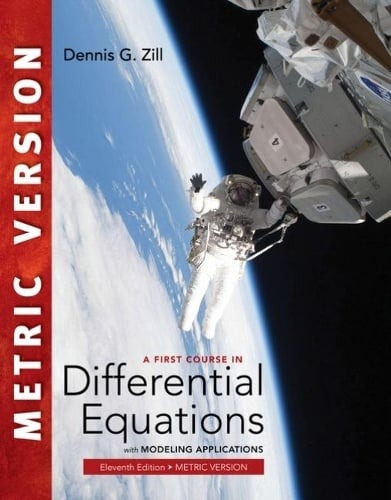
A first course in differential equations with modeling applications
A comprehensive treatment of ordinary differential equations, concisely presenting basic and essential results in a rigorous manner. Including various examples from physics, mechanics, natural sciences, engineering and automatic theory, Differential Equations is a bridge between the abstract theory of differential equations and applied systems theory.

A First Course in Differential Equations
This text is designed for the standard post-calculus course in elementary differential equations. It is a brief, one-semester treatment of the basic ideas, models, and solution methods. The book, which serves as an alternative to existing texts for instructors who want more concise coverage, emphasizes graphical, analytical, and numerical approaches, and is written with clear language in a user-friendly format. It provides students with the tools to continue on to the next level in applying differential equations to problems in engineering, science, and applied mathematics.
A Dressing Method in Mathematical Physics
The monograph is devoted to the systematic presentation of the so called "dressing method" for solving differential equations (both linear and nonlinear) of mathematical physics. The essence of the dressing method consists in a generation of new non-trivial solutions of a given equation from (maybe trivial) solution of the same or related equation.

A Concise Course on Stochastic Partial Differential Equations
Concentrate on (nonlinear) stochastic partial differential equations (SPDE) of evolutionary type. All kinds of dynamics with stochastic influence in nature or man-made complex systems can be modelled by such equations.

A Benchmark Approach to Quantitative Finance
The general framework is used to provide an understanding of the nature of stochastic volatility. The book is intended for a wide audience that includes quantitative analysts, postgraduate students and practitioners in finance, economics and insurance. It aims to be a self-contained, accessible but mathematically rigorous introduction to quantitative finance for readers that have a reasonable mathematical or quantitative background. Finally, the book should stimulate interest in the benchmark approach by describing some of its power and wide applicability.
