



الصفحة 11
الصفحة 11
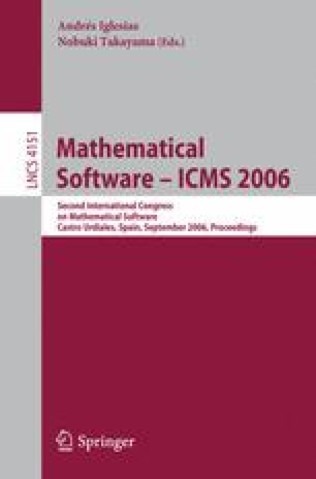
Mathematical Software - ICMS 2006 ; 2nd International Congress on Mathematical Software, Castro Urdiales, Spain, September 1-3, 2006, Proceedings
This volume contains the outstanding collection of invited papers and refereed papers selected for the Second International Congress on Mathematical Software, ICMS 2006, held in Castro Urdiales, Spain, September 1-3, 2006. This congress was devoted to all aspects of mathematical software, whose appearance is — in our opinion — one of the most important events in mathematics. Mathematical software systems are used to construct examples, to prove theorems, and to find new mathematical phenomena. Conversely, mathematical research often motivates developments of new algorithms and new systems. Beyond mathematics, mathematical software systems are becoming indispensable tools in many branches of science and technology.

Mathematical Problems from Applied Logic I : Logics for the XXIst Century
Mathematical Problems from Applied Logic I presents chapters from selected, world renowned, logicians. Important topics of logic are discussed from the point of view of their further development in light of requirements arising from their successful application in areas such as Computer Science and AI language. An overview of the current state as well as open problems and perspectives are clarified in such fields as non-standard inferences in description logics, logic of provability, logical dynamics and computability theory. The book contains interesting contributions concerning the role of logic today, including some unexpected aspects of contemporary logic and the application of logic. This should be of interest to logicians and mathematicians in general.

Mathematical Models of Financial Derivatives
Mathematical Models of Financial Derivatives is a textbook on the theory behind modeling derivatives using the financial engineering approach, focussing on the martingale pricing principles that are common to most derivative securities. A wide range of financial derivatives commonly traded in the equity and fixed income markets are analyzed, emphasizing on the aspects of pricing, hedging and their risk management. Starting from the renowned Black-Scholes-Merton formulation of option pricing model, readers are guided through the text on the new advances on the state-of-the-art derivative pricing models and interest rate models. Both analytic techniques and numerical methods for solving various types of derivative pricing models are emphasized.

Islamic banking and finance
Explores the nature and role of money in modern economies and elaborates on the process of credit deposit creation, trade cycles and instruments for the creation of value in financial markets through the perspectives of Islamic finance. The author explains its characteristics, especially the rationale for the lack of interest-based financial activities. He examines the intrinsic ethical and humanistic frameworks that govern financial theories and practices and the models for the creation of value, risk-sharing and socially responsible investing, as well as the governance and regulation that these systems follow. The author also does a comparative assessment of conventional financial systems with Islamic finance with relevant examples, assesses the performance of Islamic systems and examines existing and expanding markets for Islamic finance.

Irritant Dermatitis
Irritant dermatitis is a common condition, accounting for a significant proportion of occupational skin disease. The recent advent of non-invasive skin bioengineering technology has accelerated dermatology research in this field. This book comprises an exhaustive reference text on irritant contact dermatitis, covering all aspects of the condition.

Iron Nutrition in Plants and Rhizospheric Microorganisms
This book uses an interdisciplinary approach to provide a comprehensive review on the status of iron nutrition in plants. International scientists discuss research on acquisition of iron by strategy I and strategy II plants. These reviews summarize a variety of plant species and include both laboratory and field observations. Topics covered in this book include: plants as a source of iron for animals and humans, iron translocation in the plants, iron-stimulated activities that influence crop yield and fruit tree productivity, iron uptake by plants as influenced by microorganisms (i.e. free living soil microorganisms, symbiotic nitrogen-fixing and pathogenic bacteria), the role of plant hormones in iron transport, iron-metal competition in phytoremediation, root zone activities involving interactions between minerals and organic matter, the role of microbial siderophores in rhizospheric iron cycling, iron storage as phytoferritin, proteomic and metabolic studies associated with iron stress response, methods for studying iron metabolism including stable isotopes, and the correction of iron deficiency through the use of synthetic or natural chelates.

Iron metabolism : Methods and protocols
Explores classical and cutting-edge methods optimized and validated to analyze various aspects of iron metabolism, from in vitro to multi-organ level. Opening with a section on basic iron metabolism methods, the book continues with methods applicable to a variety of systems, ranging from bacteria to cultured mammalian cells and tissues, with a focus on cellular heme and iron-sulfur cluster species, as well as mitochondrial iron and its derivatives. Written for the highly successful Methods in Molecular Biology series, chapters include introductions to their respective topics, lists of the necessary materials and reagents, step-by-step and readily reproducible laboratory protocols, and tips on troubleshooting and avoiding known pitfalls.

Investigations Into the Phenomenology and the Ontology of the Work of Art : What are Artworks and How Do We Experience Them?
This book investigates the nature of aesthetic experience and aesthetic objects. Written by leading philosophers, psychologists, literary scholars and semioticians, the book addresses two intertwined issues. The first is related to the phenomenology of aesthetic experience: The understanding of how human beings respond to artworks, how we process linguistic or visual information, and what properties in artworks trigger aesthetic experiences. The examination of the properties of aesthetic experience reveals essential aspects of our perceptual, cognitive, and semiotic capacities. The second issue studied in this volume is related to the ontology of the work of art: Written or visual artworks are a specific type of objects, containing particular kinds of representation which elicit a particular kind of experience.

Investigating Spoken English : A Practical Guide to Phonetics and Phonology Using Praat
Combining coverage of the key concepts and tools within phonetics and phonology with a systematic introduction to Praat, this textbook provides a lively and engaging 'way in' to the discipline. The author first covers the fundamentals of the articulatory and acoustic aspects of speech and introduces Praat as the main tool for examining and visualising speech. Next, the unit of analysis is gradually expanded (from syllables to words to turns and dialogues) and excerpts of real dialogues exemplify the core concepts for discovering how speech works.

Inverse Problems and Imaging : Lectures given at the C.I.M.E. Summer School held in Martina Franca, Italy September 15–21, 2002
Nowadays we are facing numerous and important imaging problems: nondestructive testing of materials, monitoring of industrial processes, enhancement of oil production by efficient reservoir characterization, emerging developments in noninvasive imaging techniques for medical purposes - computerized tomography (CT), magnetic resonance imaging (MRI), positron emission tomography (PET), X-ray and ultrasound tomography, etc. In the CIME Summer School on Imaging (Martina Franca, Italy 2002), leading experts in mathematical techniques and applications presented broad and useful introductions for non-experts and practitioners alike to many aspects of this exciting field. The volume contains part of the above lectures completed and updated by additional contributions on other related topics: a general presentation and introduction (Moscoso), X-ray tomography (Natterer), Electromagnetic imaging (Dorn, Bertete-Aguirre, Papanicolaou), coherent imaging in telecommunications in a multiple input-multiple output setup (Dorn), polarization based optical imaging (Moscoso), topological derivatives used in shape reconstruction related to inverse scattering problems (Carpio, Rapún), Point interactions (Dell’Antonio, Figari, Teta).

Invasive Plants : Ecological and Agricultural Aspects
The study of plant invasions is the science that attempts to understand causes and consequences of plant introductions outside of their native areas. contributing authors have strived to provide up-to-date reviews and discussions of invasion-related research involving natural and agroecosystems. Readers will get a unique perspective on ecological and agricultural aspects of plant invasions through employing general principles of ecology to plant invasions.

Introduzione alla teoria della misura e all’analisi funzionale = Introduction to measurement theory and functional analysis
Presents a treatment of the theory of measure from an abstract point of view, with particular emphasis on some aspects of interest in probability. The typical arguments of the theory of integration are developed in a rather in-depth way, trying where possible to deduce classical results from the modern setting of the theory as well. The text has a modular structure, with interconnections between the parts: some chapters deal with theoretical aspects, others are dedicated to more applied topics. Alongside the numerous examples, a wide range of exercises is proposed.

Introduzione alla medicina molecolare = Introduction to molecular medicine
An indispensable guide for understanding a young science with rapid and promising developments. Now in its third completely revised edition, it presents in a concise yet comprehensive way the scientific and technological principles of this discipline and provides, in widely accessible language, the basic conceptual tools for understanding the human genome, gene expression and regulation, the various aspects of genetic engineering that allow for the manipulation of DNA, and human cloning.

Introduzione al Calcolo Scientifico : Esercizi e problemi risolti con MATLAB = Introduction to scientific computing : Exercises and problem solved with MATLAB
Introduces the fundamental concepts for the numerical modeling of partial differential problems. We consider the classic linear elliptic, parabolic and hyperbolic equations, but also other equations, such as those of diffusion and transport, of Navier-Stokes, and the conservation laws. Numerous physical examples underlying these equations are provided, their main mathematical properties are studied, then numerical resolution methods based on finite elements, finite differences, finite volumes and spectral methods are proposed and analyzed. In particular, the algorithmic and computer implementation aspects are discussed and some easy-to-use programs in C ++ language are provided. The text does not presuppose an advanced mathematical knowledge of partial differential equations: the strictly indispensable concepts in this regard are reported in the Appendix. THE VOLUME is therefore suitable for students of scientific degree courses (Engineering, Mathematics, Physics, Chemistry, Information Sciences) and recommended for researchers from the academic and extra-academic world who want to approach this interesting branch of applied mathematics.

Introduction to Plane Algebraic Curves
This work treats an introduction to commutative ring theory and algebraic plane curves, requiring of the student only a basic knowledge of algebra, with all of the algebraic facts collected into several appendices that can be easily referred to, as needed.IT focuses on the purely algebraic aspects of plane curve theory, leaving the topological and analytical viewpoints in the background, with only casual references to these subjects and suggestions for further reading.

Introduction to organic and medicinal chemistry
Designed to be an undergraduate reference textbook for students of chemistry who aim to select degree modules geared towards medicinal chemistry. The first two chapters offer an overview of basic organic chemistry, followed by organic synthesis in Chapter 3, with an emphasis on the importance of synthetic procedures in relation to the chemistry of drug design. In Chapter 4, the book covers foundational aspects of biochemistry and biomedical science to provide a basis for students understanding where and how drugs work on selected targets. Later, the book explains how medicines have been created for selected topics in medicinal chemistry – namely against pathogens, cancer and neurological targets.

Introduction to Optics
Since the discovery of the laser in 1960 and optical fibers in 1970, optics has undergone dramatic changes that accentuate its multi-disciplinary character. This text covers essential concepts and reports the key developments and progress in current knowledge in the field. Inspired by the style of Richard Feynman, the method of presentation emphasizes "telling" optics, rather than deducing it from fundamental laws, as well as tactfully using mathematical tools so as not to obscure the physical phenomena of interest. For its excellent teaching approach, the book received the Arnulf-Francon Award of the French Optical Society. The concepts are formulated in a way such that the necessary mathematical tools do not hinder comprehension of the phenomena. Global in vision, the book can also be used as a reference. In addition to the traditional aspects of optics, it includes the tools and methods currently used by researchers and engineers, as well as explanation and implications of the most recent developments.

Introduction to Numerical Methods in Differential Equations
This is a textbook for upper division undergraduates and beginning graduate students. Its objective is that students learn to derive, test and analyze numerical methods for solving differential equations, and this includes both ordinary and partial differential equations. In this sense the book is constructive rather than theoretical, with the intention that the students learn to solve differential equations numerically and understand the mathematical and computational issues that arise when this is done. An essential component of this is the exercises, which develop both the analytical and computational aspects of the material. The importance of the subject of the book is that most laws of physics involve differential equations, as do the modern theories on financial assets.

Introduction to information retrieval
Teaches classical and web information retrieval, including web search and the related areas of text classification and text clustering from basic concepts. It gives an up-to-date treatment of all aspects of the design and implementation of systems for gathering, indexing, and searching documents; methods for evaluating systems; and an introduction to the use of machine learning methods on text collections. All the important ideas are explained using examples and figures, making it perfect for introductory courses in information retrieval for advanced undergraduates and graduate students in computer science.

Introduction to Computational Biology : An Evolutionary Approach
Molecular biology has changed dramatically over the past two decades. Until the early 1990s genes were studied one at a time by small teams of researchers; today entire genomes are sequenced by internationally collaborating laboratories. In the bygone gene-centered era the accumulation of data was the rate-limiting step in research. Now that step is often data interpretation. This is increasingly dependent on computational methods and as a consequence, computational biology has emerged in the past decade as a new subdiscipline of biology. This introduction to computational biology is centered on the analysis of molecular sequence data. There are two closely connected aspects to biological sequences: (i) their relative position in the space of all other sequences, and (ii) their movement through this sequence space in evolutionary time. Accordingly, the first part of the book deals with classical methods of sequence analysis: pairwise alignment, exact string matching, multiple alignment, and hidden Markov models. In the second part evolutionary time takes center stage and phylogenetic reconstruction, the analysis of sequence variation, and the dynamics of genes in populations are explained in detail. In addition, the book contains a computer program with a graphical user interface that allows the reader to experiment with a number of key concepts developed by the authors.
