



الصفحة 10
الصفحة 10

Heat Conduction : Mathematical Models and Analytical Solutions
Many phenomena in social, natural and engineering fields are governed by wave, potential, parabolic heat-conduction, hyperbolic heat-conduction and dual-phase-lagging heat-conduction equations. The focus of the present monograph is on these equations: their solution structures, methods of finding their solutions under various supplementary conditions, as well as the physical implication and applications of their solutions.

Hartree-Fock-Slater Method for Materials Science: The DV-X Alpha Method for Design and Characterization of Materials
Molecular-orbital calculations for materials design such as alloys, ceramics, and coordination compounds are now possible for experimentalists. Molecuar-orbital calculations for the interpretation of chemical effect of spectra are also possible for experimentalists. The most suitable molecular-orbital calculation method for these purpose is the DV-Xa method, which is robust in such a way that the calculation converges to a result even if the structure of the molecule or solid is impossible in the pressure and temperature ranges on earth. This book specially addresses the methods to design novel materials and to predict the spectrallline shape of unknown materials using the DV-Xa molecular-orbital method, but is also useful for those who want to calculate electronic structures of materials using any kind of method.

Hands-On Data Structures and Algorithms with Python : Store, manipulate, and access data effectively ; 3rd ed.
Expands your understanding of key structures, including stacks, queues, and lists, and also show you how to apply priority queues and heaps in applications. You'll learn how to analyze and compare Python algorithms, and understand which algorithms should be used for a problem based on running time and computational complexity. You will also become confident organizing your code in a manageable, consistent, and scalable way, which will boost your productivity as a Python developer. By the end of this Python book, you'll be able to manipulate the most important data structures and algorithms to more efficiently store, organize, and access data in your applications

Handbook of the Sociology of Gender
In this seminal work, the contributors focus on sociological theories and research concerning gender, which are discussed across the full array of social processes, structures and institutions. In each chapter, focus is placed on gender rather than on women alone, and copious cross-national and historical material is utilized in addition to an in-depth focus on contemporary North America.

Handbook of philosophical logic ; Vol. 14
I would like to take this opportunity to put forward my current views about logic in computer science, computational linguistics and arti?cial intelligence. In the early 1980s the perception of the role of logic in computer science was that of a speci?cation and reasoning tool and that of a basis for possibly neat computer languages. The computer scientist was manipulating data structures and the use of logic was one of his options.

Handbook of database security : Applications and trends
The Handbook of Database Security: Applications & Trends, an edited volume by renowned researchers within data security, provides an up-to-date overview of data security models, techniques, and architectures in a variety of data management applications and settings. This edited volume represents the most comprehensive work on numerous data security aspects published in the last ten years.

Handbook of damage mechanics : Nano to macro Scale for materials and structures
A wide range of materials that engineers may encounter are covered, including metals, composites, ceramics, polymers, biomaterials, and nanomaterials. The internationally recognized team of contributors employs a consistent and systematic approach, offering readers a user-friendly reference that is ideal for frequent consultation.

Handbook of advanced magnetic materials : Vol 1 : Nanostructural effects ; Vol 2 : Characterization and simulation ; Vol 3 : Fabrication and processing ; Vol 4 : Properties and applications
The objective of Handbook of Advanced Magnetic Materials is to provide a timely, comprehensive review of recent progress in magnetic materials research. This broad yet detailed reference consists of four volumes: 1.) Nanostructured advanced magnetic materials, 2.) Characterization and simulation of advanced magnetic materials, 3.) Processing of advanced magnetic materials, and 4.) Properties and applications of advanced magnetic materials Emphasis is on the processing, experimental investigation, theoretical understanding, and application of nanostructured magnetic materials. The chapters, authored by worldwide known specialists, provide an introduction into the topics and review the latest advances in magnetic nanostructures and materials. This includes emerging new materials, scientific methods, and experimental techniques. The coverage is very broad and includes nanostructural effects, characterization and simulation, fabrication and processing, and properties and applications of advanced magnetic materials.
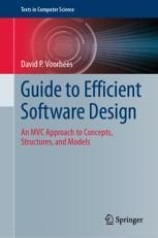
Guide to Efficient Software Design : An MVC Approach to Concepts, Structures, and Models
This classroom-tested textbook presents an active-learning approach to the foundational concepts of software design. These concepts are then applied to a case study, and reinforced through practice exercises, with the option to follow either a structured design or object-oriented design paradigm. The text applies an incremental and iterative software development approach, emphasizing the use of design characteristics and modeling techniques as a way to represent higher levels of design abstraction, and promoting the model-view-controller (MVC) architecture.

Guide to Biomolecular Simulations
Molecular dynamics simulations have become instrumental in replacing our view of proteins as relatively rigid structures with the realization that they were dynamic systems, whose internal motions play a functional role. Over the years, such simulations have become a central part of biophysics. Applications of molecular dynamics in biophysics range over many areas. They are used in the structure determination of macromolecules with x-ray and NMR data, the modelling of unknown structures from their sequence, the study of enzyme mechanisms, the estimation of ligand-binding free energies, the evaluation of the role of conformational change in protein function, and drug design for targets of known structures.

Groups of Galaxies in the Nearby Universe ; Proceedings of the ESO Workshop held at Santiago de Chile, December 5 - 9, 2005
In the cosmological context, groups trace large-scale structures better than clusters, and the evolution of groups and clusters appears to be related. All these aspects of research on groups of galaxies are summarized in this book.

Groupes et algèbres de Lie : Chapitres 4 à 6 = Lie groups and algebras : Chapters 4 to 6
Nicolas BOURBAKI's Elements of Mathematics aim to provide a rigorous, systematic presentation without prerequisites of mathematics from their foundations.This third volume of the Book on Groups and Lie Algebras, ninth Book of the treatise, is devoted to the structures of root systems , Coxeter groups and Tits systems, which appear naturally in the study of analytic or algebraic Lie groups

Ground improvement and reinforced soil structures ; Proceedings of Indian Geotechnical Conference 2020 Vol. 2
This volume comprises the select proceedings of the Indian Geotechnical Conference (IGC) 2020. The contents focus on recent developments in geotechnical engineering for sustainable tomorrow. The volume covers the topics related advances in ground improvement of weak foundation soils for various civil engineering projects and design/construction of reinforced soil structures with different fill materials using synthetic and natural reinforcements in different forms.

Grid Middleware and Services : Challenges and Solutions
This book aims to strengthen and advance scientific and technological excellence in the area of Grid Computing. The main focus in this volume is on Grid middleware and service level agreement.Grid middleware and Grid services are two pillars of grid computing systems and applications. This book includes high-level contributions by leading researchers in both areas and presents current solutions together with future challenges. This volume includes sections on knowledge and data management on grids, Grid resource management and scheduling, Grid information, resource and workflow monitoring services, and service level agreements.

Grid computing : Achievements and prospects
Grid Computing: Achievements and Prospects, the 9th edited volume of the CoreGRID series, includes selected papers from the CoreGRID Integration Workshop, held April 2008 in Heraklion-Crete, Greece. This event brings together representatives of the academic and industrial communities performing Grid research in Europe. The workshop was organized in the context of the CoreGRID Network of Excellence in order to provide a forum for the presentation and exchange of views on the latest developments in grid technology research.

Graph-theoretic concepts in computer science ; 34th International Workshop, WG 2008, Durham, UK, June 30 – July 2, 2008. Revised Papers
This book constitutes the thoroughly refereed post-conference proceedings of the 34th International Workshop on Graph-Theoretic Concepts in Computer Science, WG 2008, held in Durham, UK, in June/July 2008.The 30 revised full papers presented together with 3 invited paper were carefully reviewed and selected from 76 submissions. The papers feature original results on all aspects of graph-theoretic concepts in Computer Science, e.g. structural graph theory, sequential, parallel, and distributed graph and network algorithms and their complexity, graph grammars and graph rewriting systems.

Graphs, Dioids and Semirings : New Models and Algorithms
The primary objectives of GRAPHS, DIOÏDS AND SEMIRINGS: New Models and Algorithms are to emphasize the deep relations existing between the semiring and dioïd structures with graphs and their combinatorial properties, while demonstrating the modeling and problem-solving capability and flexibility of these structures. In addition the book provides an extensive overview of the mathematical properties employed by "nonclassical" algebraic structures, which either extend usual algebra (i.e., semirings), or correspond to a new branch of algebra (i.e., dioïds), apart from the classical structures of groups, rings, and fields.

Graph-based representations in pattern recognition ; 6th IAPR-TC-15 International Workshop, GbRPR 2007, Alicante, Spain, June 11-13, 2007, Proceedings
Constitutes the refereed proceedings of the 6th IAPR-TC-15 International Workshop on Graph-Based Representations in Pattern Recognition, GbRPR 2007, held in Alicante, Spain in June 2007.

Graph Transformations ; 4th International Conference, ICGT 2008, Leicester, United Kingdom, September 7-13, 2008. Proceedings
This book constitutes the refereed proceedings of the 4th International Conference on Graph Transformations, ICGT 2008, held in Leicester, UK, in September 2008.The 27 revised full papers presented together with 5 tutorial and workshop papers and 3 invited lectures were carefully selected from 57 submissions. All current aspects in graph drawing are addressed including hypergraphs and termgraph rewriting, applications of graph transformation, execution of graph transformations, compositional systems, validation and verification, graph languages and special transformation concepts, as well as patterns and model transformations.
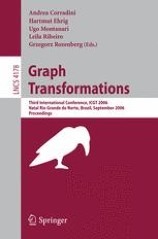
Graph Transformations ; 3rd International Conference, ICGT 2006, Rio Grande do Norte, Brazil, September 17-23, 2006, Proceedings
ICGT 2006 was the 3rd International Conference on Graph Transformation, following the previous two in Barcelona (2002) and Rome (2004), and a series of six international workshops between 1978 and 1998. The scope of the conference concerned graphical structures of various kinds (like graphs, diagrams and visual sentences) that are useful when describing complex structures and systems in a direct and intuitive way. These structures are often enriched with formalisms that model their evolution via suitable kinds of transformations. The ?eld of the conference was concerned with the theory, applications, and implementation issues of such formalisms. Particularemphasis wasputonmetamodelswhichcanaccommodateavarietyofgraphicalstructures within the same abstract theory.
