



الصفحة 10
الصفحة 10
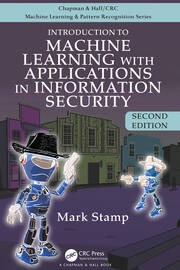
Introduction to Machine Learning with Applications in Information Security
Provides a classroom-tested introduction to a wide variety of machine learning and deep learning algorithms and techniques, reinforced via realistic applications. The book is accessible and doesn't prove theorems, or dwell on mathematical theory. The goal is to present topics at an intuitive level, with just enough detail to clarify the underlying concepts. The book covers core classic machine learning topics in depth, including Hidden Markov Models (HMM), Support Vector Machines (SVM), and clustering. Additional machine learning topics include k-Nearest Neighbor (k-NN), boosting, Random Forests, and Linear Discriminant Analysis (LDA). The fundamental deep learning topics of backpropagation, Convolutional Neural Networks (CNN), Multilayer Perceptrons (MLP), and Recurrent Neural Networks (RNN) are covered in depth. A broad range of advanced deep learning architectures are also presented, including Long Short-Term Memory (LSTM), Generative Adversarial Networks (GAN), Extreme Learning Machines (ELM), Residual Networks (ResNet), Deep Belief Networks (DBN), Bidirectional Encoder Representations from Transformers (BERT), and Word2Vec.

Introduction to Empirical Processes and Semiparametric Inference
This book provides a self-contained, linear, and unified introduction to empirical processes and semiparametric inference. These powerful research techniques are surprisingly useful for developing methods of statistical inference for complex models and in understanding the properties of such methods. The targeted audience includes statisticians, biostatisticians, and other researchers with a background in mathematical statistics who have an interest in learning about and doing research in empirical processes and semiparametric inference but who would like to have a friendly and gradual introduction to the area. The book can be used either as a research reference or as a textbook. The level of the book is suitable for a second year graduate course in statistics or biostatistics, provided the students have had a year of graduate level mathematical statistics and a semester of probability.

Introduction to Central Banking
This book gives a concise introduction to the practical implementation of monetary policy by modern central banks. It describes the conventional instruments used in advanced economies and the unconventional instruments that have been widely adopted since the financial crisis of 2007–2008. Illuminating the role of central banks in ensuring financial stability and as last resort lenders, it also offers an overview of the international monetary framework. A flow-of-funds framework is used throughout to capture this essential dimension in a consistent and unifying manner, providing a unique and accessible resource on central banking and monetary policy, and its integration with financial stability.

Introduction to applied mathematics for environmental science
Introduction to Mathematics for Environmental Science evolved from the author’s 30 years’ experience teaching mathematics to graduate and advanced undergraduate students in the environmental sciences. Its basic purpose is to teach various types of mathematical structures and how they can be applied in a broad range of environmental science subfields. Derivatives and integrals, ordinary and partial differential equations, and linear and non-linear algebraic equations are the basic kinds of structures (types of mathematical models) discussed.

Introduction to Algorithms
Combines rigor and comprehensiveness. The book covers a broad range of algorithms in depth, yet makes their design and analysis accessible to all levels of readers. Each chapter is relatively self-contained and can be used as a unit of study. The algorithms are described in English and in a pseudocode designed to be readable by anyone who has done a little programming. The explanations have been kept elementary without sacrificing depth of coverage or mathematical rigor. The first edition became a widely used text in universities worldwide as well as the standard reference for professionals. The second edition featured new chapters on the role of algorithms, probabilistic analysis and randomized algorithms, and linear programming.

Internet and Network Economics ; Vol. 4286 ; 2nd International Workshop, WINE 2006, Patras, Greece, December 15-17, 2006, Proceedings
Constitutes the refereed proceedings of the Second International Workshop on Internet and Network Economics, WINE 2006, held in Patras, Greece in December 2006. The 32 revised full papers presented together with 3 invited talks were carefully reviewed and selected from 79 submissions. The papers contain foundational and mathematical work from theories, methodologies, and applications in computer science, economics, mathematics, and management sciences for solving problems arisen in internet technologies, grid computing, network communication protocols, as well as social economic issues in virtual communities enabled through the World Wide Web.

International Symposium on Mathematics, Quantum Theory, and Cryptography ; Proceedings of MQC 2019
This book presents selected papers from International Symposium on Mathematics, Quantum Theory, and Cryptography (MQC), which was held on September 25-27, 2019 in Fukuoka, Japan.

International comparative studies in mathematics : Lessons for improving students’ learning
It argues that the main purpose of educational research is to improve student learning, and that international comparative studies are no exception.

Intermediate Dynamics : A Linear Algebraic Approach
As the name implies, Intermediate Dynamics: A Linear Algebraic Approach views "intermediate dynamics"--Newtonian 3-D rigid body dynamics and analytical mechanics--from the perspective of the mathematical field.

Interest Rate Models : an Infinite Dimensional Stochastic Analysis Perspective
Interest Rate Models: an Infinite Dimensional Stochastic Analysis Perspective studies the mathematical issues that arise in modeling the interest rate term structure. These issues are approached by casting the interest rate models as stochastic evolution equations in infinite dimensions. The book is comprised of three parts. Part I is a crash course on interest rates, including a statistical analysis of the data and an introduction to some popular interest rate models. Part II is a self-contained introduction to infinite dimensional stochastic analysis, including SDE in Hilbert spaces and Malliavin calculus. Part III presents some recent results in interest rate theory, including finite dimensional realizations of HJM models, generalized bond portfolios, and the ergodicity of HJM models.

Interacting Stochastic Systems
The Research Network on "Interacting stochastic systems of high complexity" set up by the German Research Foundation aimed at exploring and developing connections between research in infinite-dimensional stochastic analysis, statistical physics, spatial population models from mathematical biology, complex models of financial markets or of stochastic models interacting with other sciences. This book presents a structured collection of papers on the core topics, written at the close of the 6-year programme by the research groups who took part in it. The structure chosen highlights the interweaving of certain themes and certain interconnections discovered through the joint work.
Intelligent Techniques and Tools for Novel System Architectures
Provides a source wherein academics, researchers and practitioners may derive high-quality, original and state-of-the-art papers describing theoretical aspects, systems architectures, analysis and design tools and techniques, and implementation experiences in intelligent systems where information and knowledge management should be mainly characterised as a net-centric infrastructure riding on the fifth wave of "distributed intelligence".
Intelligent Interactive Systems in Knowledge-Based Environments
The main aim of this research book is to report a sample of the most recent advances in the field of intelligent interactive systems in knowledge-based environment.
Intelligent Distributed Computing, Systems and Applications ; Proceedings of the 2nd International Symposium on Intelligent Distributed Computing – IDC 2008, Catania, Italy, 2008
Addresses many topics related to intelligent and distributed computing, systems and applications, including: adaptivity and learning; agents and multi-agent systems; argumentation; auctions; case-based reasoning; collaborative systems; data structures; distributed algorithms; formal modeling and verification; genetic and immune algorithms; grid computing; information extraction, annotation and integration; network and security protocols; mobile and ubiquitous computing; ontologies and metadata; P2P computing; planning; recommender systems; rules; semantic Web; services and processes; trust and social computing; virtual organizations; wireless networks; XML technologies.
Intelligent Computer Mathematics ; 9th International Conference, AISC 2008, 15th Symposium, Calculemus 2008, 7th International Conference, MKM 2008, Birmingham, UK, July 28 - August 1, 2008. Proceedings
This book constitutes the joint refereed proceedings of the 9th International Conference on Artificial Intelligence and Symbolic Computation, AISC 2008, the 15th Symposium on the Integration of Symbolic Computation and Mechanized Reasoning, Calculemus 2008, and the 7th International Conference on Mathematical Knowledge Management, MKM 2008, held in Birmingham, UK, in July/August as CICM 2008, the Conferences on Intelligent Computer Mathematics.

Intelligent Algorithms for Packing and Cutting Problem
Introduces intelligent solving algorithms for classical packing and cutting problem and their variants / Investigates novel methods, e.g. reinforcement learning algorithms, for rectangular and irregular packing problems / Presents practical engineering application cases in combination of theory and practice / investigates in detail the two-dimensional packing and cutting problems in the field of operations research and management science. It introduces the mathematical models and intelligent solving algorithms for these problems, as well as their engineering applications. Most intelligent methods reported in this book have already been applied in reality, which can provide reference for the engineers. The presented novel methods for the two-dimensional packing problem provide a new way to solve the problem for researchers interested in operations research or computer science. This book also introduces three new variants of packing problems and their solving methods, which offer a different research direction.
Intelligence and security informatics : Techniques and applications
This book, INTELLIGENCE and SECURITY INFORMATICS: TECHNIQUES & APPLICATIONS, presents a collection of works discussing terrorism informatics, information sharing, data mining, intelligence and crime analysis, infrastructure protection, privacy protection, information surveillance, and emergency response.

Integration of AI and OR Techniques in Constraint Programming for Combinatorial Optimization Problems ; Vol.3524 : 2nd International Conference, CPAIOR 2005, Prague, Czech Republic, May 31 -- June 1, 2005
Intended primarily as a forum to focus on the integration and hybridization of the approaches of constraint programming (CP), arti?cial intelligence (AI), and operations research (OR) technologies for solving large-scale and complex real-life optimization problems. Therefore, CPAIOR is never far from industrial applications. The high number of submissions received this year, almost 100 papers, in witness to the interest of the research community in this conference. From these submissions, we chose 26 to be published in full in the proceedings. This volume includes summaries of the invited talks of CPAIOR: one from industry, one from the embedded system research community, and one from the operations research community.

Integrated Methods for Optimization
Integrated Methods for Optimization integrates the key concepts of Mathematical Programming and Constraint Programming into a unified framework that allows them to be generalized and combined. The unification of MP and CP creates optimization methods that have much greater modeling power, increased computational speed, and a sizeable reduction computational coding. Hence the benefits of this integration are substantial, providing the Applied Sciences with a powerful, high-level modeling solution for optimization problems. As reviewers of the book have noted, this integration along with constraint programming being incorporated into a number of programming languages, brings the field a step closer to being able to simply state a problem and having the computer solve it.
Integral Methods in Science and Engineering : Theoretical and Practical Aspects
The quantitative and qualitative study of the physical world makes use of many mathematical models governed by a great diversity of ordinary, partial differential, integral, and integro-differential equations. An essential step in such investigations is the solution of these types of equations, which sometimes can be performed analytically, while at other times only numerically. This edited, self-contained volume presents a series of state-of-the-art analytic and numerical methods of solution constructed for important problems arising in science and engineering, all based on the powerful operation of (exact or approximate) integration.It covers a wide variety of topics, from the theoretical development of boundary integral methods to the application of integration-based analytic and numerical techniques that include integral equations, finite and boundary elements, conservation laws, hybrid approaches, and other procedures.
