



الصفحة 10
الصفحة 10

Medical biotechnology, biopharmaceutics, forensic : science and bioinformatics
Covers a range of topics on exploiting Nigeria’s mega biodiversity for food security and health; DNA forensic science and its applications; medical biotechnology and biopharmaceutics; medicinal and underutilized plants; impact and mitigation of antibiotic resistance; bioinformatics applications; medical insect biotechnology; etc. The book will be useful reference material for the scientists and researchers working in the fields of nutraceuticals, molecular diagnostics and DNA forensics, biopharmaceuticals and medical biotechnology, nanotechnology, antimicrobials from indigenous plant species, bioinformatics, etc.

Meat Biotechnology
The main goal of this book is to provide the reader with the recent developments in biotechnology and their applications in the meat processing chain. To achieve this goal, the book is divided into four parts. The first part deals with the use of modern biotechnology applied to farm animals. The second part focuses on the recent biotechnological developments in starter cultures for better meat fermentation. The third part discusses current approaches to improve the quality and nutritional properties of meats. The final part presents the latest advances in protection against foodborne pathogens, and other recent trends in the field. Written by distinguished international contributors, this book brings together the advances in such varied and different biotechnological topics

Introduction to Ion Beam Biotechnology
It presents treatment of modern ion beam biotechnology and with respect to applications of ion beam bombardment of living cellular material in the hybrid field of ion beam physics and biology.Key Topics include: – Ion beam formation – Ion implantation fundamentals – Interaction between energetic ions and biological organisms – Reaction processes of ion implanted biological small molecules – Damage and repair of ion-bombarded DNA – Cell damage due to ion bombardment – Biological effects of ion implantation – Fundamentals of ion-bombardment-induced genetic variation – Ion beam mutation breeding of crops – Ion beam mutation breeding of microbes – Ion beam induced gene transfer – Ion beam induced synthesis of organic molecules – Single-ion bombardment mutation of cells

Intelligent drugs : How AI is transforming healthcare
The progress of biotechnologies and artificial intelligence allowed the development of vaccines in less than a year, thus saving millions of human lives and preserving the global economy. The emergence of intelligent drugs is highlighted, with the promise of ultra-targeted, more effective, and safer treatments against a wide range of diseases. Personalized medicine then becomes realistic, with computer-designed drugs, perfectly adapted to each individual, tested on virtual patients before their real use. In the near future, thanks to AI, new drugs will improve physical performance, stimulate cognitive abilities, prevent diseases, and slow down aging.

Information Technologies in Biomedicine
As the medical information systems have been integrated in order to address the core of medicine, including patient care in ambulatory and in-patient setting, computer assisted diagnosis and treatment, telemedicine, and home care we are witnessing radical changes in the Information Technologies. This will continue in the years to come. This book presents a comprehensive study in this field and contains carefully selected articles contributed by experts of information technologies.

Industrial enzymes : Structure, function and applications
Man's use of enzymes dates back to the earliest times of civilization. Important human activities such as the production of certain types of foods and beverages, and the tanning of hides and skins to produce leather for garments, serendipitously took advantage of enzyme activities. Important advances in our understanding of the nature of enzymes and their action were made in the late 19th and early 20th centuries, seeding the explosive expansion from the 1950s and 60s onward to the present billion dollar enzyme industry. Recent developments in the fields of genetic engineering and protein chemistry are bringing ever more powerful means of analysis to bear on the study of enzyme structure and function that will undoubtedly lead to the rational modification of enzymes to match specific requirements as well as the design of new enzymes with novel properties.

Industrial enzyme applications
This reference is a "must-read": It explains how an effective and economically viable enzymatic process in industry is developed and presents numerous successful examples which underline the efficiency of biocatalysis.
In Vitro Culture of Mycorrhizas
biologists have made important progress in understanding better the functioning of AM fungi. An in vitro technique has been developed using mycorrhizal root organ cultures, which made it possible to investigate the genetics, cell biology and physiology of AM fungi. We can now be objective enough to critically evaluate the impacts the in vitro technique has had to improve our knowledge on mycorrhizal symbiosis.

In Silico Dreams : How Artificial Intelligence and Biotechnology Will Create the Medicines of the Future
In Silico Dreams: How Artificial Intelligence and Biotechnology Will Create the Medicines of the Future delivers an illuminating and fresh perspective on the convergence of two powerful technologies: AI and biotech. Accomplished genomics expert, executive, and author Brian Hilbush offers readers a brilliant exploration of the most current work of pioneering tech giants and biotechnology startups who have already started disrupting healthcare.
Improvement of Crop Plants for Industrial End Uses
This book provides concerns useful to promote an increase of the productivity of crops by using functional genomics (to understand the regulation of plant metabolism at molecular, cellular and whole plants), and the improvement of photosynthetic efficiency (to design new plants with enhanced raw materials percent and recovery).

Immunity boosting medicinal plants of the Western Himalayas
Presents a comprehensive guide to traditional immunity-boosting medicinal plants of the Himalayas, their traditional uses, phytochemistry, pharmacology, diversity, conversation, biotechnology, toxicology, as well as future prospective. All the chapters cover the latest advances in ethnobotany, phytochemistry, biochemistry, and biotechnology.
Hydrogels : Design, Synthesis and Application in Drug Delivery and Regenerative Medicine
Hydrogels are crosslinked, macromolecular polymeric materials arranged in a three-dimensional network, which can absorb and retain large amounts of water. Hydrogels are commonly used in clinical practice and experimental medicine for a wide range of applications, including drug delivery, tissue engineering and regenerative medicine, diagnostics, cellular immobilization, separation of biomolecules or cells, and barrier materials to regulate biological adhesions.

Homology modeling : Methods and protocols
It Provides state-of-the-art methodologies and reviews of important topics in the field of homology modeling. From homology modeling in the twilight zone and improving accuracy through sequence space analysis to approaches to construct multi-protein complex models, the book explores a wide variety of uses and applications of this valuable technique.

Heterologous protein production in CHO cells : Methods and protocols
Explores the use of Chinese hamster ovary (CHO) cells in the production of therapeutic protein products. Beyond updates on earlier methodologies, the book also delves into the genetic manipulation of CHO cells for recombinant protein production, analysis of CHO cells using proteomic and metabolomic approaches, as well as methods for the characterization of recombinant protein products, such as glycosylation and host cell protein analysis.

Herbal pharmacopeia : Nanotechnology and advancing drug
Explores the intersection between traditional herbal medicine and cutting-edge nanotechnology. The chapters introduce modern techniques used in herbal extraction and analysis. The principles of drug discovery from plants are discussed, with a focus on the identification and development of bioactive compounds that have therapeutic potential. It discusses the pharmacological properties, biotechnological approaches in drug development, and challenges in the formulation and standardization of herbal medicines. Emerging trends and applications of nanotechnology in herbal pharmacotherapy, such as nanoparticle synthesis, enhanced bioavailability using nanocarriers, safety assessments, novel and targeted delivery systems, and regulatory considerations, are thoroughly discussed. Additionally, it includes a comparative analysis of traditional and nano-formulated approaches and their implementation in clinical settings. Towards the end, the book reviews the regulatory considerations for herbal products and future perspectives in herbal pharmacopeia. This book is intended for researchers, clinicians, and professionals in herbal medicine, pharmacology, and nanotechnology.

Handbook of research on nano-drug delivery and tissue engineering : Guide to strengthening healthcare systems
Provides an important and valuable collection of research accomplishments in nanomedicine, drug delivery, tissue engineering, processing, formulations, and their applications. Addresses topical issues in nano-drug delivery and nanotechnological approaches to tissue engineering. The first section offers research on a variety of diverse nano-based drug delivery systems, along with discussions of their efficacy, safety, toxicology, and applications for different purposes. Focusing on nanotechnology approaches to tissue engineering, part two of the volume considers the use of hydrogel systems, nanoceria and micro- and nano-structured biomaterials for bone tissue engineering, mesenchymal stem cells, and more. This volume is a systematic scientific reference of the novel research developments specifically in this area. The editors give special emphasis on the new trends and developments in the field of nanomedicine that will be very helpful for pharmaceutical and medical researchers, scientists, faculty, and students.
Handbook of Bioentrepreneurship
Providing an important and timely overview of research in the field of entrepreneurship in biotechnology, The Handbook of Bioentrepreneurship examines one of the most promising industries of the 21st century. While genetically engineered foods and biopharmaceuticals have made biotechnology part of our everyday lives, launching a bioventure is among the most complex and risky entrepreneurial undertakings, given long development cycles, high levels of technological and market uncertainty, and extraordinary capital requirements. Featuring unparalleled, in-depth analysis from experts around the world, the Handbook sheds light on emerging business models and strategies, geographical and regional networks, cooperation between firms and universities, legal frameworks, and policy issues that influence the context in which biotech ventures are established and the conditions under which they may flourish. biotechnology.
Handbook of Biochips : Integrated Circuits and Systems for Biology and Medicine
This book provides a broad survey of the field of biochips, including fundamentals of microelectronics and biomaterials interaction with various, living tissues, as well as numerous, diverse applications. Although a wide variety of biochips will be described, there will be a focus on those at the brain-machine interface. Analysis is included of the relationship between different categories of biochips and their interactions with the body and coverage includes wireless remote control of biochips and arrays of microelectrodes, based on new biomaterials.

Green gene technology : Research in an area of social conflict
Green gene technology(GGT), understood as apart of modernbiotechnology, has been on a steady, triumphal progression over the last ten years (ISAAA 2007, see thecontribution byEinsele in thisissue). This volume, jointly edited byProf. Fiechterandme, dealswithsomeactualscienti?candsocio-economic aspects with regard to genetically modi?ed plants (GMP). Worldwide more than 100 million hectares of agronomical land are covered by GMP. This - cludes some prominent industrialised Western countries like the USA and Canada, aseriesofthresholdcountrieslikeArgentina, Brazil, IndiaandChina, and a number of developing countries.
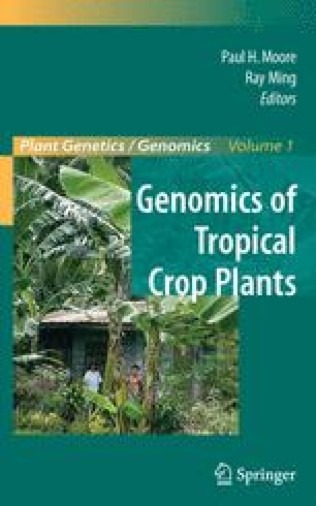
Genomics of Tropical Crop Plants
Genomics of Tropical Crop Plants summarizes recent progress on genomic research, including the development of molecular markers, genomic and cDNA libraries, expressed sequence tags (ESTs), genetic and physical maps, gene expression profiles, and whole genome sequences for 20 tropical crop plants. It offers background information about the evolutionary origin and environments of tropical crop species, international programs that are addressing the needs of tropical agriculture, and the potential for new technologies to increase the productivity and value of tropical crops. This book provides new dimensions to growing information concerning temperate crops and their morphology, physiology, and parallel evolution in diverse plant lineages.
