


تحسين النتائح
ترتيب حسب
من
الى

This book is an elementary introduction to stable maps and quantum cohomology, starting with an introduction to stable pointed curves, and culminating with a proof of the associativity of the quantum product. The viewpoint is mostly that of enumerative geometry, and the red thread of the exposition is the problem of counting rational plane curves. Kontsevich's formula is initially established in the framework of classical enumerative geometry, then as a statement about reconstruction for Gromov–Witten invariants, and finally, using generating functions, as a special case of the associativity of the quantum product.
The geometric interpretation of gravitation is one of the major foundations of modern theoretical physics. This primer introduces classical general relativity with emphasis on the clarity of conceptual structure and on the basic mathematical methods to build up systematically application skills. The wealth of physical phenomena entailed by the Einstein‘s equations is revealed with the help of specific models describing gravitomagnetism, gravitational waves, cosmology, gravitational collapse and black holes. End-of-chapter exercises complete the main text.
This book provides an introduction to the basics of sub-Riemannian differential geometry and geometric analysis in the Heisenberg group, focusing primarily on the current state of knowledge regarding Pierre Pansu's celebrated 1982 conjecture regarding the sub-Riemannian isoperimetric profile.
This textbook gives an introduction to all three classes of geometry optimization problems of mechanical structures: sizing, shape and topology optimization. The style is explicit and concrete, focusing on problem formulations and numerical solution methods. The treatment is detailed enough to enable readers to write their own implementations. On the book's homepage, programs may be downloaded that further facilitate the learning of the material covered.
This book gives an introduction to modern geometry. Starting from an elementary level the author develops deep geometrical concepts, playing an important role nowadays in contemporary theoretical physics. He presents various techniques and viewpoints, thereby showing the relations between the alternative approaches.
Manifolds, the higher-dimensional analogs of smooth curves and surfaces, are fundamental objects in modern mathematics. Combining aspects of algebra, topology, and analysis, manifolds have also been applied to classical mechanics, general relativity, and quantum field theory. In this streamlined introduction to the subject, the theory of manifolds is presented with the aim of helping the reader achieve a rapid mastery of the essential topics. By the end of the book the reader should be able to compute, at least for simple spaces, one of the most basic topological invariants of a manifold, its de Rham cohomology. Along the way the reader acquires the knowledge and skills necessary for further study of geometry and topology.
Interestingly, notions that pertain to di?erential geometry per se,suchas covariant derivatives of tensor ?elds, are also introduced in Chapters 3 and 4, where they appear most naturally in the derivation of the basic boundary value problems of three-dimensional elasticity and shell theory.
The algorithmic problems of real algebraic geometry such as real root counting, deciding the existence of solutions of systems of polynomial equations and inequalities, finding global maxima or deciding whether two points belong in the same connected component of a semi-algebraic set appear frequently in many areas of science and engineering. In this first-ever graduate textbook on the algorithmic aspects of real algebraic geometry, the main ideas and techniques presented form a coherent and rich body of knowledge, linked to many areas of mathematics and computing.
Robot algorithms are abstractions of computational processes that control or reason about motion and perception in the physical world. Because actions in the physical world are subject to physical laws and geometric constraints, the design and analysis of robot algorithms raises a unique combination of questions in control theory, computational and differential geometry, and computer science. Algorithms serve as a unifying theme in the multi-disciplinary field of robotics. This volume consists of selected contributions to the sixth Workshop on the Algorithmic Foundations of Robotics. This is a highly competitive meeting of experts in the field of algorithmic issues related to robotics and automation.
Sesquilinear and quadratic forms : The Mathematics Elements of Nicolas BOURBAKI aim to provide a rigorous, systematic presentation without prerequisites of mathematics from their foundations. This ninth chapter of the Book of Algebra, the second Book of the treatise, is devoted to quadratic, symplectic or Hermitian forms and to associated groups.
Depth, Regularity, Duality The Mathematics Elements of Nicolas BOURBAKI aim to provide a rigorous, systematic presentation without prerequisites of mathematics from their foundations. This volume of the Book of Commutative Algebra, Book 7 of the treatise, is a continuation of the earlier chapters. It introduces in particular the notions of depth and smoothness, fundamental in algebraic geometry. It ends with the introduction of the dualizing modules and the Grothendieck duality.

The Mathematics Elements of Nicolas BOURBAKI aim to provide a rigorous, systematic presentation without prerequisites of mathematics from their foundations.This second volume of the Book of Commutative Algebra, Seventh Book of the treatise, introduces two fundamental notions in commutative algebra, that of algebraic integer and that of valuation, which have many applications in number theory and algebraic geometry.

This book explores the theory and application of locally nilpotent derivations, which is a subject of growing interest and importance not only among those in commutative algebra and algebraic geometry, but also in fields such as Lie algebras and differential equations. The author provides a unified treatment of the subject, beginning with 16 First Principles on which the entire theory is based. These are used to establish classical results, such as Rentschler’s Theorem for the plane, right up to the most recent results, such as Makar-Limanov’s Theorem for locally nilpotent derivations of polynomial rings.
A self-contained introduction to algebraic control for nonlinear systems suitable for researchers and graduate students.The most popular treatment of control for nonlinear systems is from the viewpoint of differential geometry yet this approach proves not to be the most natural when considering problems like dynamic feedback and realization. Professors Conte, Moog and Perdon develop an alternative linear-algebraic strategy based on the use of vector spaces over suitable fields of nonlinear functions. This algebraic perspective is complementary to, and parallel in concept with, its more celebrated differential-geometric counterpart.Algebraic Methods for Nonlinear Control Systems describes a wide range of results, some of which can be derived using differential geometry but many of which cannot.
One of the most creative mathematicians of our times, Vladimir Drinfeld received the Fields Medal in 1990 for his groundbreaking contributions to the Langlands program and to the theory of quantum groups.These ten original articles by prominent mathematicians, dedicated to Drinfeld on the occasion of his 50th birthday, broadly reflect the range of Drinfeld's own interests in algebra, algebraic geometry, and number theory.
Algebraic Geometry provides an impressive theory targeting the understanding of geometric objects defined algebraically. Geometric Modeling uses every day, in order to solve practical and difficult problems, digital shapes based on algebraic models. In this book, we have collected articles bridging these two areas. The confrontation of the different points of view results in a better analysis of what the key challenges are and how they can be met. We focus on the following important classes of problems: implicitization, classification, and intersection. The combination of illustrative pictures, explicit computations and review articles will help the reader to handle these subjects.

The book starts with easily-formulated problems with non-trivial solutions – for example, Bézout’s theorem and the problem of rational curves – and uses these problems to introduce the fundamental tools of modern algebraic geometry: dimension; singularities; sheaves; varieties; and cohomology. The treatment uses as little commutative algebra as possible by quoting without proof (or proving only in special cases) theorems whose proof is not necessary in practice, the priority being to develop an understanding of the phenomena rather than a mastery of the technique. A range of exercises is provided for each topic discussed, and a selection of problems and exam papers are collected in an appendix to provide material for further study.
The present textbook is a lively, problem-oriented and carefully written introduction to classical modern algebra. The author leads the reader through interesting subject matter, while assuming only the background provided by a first course in linear algebra. The first volume focuses on field extensions. Galois theory and its applications are treated more thoroughly than in most texts. It also covers basic applications to number theory, ring extensions and algebraic geometry. The main focus of the second volume is on additional structure of fields and related topics. Much material not usually covered in textbooks appears here, including real fields and quadratic forms, the Tsen rank of a field, the calculus of Witt vectors, the Schur group of a field, and local class field theory.
Provides the first thorough and comprehensive treatment of irregular wavelet frames by introducing and employing a new notion of affine density as a highly effective tool for examining the geometry of sequences of time-scale indices.
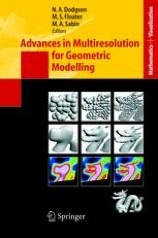
Multiresolution methods in geometric modelling are concerned with the generation, representation, and manipulation of geometric objects at several levels of detail. Applications include fast visualization and rendering as well as coding, compression, and digital transmission of 3D geometric objects.The book contains seven survey papers, providing a detailed overview of recent advances in the various fields within multiresolution modelling, and sixteen additional research papers. Each of the seven parts of the book starts with a survey paper, followed by the associated research papers in that area.

سوريا - اتستراد درعا - غباغب
+963-15 2050 - 15 860 380 /1/2/3 - 11 662 3900