



الصفحة 1
الصفحة 1

Mechatronics : Dynamics of Electromechanical and Piezoelectric Systems
Deals with Lagrange equations for electromechanical systems, including piezoelectric transducers and selected applications. Intended for the research community and graduate students at the MSc and PhD level, this book is an extension to piezoelectric systems of the work, ""Dynamics of Mechanical and Electromechanical Systems"", published in 1968.

Mechanical Modelling and Computational Issues in Civil Engineering
In this edited book various novel approaches to problems of modern civil engineering are demonstrated. Experts associated within the Lagrange Laboratory present recent research results in civil engineering dealing both with modelling and computational aspects.

Mathématiques de base pour économistes = Basic Mathematics for Economists
This book contains fundamental elements of mathematics and includes the following elements: notion of logic, propositions, theorems, sets, relations and functions; graphical representations of functions, economic applications of lines and functions, sequences, limits and first derivative, differential economic applications of derivatives; integrals: undefined and defined with economic applications; mathematical series; functions of several variables, partial derivatives, Lagrange multiplier with economic applications; linear algebra: matrix calculus, system of linear equations, vectors, differential calculus in matrix form.

Introduction to the Classical Theory of Particles and Fields
This volume is intended as a systematic introduction to gauge field theory for advanced undergraduate and graduate students in high energy physics.
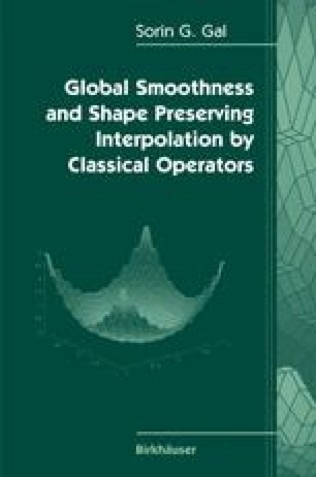
Global Smoothness and Shape Preserving Interpolation by Classical Operators
This monograph examines and develops the Global Smoothness Preservation Property (GSPP) and the Shape Preservation Property (SPP) in the field of interpolation of functions. The study is developed for the univariate and bivariate cases using well-known classical interpolation operators of Lagrange, Grünwald, Hermite-Fejér and Shepard type. One of the first books on the subject, it presents interesting new results alongwith an excellent survey of past research.

Geometric mechanics on riemannian manifolds : Applications to partial differential equations
This work presents a purely geometric treatment of problems in physics involving quantum harmonic oscillators, quartic oscillators, minimal surfaces, and Schrödinger's, Einstein's and Newton's equations. Historically, problems in these areas were approached using the Fourier transform or path integrals, although in some cases (e.g., the case of quartic oscillators) these methods do not work. New geometric methods are introduced in the work that have the advantage of providing quantitative or at least qualitative descriptions of operators, many of which cannot be treated by other methods. And, conservation laws of the Euler–Lagrange equations are employed to solve the equations of motion qualitatively when quantitative analysis is not possible. It includes : Lagrangian formalism on Riemannian manifolds; energy momentum tensor and conservation laws; Hamiltonian formalism; Hamilton–Jacobi theory; harmonic functions, maps, and geodesics; fundamental solutions for heat operators with potential; and a variational approach to mechanical curves.

From Hahn-Banach to Monotonicity
In this new edition of LNM 1693 the essential idea is to reduce questions on monotone multifunctions to questions on convex functions. However, rather than using a “big convexification” of the graph of the multifunction and the “minimax technique”for proving the existence of linear functionals satisfying certain conditions, the Fitzpatrick function is used. The journey begins with a generalization of the Hahn-Banach theorem uniting classical functional analysis, minimax theory, Lagrange multiplier theory and convex analysis and culminates in a survey of current results on monotone multifunctions on a Banach space.

Elastic Multibody Dynamics : A Direct Ritz Approach
This textbook is an introduction to and exploration of a number of core topics in the field of applied mechanics: On the basis of Lagrange's Principle, a Central Equation of Dynamics is presented which yields a unified view on existing methods. From these, the Projection Equation is selected for the derivation of the motion equations of holonomic and of non-holonomic systems. The method is applied to rigid multibody systems where the rigid body is defined such that, by relaxation of the rigidity constraints, one can directly proceed to elastic bodies. A decomposition into subsystems leads to a minimal representation and to a recursive representation, respectively, of the equations of motion.

Dynamics of Flexible Multibody Systems : Rigid Finite Element Method
A new approach is presented for modelling multi-body systems, which constitutes a substantial enhancement of the Rigid Finite Element method. The new approach is based on homogeneous transformations and joint coordinates, and it yields the advantage that equations of motion are automatically generated for systems consisting of alternate rigid and flexible links. Apart from its simple physical interpretation and easy computer implementation, the method is also valuable for educational purposes since it impressively illustrates the impact of mechanical features on the mathematical model. This novel modelling approach is then applied to systems such as offshore-cranes and telescopic rapiers.

Domain Decomposition Methods for the Numerical Solution of Partial Differential Equations
Domain decomposition methods are divide and conquer methods for the parallel and computational solution of partial differential equations of elliptic or parabolic type. They include iterative algorithms for solving the discretized equations, techniques for non-matching grid discretizations and techniques for heterogeneous approximations. This book serves as an introduction to this subject, with emphasis on matrix formulations. The topics studied include Schwarz, substructuring, Lagrange multiplier and least squares-control hybrid formulations, multilevel methods, non-self adjoint problems, parabolic equations, saddle point problems (Stokes, porous media and optimal control), non-matching grid discretizations, heterogeneous models, fictitious domain methods, variational inequalities, maximum norm theory, eigenvalue problems, optimization problems and the Helmholtz scattering problem. Selected convergence theory is included.
Math for business and economics : Compedium of essential formulas
This mathematical formulary is presented in a practice-oriented, clear, and understandable manner, as it is needed for meaningful and relevant application in global business, as well as in the academic setting and economic practice. The topics presented include but are not limited to mathematical signs and symbols, logic, arithmetic, algebra, linear algebra, combinatorics, and financial mathematics, including an international comparison between different national methods used in the calculation of interest, optimization of linear models, functions, differential calculus, integral calculus, elasticities, annuity calculation, economic functions, and the Peren Theorem.
Artificial neural network-based optimized design of reinforced concrete structures
Introduces AI-based Lagrange optimization techniques that can enable more rational engineering decisions for concrete structures while conforming to codes of practice. It shows how objective functions including cost, CO2 emissions, and structural weight of concrete structures are optimized either separately or simultaneously while satisfying constraining design conditions using an ANN-based Lagrange algorithm. Any design target can be adopted as an objective function. Many optimized design examples are verified by both conventional structural calculations and big datasets. Uniquely applies the new powerful tools of AI to concrete structural design and optimization Multi-objective functions of concrete structures optimized either separately or simultaneously Design requirements imposed by codes are automatically satisfied by constraining conditions Heavily illustrated in color with practical design examples
Adaptive-robust control with limited knowledge on systems dynamics : An artificial input delay approach and beyond
investigates the role of artificial input delay in approximating unknown system dynamics, referred to as time-delayed control (TDC), and provides novel solutions to current design issues in TDC. Its central focus is on designing adaptive-switching gain-based robust control (ARC) for a class of Euler–Lagrange (EL) systems with minimal or no knowledge of the system dynamics parameters. The newly proposed TDC-based ARC tackles the commonly observed over- and under-estimation issues in switching gain. The consideration of EL systems lends a practical perspective on the proposed methods, and each chapter is supplemented by relevant experimental data
