



الصفحة 1
الصفحة 1

Microwave Radiometry of Vegetation Canopies
Research into microwave radiation from the Earth’s surface in the presence of vegetation canopies, as well as the development of algorithms for retrieval of soil and vegetation parameters from microwave radiometric measurements, have been actively conducted for the last 30 years by scientific groups worldwide. The capability of the microwave radiometric method to determine soil moisture and vegetation biometric indices was revealed 25 years ago by the author and his colleagues. Soil moisture and vegetation covers play a key role in the hydrological cycle and in water and energy transfer on the border of land surface and atmosphere through evaporation and transpiration. Accomplishment of large international projects shows that microwave radiometry of soil and vegetation has become an instrument of practical application and operational use. A systematic account of questions concerning the microwave radiometry of the Earth’s surface in the presence of vegetation canopies is the main objective of the book.

Future Satellite Gravimetry and Earth Dynamics
Currently, a first generation of dedicated satellite missions for the precise mapping of the Earth’s gravity field is in orbit (CHAMP, GRACE, and soon GOCE). The gravity data from these satellite missions provide us with very new information on the dynamics of planet Earth. In particular, on the mass distribution in the Earth’s interior, the entire water cycle (ocean circulation, ice mass balance, continental water masses, and atmosphere), and on changes in the mass distribution. The results are fascinating, but still rough with respect to spatial and temporal resolution. Technical progress in satellite-to-satellite tracking and in gravity gradiometry will allow more detailed results in the future. In this special issue, Earth scientists develop visions of future applications based on follow-on high-precision satellite gravimetry missions.

Coupled Models for the Hydrological Cycle : Integrating Atmosphere, Biosphere and Pedosphere
Hydrologists, climatologists, soil scientists and environmental engineers are frequently asked to analyse complex environmental problems. It is becoming increasingly apparent that these problems usually involve feedbacks between atmospheric, ecological, and hydrological systems, as well as human society. It is often the feedbacks between systems that are of greatest interest because they may produce unanticipated responses. That is why coupling of different compartments of the Earth system has emerged as a general challenge to the modelling community. This book considers an array of state-of-the-art coupling and modelling concepts. First the relevant Earth system cycles are presented, followed by a discussion on scale issues and multiple equilibria. Inter- and intra-compartmental coupling is addressed, along with a debate on non-linearities and questions of parameterisation. Several applications are presented, where a focus is on cases where the hydrological cycle plays a central role.
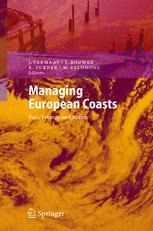
Managing European Coasts : Past, Present and Future
Many coastal areas and human activities are subject to increasing risks from natural and man-induced hazards such as flooding resulting from major changes in hydrology of river systems that has reached a global scale. Changes in the hydrological cycle coupled with changes in land and water management alter fluxes of materials transmitted from river catchments to the coastal zone, which have a major effect on coastal ecosystems. The increasing complexity of underlying processes and forcing functions that drive changes on coastal systems are witnessed at a multiplicity of temporal and spatial scales.
