



الصفحة 1
الصفحة 1

Number theory in science and communication : With applications in cryptography, physics, digital information, computing, and self-similarity
"Number Theory in Science and Communication" is a well-known introduction for non-mathematicians to this fascinating and useful branch of applied mathematics . It stresses intuitive understanding rather than abstract theory and highlights important concepts such as continued fractions, the golden ratio, quadratic residues and Chinese remainders, trapdoor functions, pseudoprimes and primitive elements. Their applications to problems in the real world are one of the main themes of the book. This revised fourth edition is augmented by recent advances in primes in progressions, twin primes, prime triplets, prime quadruplets and quintruplets, factoring with elliptic curves, quantum factoring, Golomb rulers and "baroque" integers.

Newton-Euler Dynamics
Most books on "intermediate dynamics" covering advanced Newtonian and introductory Lagrangian methods.This material cannot be covered adequately in one course if it is to be shared with an introduction to Langrangian methods. This text is devoted to application of Newton-Euler methods to complex, real-life 3-D dynamics problems.

Modelling the dispersion of radionuclides in the marine environment : An introduction
This book is a practical guide to the subject of numerical modelling of radioactivity dispersion in the marine environment. Thus, the techniques and numerical procedures required are explained in detail, with the aim of enabling the reader to build a real mathematical model. The book covers basic concepts and techniques, such as solving the advection-diffusion equation in a simple 1D form, as well as the most recent developments (full 3D models for non-conservative radionuclides including chemical reactions and speciation). A chapter is dedicated to the basic hydrodynamic modelling that is always required to simulate the dispersion of tracers in the sea; Eulerian and Lagrangian modelling techniques are also described. A chapter describes sensitivity and uncertainty analysis, the final stage in modelling works. A review on some published radionuclide dispersion models is also included.

Modeling, Control and Implementation of Smart Structures : A FEM-State Space Approach
This monograph presents an introductory overview of smart structures, their concepts, their active involvement in the vibration control, their applications and the extensive research work done on it so far. The modelling of flexible beams using two types of beam theories, viz., the Euler-Bernoulli theory and the Timoshenko beam theory is presented, including a new concept of finite element modeling of the flexible structures using Timoshenko beam theory with the inclusion of the shear both in the piezo-patches as well as in the host structure. It presents the design of the periodic output feedback control system for smart structure systems, the design of the FOS controllers for active vibration control and the design of Discrete Sliding Mode controllers using multirate output feedback technique.

Mathematical Survey Lectures 1943-2004
This collection traces the career of Beno Eckmann, whose work ranges across a broad spectrum of mathematical concepts from topology and differential geometry through homological algebra to group theory. One of our most influential living mathematicians, Eckmann has been associated for nearly his entire professional life with the Swiss Federal Institute of Technology Zurich (ETH), as student, lecturer, professor, and professor emeritus.

Integrable Systems in Celestial Mechanics
This work presents a unified treatment of three important integrable problems relevant to both Celestial and Quantum Mechanics. Under discussion are the Kepler (two-body) problem and the Euler (two-fixed center) problem, the latter being the more complex and more instructive, as it exhibits a richer and more varied solution structure. Further, because of the interesting investigations by the 20th century mathematical physicist J.P. Vinti, the Euler problem is now recognized as being intimately linked to the Vinti (Earth-satellite) problem. Here the analysis of these problems is shown to follow a definite shared pattern yielding exact forms for the solutions. A central feature is the detailed treatment of the planar Euler problem where the solutions are expressed in terms of Jacobian elliptic functions, yielding analytic representations for the orbits over the entire parameter range.

Instability in Models Connected with Fluid Flows II
Instability in Models Connected with Fluid Flows II presents chapters from world renowned specialists. The stability of mathematical models simulating physical processes is discussed in topics on control theory, first order linear and nonlinear equations, water waves, free boundary problems, large time asymptotics of solutions, stochastic equations, Euler equations, Navier-Stokes equations, and other PDEs of fluid mechanics. Fields covered include: the free surface Euler (or water-wave) equations, the Cauchy problem for transport equations, irreducible Chapman--Enskog projections and Navier-Stokes approximations, randomly forced PDEs, stability of equilibrium figures of uniformly rotating viscous incompressible liquid, Navier-Stokes equations in cylindrical domains, Navier-Stokes-Poisson flows in a vacuum.

Instability in Models Connected with Fluid Flows I
Instability in Models Connected with Fluid Flows I presents chapters from world renowned specialists. The stability of mathematical models simulating physical processes is discussed in topics on control theory, first order linear and nonlinear equations, water waves, free boundary problems, large time asymptotics of solutions, stochastic equations, Euler equations, Navier-Stokes equations, and other PDEs of fluid mechanics. Fields covered include: controllability and accessibility properties of the Navier- Stokes and Euler systems, nonlinear dynamics of particle-like wavepackets, attractors of nonautonomous Navier-Stokes systems, large amplitude monophase nonlinear geometric optics, existence results for 3D Navier-Stokes equations and smoothness results for 2D Boussinesq equations, instability of incompressible Euler equations, increased stability in the Cauchy problem for elliptic equations.

Geometric mechanics on riemannian manifolds : Applications to partial differential equations
This work presents a purely geometric treatment of problems in physics involving quantum harmonic oscillators, quartic oscillators, minimal surfaces, and Schrödinger's, Einstein's and Newton's equations. Historically, problems in these areas were approached using the Fourier transform or path integrals, although in some cases (e.g., the case of quartic oscillators) these methods do not work. New geometric methods are introduced in the work that have the advantage of providing quantitative or at least qualitative descriptions of operators, many of which cannot be treated by other methods. And, conservation laws of the Euler–Lagrange equations are employed to solve the equations of motion qualitatively when quantitative analysis is not possible. It includes : Lagrangian formalism on Riemannian manifolds; energy momentum tensor and conservation laws; Hamiltonian formalism; Hamilton–Jacobi theory; harmonic functions, maps, and geodesics; fundamental solutions for heat operators with potential; and a variational approach to mechanical curves.

Functions de variable réelle : Théorie élémentaire = Real variable functions : Elementary theory
The Mathematics Elements of Nicolas BOURBAKI aim to provide a rigorous, systematic presentation without prerequisites of mathematics from their foundations. This Book is the fourth of the treaty; it is devoted to the basics of real analysis. It includes the chapters: Derivatives; Primitive and integral; Elementary functions; Differential equations ; Local study of functions; Generalized Taylorian developments. Euler-Maclaurin summation formula; The gamma function. It also contains historical notes.

Diagrammatic Representation and Inference ; 11th International Conference, Diagrams 2020, Tallinn, Estonia, August 24–28, 2020, Proceedings
This book constitutes the refereed proceedings of the 11th International Conference on the Theory and Application of Diagrams, Diagrams 2020, held in Tallinn, Estonia, in August 2020.* The 20 full papers and 16 short papers presented together with 18 posters were carefully reviewed and selected from 82 submissions. The papers are organized in the following topical sections: diagrams in mathematics; diagram design, principles, and classification; reasoning with diagrams; Euler and Venn diagrams; empirical studies and cognition; logic and diagrams; and posters.
Mathematical Models for Registration and Applications to Medical Imaging
Image registration is an emerging topic in image processing with many applications in medical imaging, picture and movie processing. The classical problem of image registration is concerned with ?nding an appropriate transformation between two data sets. This fuzzy de?nition of registration requires a mathematical modeling and in particular a mathematical speci?cation of the terms appropriate transformations and correlation between data sets. Depending on the type of application, typically Euler, rigid, plastic, elastic deformations are considered. The variety of similarity p measures ranges from a simpleL distance between the pixel values of the data to mutual information or entropy distances. This goal of this book is to highlight by some experts in industry and medicine relevant and emerging image registration applications and to show new emerging mathematical technologies in these areas. Currently, many registration application are solved based on variational prin- ple requiring sophisticated analysis, such as calculus of variations and the theory of partial differential equations, to name but a few. Due to the numerical compl- ity of registration problems ef?cient numerical realization are required. Concepts like multi-level solver for partial differential equations, non-convex optimization, and so on play an important role. Mathematical and numerical issues in the area of registration are discussed by some of the experts in this volume.

Mathematical Foundation of Turbulent Viscous Flows : Lectures given at the C.I.M.E. Summer School held in Martina Franca, Italy, September 1-5, 2003
Five leading specialists reflect on different and complementary approaches to fundamental questions in the study of the Fluid Mechanics and Gas Dynamics equations. Constantin presents the Euler equations of ideal incompressible fluids and discusses the blow-up problem for the Navier-Stokes equations of viscous fluids, describing some of the major mathematical questions of turbulence theory.

Leonhard Euler
Euler was not only by far the most productive mathematician in the history of mankind, but also one of the greatest scholars of all time. He attained, like only a few scholars, a degree of popularity and fame which may well be compared with that of Galilei, Newton, or Einstei .This book is based in part on unpublished sources and comes right out of the current research on Euler. It is entirely free of formulae as it has been written for a broad audience with interests in the history of culture and science.
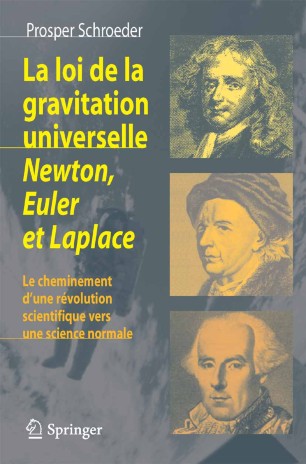
La loi de la gravitation universelle Newton, Euler et Laplace : Le cheminement d’une révolution scientifique vers une science normale = The law of universal gravitation Newton, Euler and Laplace : The progress of a scientific revolution towards a normal science
An analysis of Newton's ideas dismisses this hypothesis by the simple fact that the Principia sought to demonstrate the fallacy of earlier approaches. However, Newton suffered a failure in the application of his theory of gravitation to the explanation of the movement of the Moon, failure which marked the development of celestial mechanics throughout the 18th century. Clairaut, d'Alembert and Euler doubted the validity of Newtonian law almost at the same time and their ideas advanced celestial mechanics which reached the state of "normal science" with Laplace's treatise on celestial mechanics, a century after Newton.
Complex Numbers from A to … Z
It is impossible to imagine modern mathematics without complex numbers. Complex Numbers from A to . . . Z introduces the reader to this fascinating subject that, from the time of L. Euler, has become one of the most utilized ideas in mathematics.The exposition concentrates on key concepts and then elementary results concerning these numbers. The reader learns how complex numbers can be used to solve algebraic equations and to understand the geometric interpretation of complex numbers and the operations involving them.The theoretical parts of the book are augmented with rich exercises and problems at various levels of difficulty. A special feature of the book is the last chapter, a selection of outstanding Olympiad and other important mathematical contest problems solved by employing the methods already presented.The book reflects the unique experience of the authors. It distills a vast mathematical literature, most of which is unknown to the western public, and captures the essence of an abundant problem culture.
Classification Algorithms for Codes and Designs
Almost a century earlier, in 1782, Euler [180] published some results on classifying small Latin squares, but for the ?rst few steps in this direction one should actually go at least as far back as ancient Greece and the proof that there are exactly ?ve Platonic solids. One of the most remarkable achievements in the early, pre-computer era is the classi?cation of the Steiner triple systems of order 15, quoted above. An onerous task that, today, no sensible person would attempt by hand calcu- tion. Because, with the exception of occasional parameters for which com- natorial arguments are e?ective (often to prove nonexistence or uniqueness), classi?cation in general is about algorithms and computation.
Characteristics Finite Element Methods in Computational Fluid Dynamics
This book details a systematic characteristics-based finite element procedure to investigate incompressible, free-surface and compressible flows. The fluid dynamics equations are derived from basic thermo-mechanical principles and the multi-dimensional and infinite-directional upstream procedure is developed by combining a finite element discretization of a characteristics-bias system with an implicit Runge-Kutta time integration. For the computational solution of the Euler and Navier Stokes equations, the procedure relies on the mathematics and physics of multi-dimensional characteristics. As a result, the procedure crisply captures contact discontinuities, normal as well as oblique shocks, and generates essentially non-oscillatory solutions for incompressible, subsonic, transonic, supersonic, and hypersonic inviscid and viscous flows.

Alla ricerca della via più breve : Un'avventura matematica = Finding the shortest way : A mathematical adventure
Il libro narra la vicenda di Rut, quindicenne, trasferitasi da poco in Germania con la famiglia, al seguito del padre che lavora per un’azienda internazionale produttrice di Software. Sarà proprio il padre a regalare a Rut un computer nuovo, mentre a scuola attraversa un periodo di crisi.E’ l’inizio di un’avventura. Nel computer è installato Vim: un programma che ascolta, capisce e risponde alle domande che la ragazza, inizialmente incredula, fa. Raccontata da Vim, la matematica prende una forma completamente nuova, sorprendente e affascinante.

Adaptive-robust control with limited knowledge on systems dynamics : An artificial input delay approach and beyond
investigates the role of artificial input delay in approximating unknown system dynamics, referred to as time-delayed control (TDC), and provides novel solutions to current design issues in TDC. Its central focus is on designing adaptive-switching gain-based robust control (ARC) for a class of Euler–Lagrange (EL) systems with minimal or no knowledge of the system dynamics parameters. The newly proposed TDC-based ARC tackles the commonly observed over- and under-estimation issues in switching gain. The consideration of EL systems lends a practical perspective on the proposed methods, and each chapter is supplemented by relevant experimental data
