


تحسين النتائح
ترتيب حسب
من
الى

Embedded systems are ubiquitous. They appear in cell phones, microwave ovens, refrigerators, consumer electronics, cars, and jets. Some of these embedded s- tems are safety- or security-critical such as in medical equipment, nuclear plants, and X-by-wire control systems in naval, ground and aerospace transportation - hicles. With the continuing shift from hardware to software, embedded systems are increasingly dominated by embedded software. Embedded software is complex. Its engineering inherently involves a mul- disciplinary interplay with the physics of the embedding system or environment. Embedded software also comes in ever larger quantity and diversity. The next generation of premium automobiles will carry around one gigabyte of binary code. The proposed US DDX submarine is e?ectively a ?oating embedded so- ware system, comprising 30 billion lines of code written in over 100 programming languages. Embedded software is expensive. Cost estimates are quoted at around US$15– 30 per line (from commencement to shipping). In the defense realm, costs can range up to $100, while for highly critical applications, such as the Space Shuttle, the cost per line approximates $1,000. In view of the exponential increase in complexity, the projected costs of future embedded software are staggering.
Access Control Systems: Security, Identity Management and Trust Models provides a thorough introduction to the foundations of programming systems security, delving into identity management, trust models, and the theory behind access control models. The book details access control mechanisms that are emerging with the latest Internet programming technologies, and explores all models employed and how they work. The latest role-based access control (RBAC) standard is also highlighted.
Covers topics on both theoretical control systems and their applications across engineering domains such as automatic control, robotics, and adaptive controller design. It discusses several signal processing domains such as image, speech, biomedical signal processing and their applications in IOT, control, robotics, power and energy systems. The book emphasizes both conventional and non-conventional energy, environment, and green processes as related to energy and power systems engineering.
Kanban control systems bear a great potential to significantly improve operations. A company may reap the full benefits of kanban control only after determining an optimal or near-optimal system configuration. To do that, methods are needed to evaluate the performance and operating costs of individual system configurations. We propose an innovative construction-kit approach that enables us to build stochastic analytical models of a large class of single- and multi-product kanban systems. The presented construction-kit approach may be extended and augmented in various directions
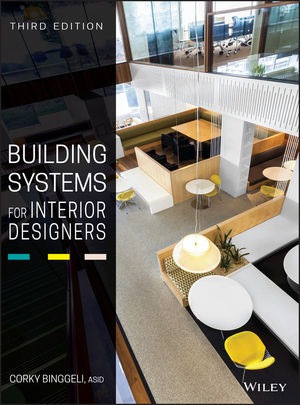
The ultimate interior designer's guide to building systems and safety Building Systems for Interior Designers, Third Edition is the single-source technical reference that every designer needs, and an ideal solution for NCIDQ exam preparation. Addresses the special concerns of the interior designer within the context of the entire design team. New coverage includes the latest information on sustainable design and energy conservation, expanded coverage of security and building control systems, and a new and expanded art program with over 250 new illustrations. Covering systems from HVAC to water to waste to lighting, this book explains technical building systems and engineering issues in a clear and accessible way to help interior designers communicate more effectively with architects, engineers, and contractors.

The main topic of Magnetic Control of Tokamak Plasmas is the design of feedback control systems guaranteeing the stability of plasma equilibrium inside a tokamak and the regulation of the plasma position and shape during plasma pulses. Modelling and control details are presented, allowing the non-expert to understand the control problem. Starting from equations of magneto-hydro-dynamics, all the steps needed for the derivation of plasma state-space models are enumerated. The basics of electromagnetics are frequently recalled. The control problem is then described beginning with control of current and position – vertical and radial – and progressing to the more challenging shape control. The solutions proposed vary from simple PIDs to more sophisticated MIMO controllers.
A Differential-Geometric Approach for Bernstein’s Degrees-of-Freedom Problem.- Nonsmooth Riemannian Optimization with Applications to Sphere Packing and Grasping.- Synchronization of Networked Lagrangian Systems.- An Algorithm to Discretize One-Dimensional Distributed Port Hamiltonian Systems.- Virtual Lagrangian Construction Method for Infinitedimensional Systems with Homotopy Operators.- Direct Discrete-Time Design for Sampled-Data Hamiltonian Control Systems.- Kinematic Compensation in Port-Hamiltonian Telemanipulation.- Interconnection and Damping Assignment Passivity-Based Control of a Four-Tank System.- Towards Power-based Control Strategies for a Class of Nonlinear Mechanical Systems.- Power Shaping Control of Nonlinear Systems: A Benchmark Example.- Total Energy Shaping Control of Mechanical Systems: Simplifying the Matching Equations via Coordinate Changes.- Simultaneous Interconnection and Damping Assignment Passivity–Based Control: Two Practical Examples.
Reflecting the trend to optimization through integrative approaches for engine, driveline and vehicle control, this book enables control engineers to understand engine and vehicle models necessary for controller design and also introduces mechanical engineers to vehicle-specific signal processing and automatic control. The emphasis on measurement, comparisons between performance and modelling, and realistic examples derive from the authors’ industrial experience at Bosch and interactions within IFAC and SAE. The second edition offers new or expanded topics such as diesel-engine modelling, diagnosis and anti-jerking control, and vehicle modelling and parameter estimation. The book addresses professional engineers as well as students.
The chapters in this book cover a significant number of control and systems theory topics and describe a mix of new methodological results, advanced applications, emerging control areas and tutorial works.
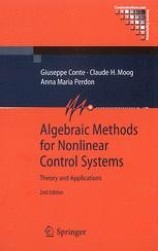
A self-contained introduction to algebraic control for nonlinear systems suitable for researchers and graduate students.The most popular treatment of control for nonlinear systems is from the viewpoint of differential geometry yet this approach proves not to be the most natural when considering problems like dynamic feedback and realization. Professors Conte, Moog and Perdon develop an alternative linear-algebraic strategy based on the use of vector spaces over suitable fields of nonlinear functions. This algebraic perspective is complementary to, and parallel in concept with, its more celebrated differential-geometric counterpart.Algebraic Methods for Nonlinear Control Systems describes a wide range of results, some of which can be derived using differential geometry but many of which cannot.
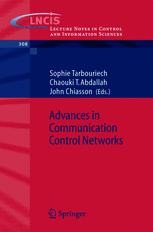
Brings together solicited contributions from experts in the various areas of communication/control networks referring to both networks under control (control in networks) as well as networked control systems (control over networks).

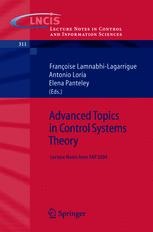
"Advanced Topics in Control Systems Theory" contains selected contributions written by lecturers at the third (annual) Formation d’Automatique de Paris (FAP) (Graduate Control School in Paris). Following on from the lecture notes from the second FAP (Volume 311 in the same series) it is addressed to graduate students and researchers in control theory with topics touching on a variety of areas of interest to the control community such as nonlinear optimal control, observer design, stability analysis and structural properties of linear systems. The reader is provided with a well-integrated synthesis of the latest thinking in these subjects without the need for an exhaustive literature review. The internationally known contributors to this volume represent many of the most reputable control centers in Europe.
Advanced Topics in Control Systems Theory contains selected contributions written by lecturers at the second (annual) Formation dAutomatique de Paris (FAP) (Graduate Control School in Paris). It is addressed to graduate students and researchers in control theory with topics touching on a variety of areas of interest to the control community such as cascaded systems, flatness, optimal control, and Hamiltonian and infinite-dimensional systems. The reader is provided with a well-integrated synthesis of the latest thinking in these subjects without the need for an exhaustive literature review.
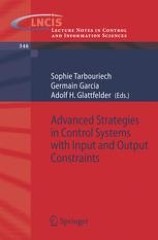
The different techniques described throughout the book are particularly attractive for industrial applications not only in aeronautical or space domains but also in the context of biological systems domain. Such methods are well suited for the development of tools that help engineers to solve analysis and synthesis problems in the context of control systems with input and output constraints
Adaptive Voltage Control in Power Systems, a self-contained blend of theory and novel application, is an in-depth treatment of such adaptive control schemes. The reader moves from power-system-modelling problems through illustrations of the main adaptive control systems (self-tuning, model-reference and nonlinearities compensation) to a detailed description of design methods: Kalman filtering, parameter-identification algorithms and discrete-time controller design are all represented. Case studies address applications issues in the implementation of adaptive voltage control.
Following the recent developments in the field of absolute stability, Professor Xiaoxin Liao, in conjunction with Professor Pei Yu, has created a second edition of his seminal work on the subject. Liao begins with an introduction to the Lurie problem and the Lurie control system, before moving on to the simple algebraic sufficient conditions for the absolute stability of autonomous and non-autonomous ODE systems, as well as several special classes of Lurie-type systems. The focus of the book then shifts toward the new results and research that have appeared in the decade since the first edition was published. This includes nonlinear control systems with multiple controls, interval control systems, time-delay and neutral Lurie control systems, systems described by functional differential equations, the absolute stability for neural networks, as well as applications to chaos control and chaos synchronization.

سوريا - اتستراد درعا - غباغب
+963-15 2050 - 15 860 380 /1/2/3 - 11 662 3900