


تحسين النتائح
ترتيب حسب
من
الى

The goal of this book is to address the use of several important machine learning techniques into computer vision applications. An innovative combination of computer vision and machine learning techniques has the promise of advancing the field of computer vision, which contributes to better understanding of complex real-world applications. The effective usage of machine learning technology in real-world computer vision problems requires understanding the domain of application, abstraction of a learning problem from a given computer vision task, and the selection of appropriate representations for the learnable (input) and learned (internal) entities of the system. In this book, we address all these important aspects from a new perspective: that the key element in the current computer revolution is the use of machine learning to capture the variations in visual appearance, rather than having the designer of the model accomplish this. As a bonus, models learned from large datasets are likely to be more robust and more realistic than the brittle all-design models.
Business process management is usually treated from two different perspectives: business administration and computer science. While business administration professionals tend to consider information technology as a subordinate aspect for experts to handle, by contrast computer scientists often consider business goals and organizational regulations as terms that do not deserve much thought but require the appropriate level of abstraction.This textbook is ideally suited for classes on business process management, information systems architecture, and workflow management. It is also valuable for project managers and IT professionals working in business process management.
As software systems become ubiquitous, the issues of dependability become more and more crucial. Given that solutions to these issues must be considered from the very beginning of the design process, it is reasonable that dependability is addressed at the architectural level. This book comes as a result of an effort to bring together the research communities of software architectures and dependability. The papers are organised in topical sections on architectures for dependable services, monitoring and reconfiguration in software architectures, dependability support for software architectures, architectural evaluation, and architectural abstractions for dependability
This textbook presents the crucial issues in software engineering using the agile approach to software development - one of the mainstream paradigms for the management of software projects and one that is being applied more and more extensively.
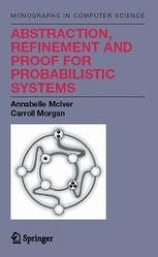
Probabilistic techniques are increasingly being employed in computer programs and systems because they can increase efficiency in sequential algorithms, enable otherwise nonfunctional distribution applications, and allow quantification of risk and safety in general. This makes operational models of how they work, and logics for reasoning about them, extremely important. Abstraction, Refinement and Proof for Probabilistic Systems presents a rigorous approach to modeling and reasoning about computer systems that incorporate probability. Its foundations lie in traditional Boolean sequential-program logic—but its extension to numeric rather than merely true-or-false judgments takes it much further, into areas such as randomized algorithms, fault tolerance, and, in distributed systems, almost-certain symmetry breaking. The presentation begins with the familiar "assertional" style of program development and continues with increasing specialization: Part I treats probabilistic program logic, including many examples and case studies; Part II sets out the detailed semantics; and Part III applies the approach to advanced material on temporal calculi and two-player games.
Model checking technology is among the foremost applications of logic to computer science and computer engineering. The model checking community has achieved many breakthroughs, bridging the gap between theoretical computer science and hardware and software engineering, and it is reaching out to new challenging areas such as system biology and hybrid systems. Model checking is extensively used in the hardware industry and has also been applied to the verification of many types of software. Model checking has been introduced into computer science and electrical engineering curricula at universities worldwide and has become a universal tool for the analysis of systems.

Distills complex concepts of design into a clear focus and brings difficult abstractions to life. It explains form and space in relation to light, view, openings, and enclosures and explores the organization of space, and the elements and relationships of circulation, as well as proportion and scale. In addition, the text's detailed illustrations demonstrate the concepts presented and reveal the relationships between fundamental elements of architecture through the ages and across cultures.
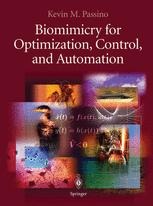
In this book, we focus onhowtousebiomimicryof the functionaloperationofthe “hardwareandso- ware” of biological systems for the development of optimization algorithms and feedbackcontrolsystemsthatextendourcapabilitiestoimplementsophisticated levels of automation. The primary focus is not on the modeling, emulation, or analysis of some biological system. The focus is on using “bio-inspiration” to inject new ideas, techniques, and perspective into the engineering of complex automation systems. There are many biological processes that, at some level of abstraction, can berepresentedasoptimizationprocesses,manyofwhichhaveasa basicpurpose automatic control, decision making, or automation.
Logical thinking, the analysis of complex relationships, the recognition of und- lying simple structures which are common to a multitude of problems — these are the skills which are needed to do mathematics, and their development is the main goal of mathematics education. Of course, these skills cannot be learned ‘in a vacuum’. Only a continuous struggle with concrete problems and a striving for deep understanding leads to success. A good measure of abstraction is needed to allow one to concentrate on the essential, without being distracted by appearances and irrelevancies. The present book strives for clarity and transparency. Right from the beg- ning, it requires from the reader a willingness to deal with abstract concepts, as well as a considerable measure of self-initiative. For these e?orts, the reader will be richly rewarded in his or her mathematical thinking abilities, and will possess the foundation needed for a deeper penetration into mathematics and its applications.
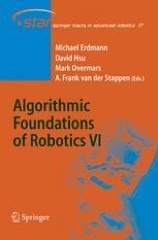
Robot algorithms are abstractions of computational processes that control or reason about motion and perception in the physical world. Because actions in the physical world are subject to physical laws and geometric constraints, the design and analysis of robot algorithms raises a unique combination of questions in control theory, computational and differential geometry, and computer science. Algorithms serve as a unifying theme in the multi-disciplinary field of robotics. This volume consists of selected contributions to the sixth Workshop on the Algorithmic Foundations of Robotics. This is a highly competitive meeting of experts in the field of algorithmic issues related to robotics and automation.

To do algebra is essentially to calculate, that is to say to perform, on elements of a set, (<algebraic operations n, the best-known example of which is provided by the (<four rules)) of elementary arithmetic. This is not the place to retrace the slow process of progressive abstraction by which the notion of algebraic operation, initially restricted to natural integers and to measurable quantities, gradually widened its field, as it grew. at the same time generalized the notion of ((number O, until, going beyond the latter, it came to apply to elements which no longer had any character ((numeric)>, for example to permutations of a - seems (see Historical Note in chap. 1).
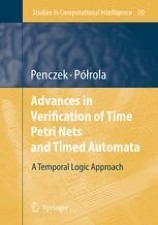
This monograph presents a comprehensive introduction to timed automata (TA) and time Petri nets (TPNs) which belong to the most widely used models of real-time systems. Some of the existing methods of translating time Petri nets to timed automata are presented, with a focus on the translations that correspond to the semantics of time Petri nets, associating clocks with various components of the nets. "Advances in Verification of Time Petri Nets and Timed Automata – A Temporal Logic Approach" introduces timed and untimed temporal specification languages and gives model abstraction methods based on state class approaches for TPNs and on partition refinement for TA. Moreover, the monograph presents a recent progress in the development of two model checking methods, based on either exploiting abstract state spaces or on application of SAT-based symbolic techniques.
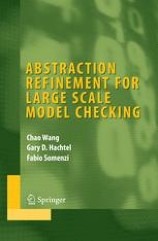
This book describes recent research developments in automatic abstraction refinement techniques. The authors address the main challenge in abstraction refinement, i.e., the ability to efficiently reach or come close to the optimum abstraction (the smallest abstract model that proves or refutes the given property). A suite of fully automatic abstraction techniques are proposed to improve the overall computation efficiency. The suite of algorithms presented in this book has demonstrated significant improvement over the prior art; some of them have already been adopted by the EDA companies in their commercial/in-house verification tools.

سوريا - اتستراد درعا - غباغب
+963-15 2050 - 15 860 380 /1/2/3 - 11 662 3900