


تحسين النتائح
ترتيب حسب
من
الى

This self-contained introduction to modern cryptography emphasizes the mathematics behind the theory of public key cryptosystems and digital signature schemes. The book focuses on these key topics while developing the mathematical tools needed for the construction and security analysis of diverse cryptosystems. Only basic linear algebra is required of the reader; techniques from algebra, number theory, and probability are introduced and developed as required.
Manifolds, the higher-dimensional analogs of smooth curves and surfaces, are fundamental objects in modern mathematics. Combining aspects of algebra, topology, and analysis, manifolds have also been applied to classical mechanics, general relativity, and quantum field theory. In this streamlined introduction to the subject, the theory of manifolds is presented with the aim of helping the reader achieve a rapid mastery of the essential topics. By the end of the book the reader should be able to compute, at least for simple spaces, one of the most basic topological invariants of a manifold, its de Rham cohomology. Along the way the reader acquires the knowledge and skills necessary for further study of geometry and topology.
The algorithmic problems of real algebraic geometry such as real root counting, deciding the existence of solutions of systems of polynomial equations and inequalities, finding global maxima or deciding whether two points belong in the same connected component of a semi-algebraic set appear frequently in many areas of science and engineering. In this first-ever graduate textbook on the algorithmic aspects of real algebraic geometry, the main ideas and techniques presented form a coherent and rich body of knowledge, linked to many areas of mathematics and computing.

This book treats the Mathematics of many important areas in digital information processing.It covers, in a unified presentation, five topics: Data Compression, Cryptography, Sampling (Signal Theory), Error Control Codes, Data Reduction. The thematic choices are practice-oriented. So, the important final part of the book deals with the Discrete Cosine Transform and the Discrete Wavelet Transform, acting in image compression. The presentation is dense, the examples and numerous exercises are concrete. The pedagogic architecture follows increasing mathematical complexity.

To do algebra is essentially to calculate, that is to say to perform, on elements of a set, (<algebraic operations n, the best-known example of which is provided by the (<four rules)) of elementary arithmetic. This is not the place to retrace the slow process of progressive abstraction by which the notion of algebraic operation, initially restricted to natural integers and to measurable quantities, gradually widened its field, as it grew. at the same time generalized the notion of ((number O, until, going beyond the latter, it came to apply to elements which no longer had any character ((numeric)>, for example to permutations of a - seems (see Historical Note in chap. 1).
Sesquilinear and quadratic forms : The Mathematics Elements of Nicolas BOURBAKI aim to provide a rigorous, systematic presentation without prerequisites of mathematics from their foundations. This ninth chapter of the Book of Algebra, the second Book of the treatise, is devoted to quadratic, symplectic or Hermitian forms and to associated groups.
The Mathematics Elements of Nicolas BOURBAKI aim to provide a rigorous, systematic presentation without prerequisites of mathematics from their foundations. Deals in particular with extensions of fields and Galois theory. It includes the chaptires: 4. Polynomials and rational fractions; 5. Commutative bodies 6. Orderly groups and bodies; 7. Modules on the main rings
Depth, Regularity, Duality The Mathematics Elements of Nicolas BOURBAKI aim to provide a rigorous, systematic presentation without prerequisites of mathematics from their foundations. This volume of the Book of Commutative Algebra, Book 7 of the treatise, is a continuation of the earlier chapters. It introduces in particular the notions of depth and smoothness, fundamental in algebraic geometry. It ends with the introduction of the dualizing modules and the Grothendieck duality.

The Mathematics Elements of Nicolas BOURBAKI aim to provide a rigorous, systematic presentation without prerequisites of mathematics from their foundations.

The Mathematics Elements of Nicolas BOURBAKI aim to provide a rigorous, systematic presentation without prerequisites of mathematics from their foundations.This second volume of the Book of Commutative Algebra, Seventh Book of the treatise, introduces two fundamental notions in commutative algebra, that of algebraic integer and that of valuation, which have many applications in number theory and algebraic geometry.

Nicolas BOURBAKI's Elements of Mathematics aim to provide a rigorous, systematic presentation without prerequisites of mathematics from their foundations. This first volume of the Book of Commutative Algebra, the seventh Book of the treatise, is devoted to the fundamental concepts of commutative algebra. It includes the chapters, Flat modules, Localization, Graduations, filtrations and topologies, First associated ideals and primary decomposition, It also contains historical notes. This volume is a reprint of the 1969 edition.

The Mathematics Elements of Nicolas BOURBAKI aim to provide a rigorous, systematic presentation without prerequisites of mathematics from their foundations. This tenth chapter of the Book of Algebra, the second Book of the treatise, lays the foundations of the homological calculus.

Covers the major topics in ring and module theory and includes both fundamental classical results and more developments. This book is devoted to a study of special classes of rings and algebras, such as serial rings, hereditary rings, semidistributive rings and tiled orders.
This book provides both the classical aspects of the theory of groups and their representations as well as a general introduction to the modern theory of representations including the representations of quivers and finite partially ordered sets and their applications to finite dimensional algebras.

This book explores the theory and application of locally nilpotent derivations, which is a subject of growing interest and importance not only among those in commutative algebra and algebraic geometry, but also in fields such as Lie algebras and differential equations. The author provides a unified treatment of the subject, beginning with 16 First Principles on which the entire theory is based. These are used to establish classical results, such as Rentschler’s Theorem for the plane, right up to the most recent results, such as Makar-Limanov’s Theorem for locally nilpotent derivations of polynomial rings.
This book brings together all the most important known results of research into the theory of algebraic multiplicities, from well-known classics like the Jordan Theorem to recent developments such as the uniqueness theorem and the construction of multiplicity for non-analytic families.
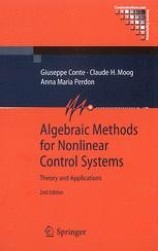
A self-contained introduction to algebraic control for nonlinear systems suitable for researchers and graduate students.The most popular treatment of control for nonlinear systems is from the viewpoint of differential geometry yet this approach proves not to be the most natural when considering problems like dynamic feedback and realization. Professors Conte, Moog and Perdon develop an alternative linear-algebraic strategy based on the use of vector spaces over suitable fields of nonlinear functions. This algebraic perspective is complementary to, and parallel in concept with, its more celebrated differential-geometric counterpart.Algebraic Methods for Nonlinear Control Systems describes a wide range of results, some of which can be derived using differential geometry but many of which cannot.

Algebraic groups are treated in this volume from a group theoretical point of view and the obtained results are compared with the analogous issues in the theory of Lie groups. The main body of the text is devoted to a classification of algebraic groups and Lie groups having only few subgroups or few factor groups of different type. In particular, the diversity of the nature of algebraic groups over fields of positive characteristic and over fields of characteristic zero is emphasized. This is revealed by the plethora of three-dimensional unipotent algebraic groups over a perfect field of positive characteristic, as well as, by many concrete examples which cover an area systematically. In the final section, algebraic groups and Lie groups having many closed normal subgroups are determined.
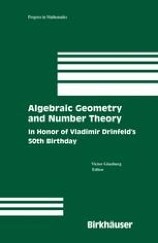
One of the most creative mathematicians of our times, Vladimir Drinfeld received the Fields Medal in 1990 for his groundbreaking contributions to the Langlands program and to the theory of quantum groups.These ten original articles by prominent mathematicians, dedicated to Drinfeld on the occasion of his 50th birthday, broadly reflect the range of Drinfeld's own interests in algebra, algebraic geometry, and number theory.
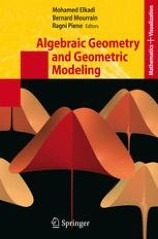
Algebraic Geometry provides an impressive theory targeting the understanding of geometric objects defined algebraically. Geometric Modeling uses every day, in order to solve practical and difficult problems, digital shapes based on algebraic models. In this book, we have collected articles bridging these two areas. The confrontation of the different points of view results in a better analysis of what the key challenges are and how they can be met. We focus on the following important classes of problems: implicitization, classification, and intersection. The combination of illustrative pictures, explicit computations and review articles will help the reader to handle these subjects.

سوريا - اتستراد درعا - غباغب
+963-15 2050 - 15 860 380 /1/2/3 - 11 662 3900