



الصفحة 270
الصفحة 270
Argumentation in multi-agent systems ; 4th International Workshop, ArgMAS 2007, Honolulu, HI, USA, May 15, 2007, revised selected and invited papers
This volume presents the latest developments in the growing area of research at the interface of argumentation theory and multiagent systems. Argumentation provides tools for designing, implementing and analyzing sophisticated forms of interaction among rational agents.
Arguing on the Toulmin model : New essays in argument analysis and evaluation
In The Uses of Argument Stephen Toulmin proposed a new model for the layout of arguments, with six components: claim, data, warrant, qualifier, rebuttal, backing. Toulmin’s model has been appropriated, adapted and extended by researchers in the fields of speech communications, philosophy and artificial intelligence. The volume aims to bring together the best contemporary reflection in these fields on the Toulmin model and its current appropriation.

Arguing Fundamental Rights
The book is unique in combining a challenging interpretation of one the foremost European conceptions of fundamental rights with the discussion of the pragmatics of constitutional adjudication.

Area-wide control of insect pests : From research to field implementation
This new textbook on area-wide control of insect pests collates a series of selected papers that attempts to address various funda- mental components of AW-IPM, e.g. the importance of relevant problem-solving research, the need for essential baseline data, thesignificanceofadequatetoolsforappropri-atecontrolstrategies,andthevalueofpilottri- als, etc.

Arctic-Subarctic Ocean Fluxes : Defining the Role of the Northern Seas in Climate
The two-way oceanic exchanges that connect the Arctic and Atlantic oceans through subarctic seas are of fundamental importance to climate. Change may certainly be imposed on the Arctic Ocean from subarctic seas, including a changing poleward ocean heat flux that is central to determining the present state and future fate of the perennial sea-ice. And the signal of Arctic change is expected to have its major climatic impact by reaching south through subarctic seas, either side of Greenland, to modulate the Atlantic thermohaline ‘conveyor’. Developing the predictive skills of climate models is seen to be the most direct way of extending the ability of society to mitigate for or adapt to 'global change' and is the main justification for continuing an intense observational effort in these waters. As records have lengthened, they have shown that important aspects of oceanic exchange through subarctic seas are currently at a long-term extreme state, providing further motivation for their study.
Arctic Alpine ecosystems and people in a changing environment
This book addresses the significant environmental changes experienced by high latitude and high altitude ecosystems at the beginning of the 21st c- tury. Increased temperatures and precipitation, reduction in sea ice and glacier ice, the increased levels of UV-radiation and the long-range tra- ported contaminants in arctic and alpine regions are stress factors that challenge terrestrial and aquatic ecosystems. The large natural variation in the physical parameters of these extreme environments is a key factor in structuring the biodiversity and biotic productivity, and the effect of the new stress factors can be critical for the population structures and the - teraction between species. These changes may also have socio-economic effects if the changes affect the bio-production, which form the basis for the marine and terrestrial food chains. The book is uniquely multidisciplinary and provides examples of va- ous aspects of contemporary environmental change in arctic and alpine - gions. The 21 chapters of the book are organised under the fields of •Climate change and ecosystem response, •Long range transport of poll- ants and ecological impacts, and •UV radiation and biological effects, each also including aspects of the •Socio-economic effects of environmental change. The introductory chapter presents and explains the internal c- nection and integration of all chapters.
Architecture of computing systems ; 34th International Conference, ARCS 2021, Virtual Event, June 7–8, 2021, Proceedings
This book constitutes the proceedings of the 34th International Conference on Architecture of Computing Systems, ARCS 2021, held virtually in July 2021. The 12 full papers in this volume were carefully reviewed and selected from 24 submissions. 2 workshop papers (VEFRE) are also included. ARCS has always been a conference attracting leading-edge research outcomes in Computer Architecture and Operating Systems, including a wide spectrum of topics ranging from fully integrated, self-powered embedded systems up to high-performance computing systems. It also provides a platform covering newly emerging and cross-cutting topics, such as autonomous and ubiquitous systems, reconfigurable computing and acceleration, neural networks and artificial intelligence. The selected papers cover a variety of topics from the ARCS core domains, including heterogeneous computing, memory optimizations, and organic computing.
Architecture of computing systems - ARCS 2008 ; 21st International Conference, Dresden, Germany, February 25-28, 2008. Proceedings
This book constitutes the refereed proceedings of the 21st International Conference on Architecture of Computing Systems, ARCS 2008, held in Dresden, Germany, in February 2008.

Architecture of computing systems - ARCS 2007 ; 20th International Conference, Zurich, Switzerland, March 12-15, 2007, Proceedings
The ARCS is reporting hi- quality results in computer architecture and operating systems research.It is also represent a - namic, evolving community that closely follows new research trends and topics. ARCS has evolved towards a strong focus on s- tem aspects of pervasive computing and self-organization techniques (organic and autonomic computing).

Architecture of computing systems - ARCS 2006 ; 19th International Conference, Frankfurt / Main, Germany, March 13-16, 2006, Proceedings
Technological progress is one of the driving forces behind the dramatic devel- mentofcomputersystemarchitecturesoverthe pastthreedecades.Eventhough it is quite clear that this development cannot only be measured by the ma- mum number of components on a chip, Moore’s Law may be and is often taken as a simple measure for the non-braked growth of computational power over the years. The more components are realizable on a chip, the more innovative and unconventional ideas can be realized by system architects. As a result, research in computer system architectures is more exciting than ever before. This book coversthe trends that shape the ?eld of computer system archit- tures.
Architecture of advanced numerical analysis systems: designing a scientific computing system using ocaml
Applies the functional OCaml programming language to numerical or computational weighted data science, engineering, and scientific applications. This book is based on the authors' first-hand experience building and maintaining Owl, an OCaml-based numerical computing library. You'll first learn the various components in a modern numerical computation library. Then, you will learn how these components are designed and built up and how to optimize their performance. After reading and using this book, you'll have the knowledge required to design and build real-world complex systems that effectively leverage the advantages of the OCaml functional programming language.

Architecture description languages ; IFIP TC-2 workshop on architecture description languages (WADL), World Computer Congress, Aug. 22-27, 2004, Toulouse, France
These proceedings record the papers presented at the Workshop onArchitecture Description Languages held in the city of Toulouse in thesouth of France.The aim of an ADL (Architecture Description Language) is to formallydescribe software and hardware architectures. Usually, an ADL describescomponents, their interfaces, their structures, their interactions (structureof data flow and control flow) and the mappings to hardware systems. Amajor goal of such descriptions is to allow analysis with respect to severalaspects like timing, safety, reliability, ...

Architecting Systems with Trustworthy Components ; International Seminar, Dagstuhl Castle, Germany, December 12-17, 2004. Revised Selected Papers
This book constitutes the thoroughly refereed post-proceedings of the International Dagstuhl-Seminar on Architecting Systems with Trustworthy Components, held in Dagstuhl Castle, Germany, in December 2004. The 10 revised full papers presented together with 5 invited papers contributed by outstanding researchers were carefully selected and included in the book reflecting ongoing impovement from the seminar. Core problems addressed by the seminar are measurement and normalization of non-functional properties, modular reasoning over non-functional properties, capture of component requirements in interfaces and protocols, interference and synergy of top-down and bottom-up aspects, duality of componentization and architecture, system properties, and opportunities for correctness by construction/static checking.
Architecting dependable systems V
As software systems become increasingly ubiquitous, the issues of dependability become more and more crucial. Given that solutions to these issues must be considered from the very beginning of the design process, it is reasonable that dependability is addressed at the architectural level. This book was born of an effort to bring together the research communities of software architectures and dependability.
Architecting dependable systems IV
As software systems become ubiquitous, the issues of dependability become more and more crucial. Given that solutions to these issues must be considered from the very beginning of the design process, it is reasonable that dependability is addressed at the architectural level. It also contains sections on architectural description languages, architectural components and patterns, architecting distributed systems, and architectural assurances for dependability.
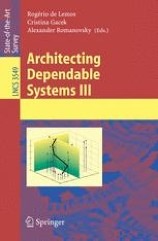
Architecting dependable systems III
As software systems become ubiquitous, the issues of dependability become more and more crucial. Given that solutions to these issues must be considered from the very beginning of the design process, it is reasonable that dependability is addressed at the architectural level. This book comes as a result of an effort to bring together the research communities of software architectures and dependability. The papers are organised in topical sections on architectures for dependable services, monitoring and reconfiguration in software architectures, dependability support for software architectures, architectural evaluation, and architectural abstractions for dependability
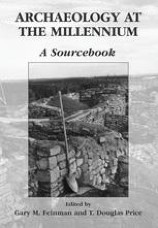
Archaeology at the millennium : A sourcebook
The sourcebook is divided into four substantive sections, each of which is introduced by a summary statement outlining the chapters in the section. Part I deals with the history of archaeology and the advance of archaeological theory. Part II ranges over the first four million years of our evolution as a cultural species and covers the first hominids to complex hunter-gatherers. Part III concerns the origins of agriculture and features discussions of such issues as craft production, the division of labor, warfare, and the rise of social inquality. Part IV analyzes the rise of states and empired in both the Old and New World; the archaeology of the classical Mediterranean states is also included in this section. A final chapter portends the future of archaeology.

Archaelogy Under Dictatorship
This volume aims to provide a theoretical basis for understanding the specific effects of totalitarian dictatorship upon the practice of archaeology, both during and after the dictator's reign.
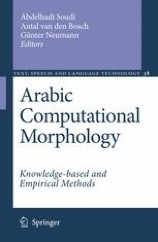
Arabic Computational Morphology : Knowledge-based and Empirical Methods
The morphology of Arabic poses special challenges to computational natural language processing systems. The exceptional degree of ambiguity in the writing system, the rich morphology, and the highly complex word formation process of roots and patterns all contribute to making computational approaches to Arabic very challenging. Indeed many computational linguists across the world have taken up this challenge over time, and many of the researchers with a track record in this research area have contributed to this book.
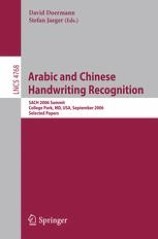
Arabic and Chinese Handwriting Recognition ; SACH 2006 Summit College Park, MD, USA, September 27-28, 2006 Selected Papers
Cheriet provides an overview of the problems of Arabic recognition and how systems can use natural language processing techniques to correct errors in lexicon-based systems.
