



الصفحة 116
الصفحة 116
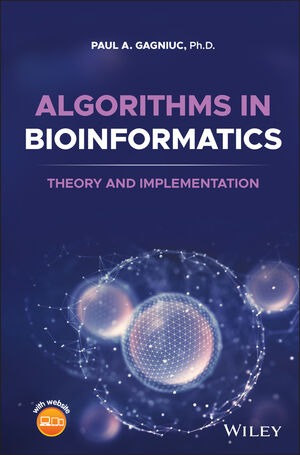
Algorithms in Bioinformatics : Theory and Implementation
Explores a comprehensive and insightful treatment of the practical application of bioinformatic algorithms in a variety of fields. Delivers a fulsome treatment of some of the main algorithms used to explain biological functions and relationships. It introduces readers to the art of algorithms in a practical manner which is linked with biological theory and interpretation. The book covers many key areas of bioinformatics, including global and local sequence alignment, forced alignment, detection of motifs, Sequence logos, Markov chains or information entropy. Other novel approaches are also described, such as Self-Sequence alignment, Objective Digital Stains (ODSs) or Spectral Forecast and the Discrete Probability Detector (DPD) algorithm. Readers will also benefit from the inclusion of: A detailed presentation of new methods, such as Self-sequence alignment, Objective Digital Stains and Spectral Forecast ; A treatment of sequence alignment, including local sequence alignment, global sequence alignment and forced sequence alignment with full implementations ; Discussions of position-specific weight matrices, including the count, weight, relative frequencies, and log-likelihoods matrices ; A detailed presentation of the methods related to Markov Chains as well as a description of their implementation in Bioinformatics and adjacent fields ; An examination of information and entropy, including sequence logos and explanations related to their meaning ; A chapter on philosophical transactions that allows the reader a broader view of the prediction process ; Extensive worked examples with detailed case studies that point out the meaning of different results
Algorithmic Foundations of Robotics VI
Robot algorithms are abstractions of computational processes that control or reason about motion and perception in the physical world. Because actions in the physical world are subject to physical laws and geometric constraints, the design and analysis of robot algorithms raises a unique combination of questions in control theory, computational and differential geometry, and computer science. Algorithms serve as a unifying theme in the multi-disciplinary field of robotics. This volume consists of selected contributions to the sixth Workshop on the Algorithmic Foundations of Robotics. This is a highly competitive meeting of experts in the field of algorithmic issues related to robotics and automation.
Algorithmic Aspects of Bioinformatics
Advances in bioinformatics and systems biology require improved computational methods for analyzing data, while progress in molecular biology is in turn influencing the development of computer science methods. This book introduces some key problems in bioinformatics, discusses the models used to formally describe these problems, and analyzes the algorithmic approaches used to solve them. After introducing the basics of molecular biology and algorithmics, Part I explains string algorithms and alignments; Part II details the field of physical mapping and DNA sequencing; and Part III examines the application of algorithmics to the analysis of biological data. Exciting application examples include predicting the spatial structure of proteins, and computing haplotypes from genotype data. This book describes topics in detail and presents formal models in a mathematically precise, yet intuitive manner, with many figures and chapter summaries, detailed derivations, and examples. It is well suited as an introduction into the field of bioinformatics, and will benefit students and lecturers in bioinformatics and algorithmics, while also offering practitioners an update on current research topics.
Algorithm collections for digital signal processing applications using matlab
The Algorithms such as SVD, Eigen decomposition, Gaussian Mixture Model, HMM etc. are scattered in different fields. There is the need to collect all such algorithms for quick reference. Also there is the need to view such algorithms in application point of view. Algorithm Collections for Digital Signal Processing Applications using MATLAB attempts to satisfy the above requirement. Also the algorithms are made clear using MATLAB programs.
Algèbre, Chapitre 9 = Algebra, Chapter 9
Sesquilinear and quadratic forms : The Mathematics Elements of Nicolas BOURBAKI aim to provide a rigorous, systematic presentation without prerequisites of mathematics from their foundations. This ninth chapter of the Book of Algebra, the second Book of the treatise, is devoted to quadratic, symplectic or Hermitian forms and to associated groups.
Algèbre commutative, Chapitre 10 = Commutative Algebra, Chapter 10
Depth, Regularity, Duality The Mathematics Elements of Nicolas BOURBAKI aim to provide a rigorous, systematic presentation without prerequisites of mathematics from their foundations. This volume of the Book of Commutative Algebra, Book 7 of the treatise, is a continuation of the earlier chapters. It introduces in particular the notions of depth and smoothness, fundamental in algebraic geometry. It ends with the introduction of the dualizing modules and the Grothendieck duality.

Algèbre : Chapitre 10 : Algèbre homologique = Algebra : Chapter 10 : Homological algebra
The Mathematics Elements of Nicolas BOURBAKI aim to provide a rigorous, systematic presentation without prerequisites of mathematics from their foundations. This tenth chapter of the Book of Algebra, the second Book of the treatise, lays the foundations of the homological calculus.
Algebras, Rings and Modules ; Vol.2
This book provides both the classical aspects of the theory of groups and their representations as well as a general introduction to the modern theory of representations including the representations of quivers and finite partially ordered sets and their applications to finite dimensional algebras.
Algebraic Methodology and Software Technology ; 12th International Conference, AMAST 2008 Urbana, IL, USA, July 28-31, 2008 Proceedings
This book constitutes the refereed proceedings of the 12th International Conference on Algebraic Methodology and Software Technology, AMAST 2008, held in Urbana, IL, USA, in July 2008.

Algebraic Methodology and Software Technology ; 11th International Conference, AMAST 2006, Kuressaare, Estonia, July 5-8, 2006, Proceedings
This is the proceedings of the 11th edition of the Algebraic Methodology and Software Technology (AMAST) conference series. The rst conference was held in the USA in 1989, and since then AMAST conferences have been held on (or near) fve diferent continents and have been hosted by many of the most prominent people and organizations in the ?eld. The AMAST initiative has always sought to have practical efects by dev- oping the science of software and basing it on a ?rm mathematical foundation. AMAST hasinterpretedsoftwaretechnologybroadly,andhas, for example, held AMAST workshops in areas as diverse as real-time systems and (natural) l- guage processing. Similarly, algebraic methodology is interpreted broadly and includes abstract algebra, category theory, logic, and a range of other ma- ematical subdisciplines.

Algebraic informatics ; 2nd International conference, CAI 2007, Thessalonkik, Greece, May 21-25, 2007, Revised Selected and Invited Papers
It covers algebraic semantics on graphs and trees, formal power series, syntactic objects, algebraic picture processing, infinite computation, acceptors and transducers for strings, trees, graphs, arrays, etc., and decision problems.
Algebraic Biology ; 3rd International Conference, AB 2008, Castle of Hagenberg, Austria, July 31-August 2, 2008 Proceedings
This book constitutes the refereed proceedings of the Third International Conference on Algebraic Biology, AB 2008, held at the Castle of Hagenberg, Austria in July 2008 as part of the RISC Summer 2008, organized by the Research Institute for Symbolic Computation.
Algebraic Biology ; 2nd International Conference, AB 2007, Castle of Hagenberg, Austria, July 2-4, 2007, Proceedings
This volume constitutes the refereed proceedings of the Second International Conference on Algebraic Biology. The conference served as an interdisciplinary forum for the presentation of research on all aspects of the application of symbolic computation in biology, including computer algebra, computational logic, and related methods.

Algebraic and Proof-theoretic Aspects of Non-classical Logics : Papers in Honor of Daniele Mundici on the Occasion of His 60th Birthday
It profound connections between logic and such diverse fields of research as functional analysis, probability and measure theory, the geometry of toric varieties, piecewise linear geometry, and error-correcting codes. Several prominent logicians, mathematicians, and computer scientists
Algebra, Meaning, and Computation ; Essays dedicated to Joseph A. Goguen on the Occasion of His 65th Birthday
This Festschrift volume - published to honor Joseph Goguen on his 65th Birthday on June 28, 2006 - includes 32 refereed papers by leading researchers in the different areas spanned by Joseph Goguen's work. The papers address a broad variety of topics from meaning, meta-logic, specification and composition, behavior and formal languages, as well as models, deduction, and computation.The papers were presented at a Symposium in San Diego, California, USA in June 2006.
Algebra and Coalgebra in Computer Science; First International Conference, CALCO 2005, Swansea, UK, September 3-6, 2005, Proceedings
CALCO, the Conference on Algebra and Coal-gebra in Computer Science, was created to bring together researchers and practitio-ners to exchange new results related to foundational aspects, and both traditional and emerging uses of algebras and coalgebras in computer science. CALCO 2005 was the first instance of this new conference. The interest that it generated in the scientific community suggests that it will not be the last. Indeed, it attracted as many as 62 submissions covering a wide range of topics roughly divided into two areas: Algebras and Coalgebras as Mathematical Objects: Automata and languages; categorical semantics; hybrid, probabilistic, and timed systems; inductive and coin-ductive methods; modal logics; relational systems and term rewriting.

Algebra and Coalgebra in Computer Science ; 2nd International Conference, CALCO 2007, Bergen, Norway, August 20-24, 2007, Proceedings
Addressing two basic areas of application for algebras and coalgebras - as mathematical objects as well as in the context of their application in computer science - the papers cover topics such as abstract models and logics, specialised models and calculi, algebraic and coalgebraic semantics, and system specification and verification.

Algebra 3 : Homological Algebra and Its Applications
Includes algebra, deals with important topics in homological algebra, including abstract theory of derived functors, sheaf co-homology, and an introduction to etale and l-adic co-homology. It contains four chapters which discuss homology theory in an abelian category together with some important and fundamental applications in geometry, topology, algebraic geometry (including basics in abstract algebraic geometry), and group theory.
Algal Toxins : Nature, Occurrence, Effect and Detection
This volume contains the lectures and seminars given at the NATO Advanced Study Institute on “Sensor Systems for Biological Threads: The Algal Toxins Case”, held in Pisa, Italy in October, 2007. Algae can form heavy growths in ponds, lakes, reservoirs and sl- moving rivers throughout the world; algae can house toxins which are - ually released into water when the cells rupture or die. Hundreds of toxins have been identified so far. Detection methods, including rapid screening, have been developed to help us learning more about them, especially to find out which toxins are a real threat for people and what conditions encourage their production and accumulation. Early detection of algal toxins is an - portant aspect for public safety and natural environment, and significant efforts are underway to develop effective and reliable tools that can be used for this purpose.
Algal Chemical Ecology
This is the first ever book devoted entirely to the chemical ecology of algae. Algae from both marine and freshwater habitats are covered, as are macroalgae (seaweeds) and microalgae (including phytoplankton). While its main emphasis is on the ecological rather than chemical aspects of the field, the book also includes a unique introductory chapter intended as a primer on algal natural products chemistry for ecologists. It elucidates the roles of chemical defenses in various regions and habitats, of DMSP, oxidative burst responses, and herbivore offense. Topics such as algal sensory chemical ecology and defenses against ultraviolet radiation are also treated, and an introduction to the chemical ecology of phytoplankton is provided.
