



الصفحة 10
الصفحة 10
AI in learning : Designing the future
AI (artificial intelligence) is predicted to radically change teaching and learning in both schools and industry causing radical disruption of work. AI can support well-being initiatives and lifelong learning but educational institutions and companies need to take the changing technology into account. Moving towards AI supported by digital tools requires a dramatic shift in the concept of learning, expertise and the businesses built off of it. Based on the latest research on AI and how it is changing learning and education, this book will focus on the enormous opportunities to expand educational settings with AI for learning in and beyond the traditional classroom. This book also introduces ethical challenges related to learning and education, while connecting human learning and machine learning.

Agility by ARIS business process management : Yearbook business process excellence 2006/2007
Business Process Management has recently become a real "hype" topic. Too often, however, the technical aspects are being focused upon. The book offers valuable ideas to companies on how to optimize their own business processes and thus become more competitive.

Advances in pharma business management and research ; Vol. 1
This book presents a unique collection of practical examples from the field of pharma business management and research. It covers a wide range of topics such as: 'Brexit and its Impact on pharmaceutical Law - Implications for Global Pharma Companies', 'Implementation of Measures and Sustainable Actions to Improve Employee's Engagement', 'Global Medical Clinical and Regulatory Affairs (GMCRA)', and 'A Quality Management System for R&D Project and Portfolio Management in a Pharmaceutical Company'.

Advances in Human-Robot Interaction
The book addresses key issues of human-robot interaction concerned with perception, modelling, control, planning and cognition, covering a wide spectrum of applications. This includes interaction and communication with robots in manufacturing environments and the collaboration and co-existence with assistive robots in domestic environments. Among the presented examples are a robotic bartender, a new programming paradigm for a cleaning robot, or an approach to interactive teaching of a robot assistant in manufacturing environment. This carefully edited book reports on contributions from leading German academic institutions and industrial companies brought together within MORPHA, a 4 year project on interaction and communication between humans and anthropomorphic robot assistants
Advances in Data Mining : Applications in E-Commerce, Medicine, and Knowledge Management
Presents papers describing selected projects on the topic of data mining in fields like e commerce, medicine, and knowledge management. The objective is to report on current results and at the same time to give a review on the present activities in this field in Germany. An effort has been made to include the latest scientific results, as well as lead the reader to the various fields of activity and the problems related to them. Knowledge discovery on the basis of web data is a wide and fast growing area. E commerce is the principal theme of motivation in this field, as companies invest large sums in the electronic market, in order to maximize their profits and minimize their risks. Other applications are telelearning, teleteaching, service support, and citizen information systems. Concerning these applications, there is a great need to understand and support the user by means of recommendation systems, adaptive information systems, as well as by personalization.
Advances in Assessment and Modeling of Earthquake Loss
Originates from an international workshop organized by Turkish Natural Catastrophe Insurance Pool (TCIP) in November 2019 that gathered renown researchers from academia, representatives of leading international reinsurance and modeling companies as well as government agencies responsible of insurance pricing in Turkey. The book includes chapters related to post-earthquake damage assessment, the state-of-art and novel earthquake loss modeling, their implementation and implication in insurance pricing at national, regional and global levels, and the role of earthquake insurance in building resilient societies and fire following earthquakes. The rich context encompassed in the book makes it a valuable tool not only for professionals and researchers dealing with earthquake loss modeling but also for practitioners in the insurance and reinsurance industry.
Advanced Microsystems for Automotive Applications 2007 ; 3rd ed.
There is a coincidence of the AMAA objectives and those of EPoSS, the European Technology Platform on Smart Systems Integration, contributing intensively to the development of automotive-specific smart systems. You will find a series of the EPoSS items in the programme of the 11th AMAA, which continues to be a unique exchange forum for companies in the automotive value chain. The publication in hand also reflects these issues. It is a cut-out of new technological priorities in the area of microsystems-based smart devices and opens up a mid-term perspective of future smart systems applications in automobiles
Action Research in Software Engineering: Theory and Applications
This book addresses action research (AR), one of the main research methodologies used for academia-industry research collaborations. It elaborates on how to find the right research activities and how to distinguish them from non-significant ones. Further, it details how to glean lessons from the research results, no matter whether they are positive or negative. Lastly, it shows how companies can evolve and build talents while expanding their product portfolio.

Achieving the Paris Climate Agreement goals ; Part 2 : Science-based target setting for the finance industry — Net-Zero Sectoral 1.5˚C pathways for real economy sectors
Provides an in-depth analysis of industry sectors globally, and its purpose is to present emission reduction targets in 5-year steps (2025 to 2050) for the main twelve finance sectors per the Global Industry Classification System. This scientific analysis aims to support the United Nations Principles for Responsible Investment initiative to give sustainability guidance for the global finance industry. The industry sector pathways presented here are based on the latest global and regional 100% renewable energy and non-energy greenhouse gas Representative Concentration Pathways in order to keep climate change significantly under +1.5 C and thereby achieve the Paris Climate Agreement goals. The heart of this book is three chapters presenting the results of industry scenario modelling. These chapters cover twelve industry and service sectors as well as transportation and buildings. The specific energy demand and specific emissions are presented based on the emission accounting concept of “Scope 1, Scope 2 and Scope 3” emission pathways. This methodology has been developed to measure the climate and sustainability index for companies, and this research project expands the methodology to apply it to entire industry sectors ...

Accounting, Cash Flow and Value Relevance
Investigates the value relevance of the operating cash flow as reported under the International Financial Reporting Standards (IAS/IFRS) for the largest European listed companies and US listed companies in the past recent years. Using the model based on the valuation theory developed by Ohlson, which measures the market value of equity as a function of accounting variables, the author concludes that operating cash flow represents a significant variable in determining the value relevance of the largest European and US listed companies. These findings provide siginificant implications for standard setters and support the continued requirements for disclosure of cash flow information under IAS 7.

Accounting for social and environmental sustainability : A multi-capital approach
Offers an in‑depth examination of multi‑capital accounting, which has already been integrated within the corporate sustainability reporting directive and will follow on from sustainability reporting. the LIFTS model (limits and foundations towards sustainability accounting model) used in this book combines various scientific and practical contributions to develop budgets for environmental impacts and social obligations on an organisational scale. it proposes an accounting mechanism that enables an organization to manage each of its budgets and measure variances between forecast and actual. it provides an introduction to the principles of this model and its conditions of application and describes its implementation in numerous companies.
Accounting for business : Practicalities and strategies
Identifies the types of organizations that generate financial information and explains how you can use it for your benefit. The early chapters focus on the information that is publicly available for large companies and demonstrate how to select and analyze the figures for decision making. The later chapters concentrate on the detailed management accounting information that is available internally for managers so that they can make decisions, investigate problems, and set performance targets. The final chapter, explores emerging and very pertinent issues such as "Can the organization obtain the basic resources to stay in business?" and "Are its activities harmful to the environment??
Acceptance and Usage of Technology through the Digital User Experience
Sheds light on the challenges and solutions for companies when dealing with the online consumer on social media and in the era of Web 4.0. It investigates the digital transformation in terms of customer experience, customer empowerment, resistance, influencer marketing, and trust. The volume shows how consumers perceive, react and behave towards brands’ digital marketing strategies in addition to the barriers, constraints, advantages and modes of action of online consumers.
Abstraction Refinement for Large Scale Model Checking
This book describes recent research developments in automatic abstraction refinement techniques. The authors address the main challenge in abstraction refinement, i.e., the ability to efficiently reach or come close to the optimum abstraction (the smallest abstract model that proves or refutes the given property). A suite of fully automatic abstraction techniques are proposed to improve the overall computation efficiency. The suite of algorithms presented in this book has demonstrated significant improvement over the prior art; some of them have already been adopted by the EDA companies in their commercial/in-house verification tools.

A Stakeholder Rationale for Risk Management : Implications for Corporate Finance Decisions
Ordinarily, only the interests of shareholders, debtholders, and corporate management are taken into account when analyzing corporate financial decisions while the interests of non-financial stakeholders are often neglected. Gregor Gossy develops a so-called stakeholder rationale for risk management arguing that firms which are more dependent on implicit claims from their non-financial stakeholders, such as customers, suppliers, and employees, prefer conservative financial policies. In order to perform panel data analyses of the determinants of corporate financial decisions, the author uses data from Austrian and German industrial companies. He shows that variables for a firm’s most important non-financial stakeholders explain the firm’s capital structure and cash holding decisions. His findings suggest that a firm’s choice of accounting standards have a moderating effect on the determinants of corporate finance decisions.

A Guide to Sustainable Corporate Responsibility : From Theory to Action
Discusses the challenges and opportunities faced by companies in an age that increasingly values sustainability and demands corporate responsibility. Beginning with the historical development of corporate responsibility, this book moves from academic theory to practical application. It points to ways in which companies can successfully manage their transition to a more responsible, sustainable way of doing business, common mistakes to avoid and how the UN Sustainable Development Goals are integral to any sustainability transformation.
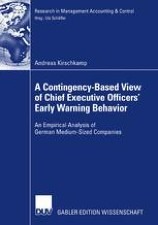
A Contingency-Based View of Chief Executive Officers' Early Warning Behaviour : An Empirical Analysis of German Medium-Sized Companies
Organizations need to identify risks and chances of environmental changes in order to adapt to or possibly even to influence them. Early warning which comprises scanning and interpretation plays an important role in this process. Whereas the traditional contingency approach considers early warning as a part of the organizational structure, the extended contingency theory assumes the additional influence of an individual’s personality on early warning. Andreas Kirschkamp empirically analyses the early warning behavior of Chief Executive Officers in German medium-sized companies. First, he presents the design variables of early warning, then the influencing contingency variables. On the basis of the scholarly research on psychological and contingency theory, the author deduces hypotheses and tests them. The results show that early warning behavior is not only influenced by traditional contingency variables but also by personal attitudes.

(R)Evolution : Organizations and the Dynamics of the Environment
Investigates the possible changes needed for industrial organizations to adapt to and remain competitive in their ever evolving environment. (R)Evolution’s main area of contribution to these very complex issues is embedded in the work’s ambitious attempt to borrow from evolutionary biology and genetics not only metaphors but also concepts and models to be adapted to the management of business organizations. The work provides us with a comprehensive vision of adaptation and variation in the business community, integrating various intellectual inputs which are based on an evolutionary vision of economic behavior. Using an extensive study of the literature in management science, and applying new models and methodologies in numerous case studies, Dekkers draws many insightful conclusions including the claim that companies often evolve slower than generally expected. Furthermore the research calls into question the effectiveness of the common practice of corporate reorganization. Embracing and merging most major contemporary developments in the theories of change into a comprehensive integrated approach, (R)Evolution is an invaluable resource for researchers specializing in the management of technological change.
