



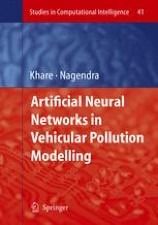
Artificial neural networks in Vehicular Pollution Modelling
Artificial neural networks (ANNs), which are parallel computational models, comprising of interconnected adaptive processing units (neurons) have the capability to predict accurately the dispersive behavior of vehicular pollutants under complex environmental conditions. This book aims at describing step-by-step procedure for formulation and development of ANN based VP models considering meteorological and traffic parameters. The model predictions are compared with existing line source deterministic/statistical based models to establish the efficacy of the ANN technique in explaining frequent dispersion complexities in urban areas. The book is very useful for hardcore professionals and researchers working in problems associated with urban air pollution management and control.
كتب مشابهة

Hotel building in Damascus city
Show a hotel building in Damascus. The project is a facility consisting of one basement use as a storage rooms and shelter, and ground story and twelve story.

A structural study and study of the site of Al-Rahma hospital - Deir Ez-Zour
Presents the structural study and design of Al-Rahma Hospital, located in Deir Ez-Zour, Al-Kanamat area near the Euphrates River. The hospital includes two basement levels and ten floors above ground. The basements house medical imaging rooms, storage spaces, and a shelter.

Introduction to finite element analysis : A textbook for engineering students
Covers the basic concepts and applications of finite element analysis. It is specifically aimed at introducing this advanced topic to undergraduate-level engineering students and practicing engineers in a lucid manner. It also introduces a structural and heat transfer analysis software FEASTSMT which has wide applications in civil, mechanical, nuclear and automobile engineering domains.

Fundamentals of durable reinforced concrete
The book presents a framework for specification through internationally adopted codes and standards and summarises the background to probabilistic approaches to durability design, providing a state-of-the-art review of mathematical modelling of deterioration mechanisms along with current directions in test methods for performance-based specifications.
