


تحسين النتائح
ترتيب حسب
من
الى

While the original works on Malliavin calculus aimed to study the smoothness of densities of solutions to stochastic differential equations, this book has another goal. It portrays the most important and innovative applications in stochastic control and finance, such as hedging in complete and incomplete markets, optimisation in the presence of asymmetric information and also pricing and sensitivity analysis. In a self-contained fashion, both the Malliavin calculus with respect to Brownian motion and general Lévy type of noise are treated. Besides, forward integration is included and indeed extended to general Lévy processes. The forward integration is a recent development within anticipative stochastic calculus that, together with the Malliavin calculus, provides new methods for the study of insider trading problems.
Low-Frequency Noise in Advanced CMOS Devices begins with an introduction to noise, describing the fundamental noise sources and basic circuit analysis. The characterization of low-frequency noise is discussed in detail and useful practical advice is given. The various theoretical and compact low-frequency (1/f) noise models in MOS transistors are treated extensively providing an in-depth understanding of the low-frequency noise mechanisms and the potential sources of the noise in MOS transistors. Advanced CMOS technology including nanometer scaled devices, strained Si, SiGe, SOI, high-k gate dielectrics, multiple gates and metal gates are discussed from a low-frequency noise point of view. Some of the most recent publications and conference presentations are included in order to give the very latest view on the topics. The book ends with an introduction to noise in analog/RF circuits and describes how the low-frequency noise can affect these circuits.
Among numerical methods applied in acoustics, the Finite Element Method (FEM) is normally favored for interior problems whereas the Boundary Element Method (BEM) is quite popular for exterior ones. That is why this valuable reference provides a complete survey of methods for computational acoustics, namely FEM and BEM. It demonstrates that both methods can be effectively used in the complementary cases. The chapters by well-known authors are evenly balanced: 10 chapters on FEM and 10 on BEM. An initial conceptual chapter describes the derivation of the wave equation and supplies a unified approach to FEM and BEM for the harmonic case. A categorization of the remaining chapters and a personal outlook complete this introduction. In what follows, both FEM and BEM are discussed in the context of very different problems.
Bandwidth Extension of Speech Signals provides discussion on different approaches for efficient and robust bandwidth extension of speech signals while acknowledging the influence of noise corrupted real-world signals. The book describes the theory and methods for quality enhancement of clean speech signals and distorted speech signals.
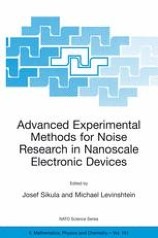
The approach described is to create methods for experimental observations of noise sources, their localization and their frequency spectrum, voltage-current and thermal dependences. Our current knowledge of measurement methods for mesoscopic devices is summarized to identify directions for future research, related to downscaling effects. The directions for future research into fluctuation phenomena in quantum dot and quantum wire devices are specified. Nanoscale electronic devices will be the basic components for electronics of the 21st century. From this point of view the signal-to-noise ratio is a very important parameter for the device application. Since the noise is also a quality and reliability indicator, experimental methods will have a wide application in the future.
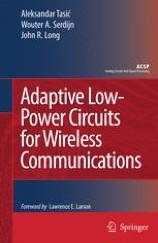
Adaptive radio transceivers require a comprehensive theoretical framework in order to optimize their performance. Adaptive Low-Power Circuits for Wireless Communications provides this framework with a discussion of joint optimization of Noise Figure and Input Intercept Point in receiver systems. Original techniques to optimize voltage controlled oscillators and low-noise amplifiers to minimize their power consumption while maintaining adequate system performance are also provided. The experimental results presented at the end of the book confirm the utility of the proposed techniques.

سوريا - اتستراد درعا - غباغب
+963-15 2050 - 15 860 380 /1/2/3 - 11 662 3900