تحسين النتائح
ترتيب حسب
من
الى



الكليات في الجامعة العربية الدولية
الخدمات الطلابية والأكاديمية

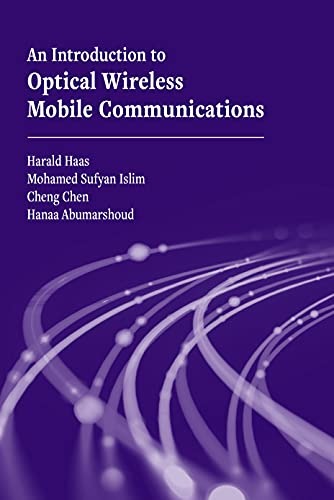
Discusses existing conventional radio frequency (RF)-based wireless access technology and presents the challenges that can impact the requirements of the future wave of new wireless services in the context of artificial intelligence (AI) driven autonomous systems and machine-type communications. The relationship between visible light communications (VLC) and light fidelity (LiFi), is explored, and the major advantages of VLC and LiFi such as security and data density, and discuss existing research challenges are also introduced. Channel modeling techniques are provided for mobile multiuser scenarios, and will introduce key building blocks to achieve LiFi cellular networks achieving orders of magnitude improvements of area spectral efficiency compared to state-of-the-art. Challenges that arise from moving from a static point-to-point visible light link to a LiFi network that is capable of serving hundreds of mobile and fixed nodes are discussed. An overview of recent standardization activities and the commercialization challenges of this disruptive technology is also provided.
Focuses on the foundations of linear estimation theory which is essential for effective signal processing. In its first part, it gives a comprehensive overview of several key methods like reduced-rank signal processing and Krylov subspace methods of numerical mathematics. Based on the derivation of the multistage Wiener filter in its most general form, the relationship between statistical signal processing and numerical mathematics is presented. In the second part, the theory is applied to iterative multiuser detection receivers (Turbo equalization) which are typically desired in wireless communication systems.
Complex Orthogonal Space-Time Processing in Wireless Communications incorporates orthogonal space-time processing using STBCs in MIMO wireless communication systems. Complex Orthogonal STBCs (CO STBCs) are given emphasis because they can be used for PSK/QAM modulation schemes and are more practical than real STBCs. The overall coverage provides general knowledge about space-time processing and its applications for broad audiences. It also includes the most up-to-date review of the literature on space-time processing in general, and space-time block processing in particular.
