



الصفحة 1
الصفحة 1

The post-socialist City : Urban form and space transformations in Central and Eastern Europe after Socialism
This book focuses on the spatial transformations in the most dynamically evolving urban areas of post-socialist Central and Eastern Europe, linking the restructuring of the built environment with the underlying processes and forces of socio-economic reforms. We hope that the detailed accounts of the spatial transformations in a key moment of urban history in the region will enhance our understanding of the linkages between society and space, adding to the knowledge that is needed for resolving the difficult challenges facing cities throughout the globe in the beginning of the twenty-first century.

The Poetics of Arabian Suqs : A Hermeneutic Reading of the Development of Arabian Sūqs from the Pre-Islamic Era to Present
Investigates the history of Arabian sūqs from their pre-Islamic beginnings to the present. Collecting evidence from archaeological ruins, Islamic towns, modern cities, Arabic poetry, philosophical debates, political conflicts, puppet shows and the insights of modern-day market-goers, the book presents new and unforeseen interpretations of the Arabian sūq’s meaning and its transformation through time and place. The finding that such meaning is tied to ancient trade rituals, where temple and market presented a holistic socio-urban unit, re-questions some instrumental assumptions regarding the value of sūq-ness in Arabia’s everyday practices. Such a finding, which locates the fadaā/tareeq duality as a central theme in Arabia’s socio-urban discourse, emphasizes the importance of lived experiences and poetics as key sources for understanding socio-urban phenomena.

Space, Movement, and Visibility in Pompeian Houses
Examines the pivotal role of movement, visibility, and experience within Pompeian houses as a major factor determining house form; the use of space; and the manner, meaning, and modalities of domestic daily life, through the application of GIS-based analysis. Through close consideration of ancient literature, detailed explanations of methodology, and exploration of results, Michael Anderson provides new perspectives on Pompeian domestic space including room types and household activities that rarely feature in the discussion of ancient housing. Readers gain a better understanding of priorities in the design of Pompeian houses, the degree to which daily life was interrupted by earthquake damage in the site’s final years, and evolving motivations behind wall painting decoration. The volume not only explores how Pompeian houses reflected the needs of everyday life as imagined by their architects, but also how these spaces served to influence and control daily activities and ultimately how they were transformed by the spatial and visual requirements of domestic life.

Planning Abu Dhabi : An Urban History
Alamira Reem, a native Abu Dhabian and urban planner and researcher who has studied the emirate’s development for more than a decade, is uniquely placed to write its urban history. Following the introduction and description of Abu Dhabi’s early modern history, she focuses on three distinct periods dating from the discovery of oil in 1960, and coinciding with periods in power of the three rulers since then: Sheikh Shakhbut bin Sultan Al Nahyan (1960–1966), Sheikh Zayed bin Sultan Al Nahyan (1966–2004), and Sheikh Khalifa bin Zayed Al Nahyan (2004–). Based on archival research, key interviews and spatial mapping, she analyses the different approaches of each ruler to development; investigates the role of planning consultants, architects, developers, construction companies and government agencies; examines the emergence of comprehensive development plans and the policies underlying them; and assesses the effects of these many and varied influences on Abu Dhabi’s development.

European cultural diplomacy and Arab Christians in Palestine, 1918–1948 : Between contention and connection
This book investigates the transnationally connected history of Arab Christian communities in Palestine during the British Mandate (1918-1948) through the lens of the birth of cultural diplomacy.

Coming to Terms with Superdiversity: The Case of Rotterdam
This book discusses Rotterdam as clear example of a superdiverse city that is only reluctantly coming to terms with this new reality. Rotterdam, as is true for many post-industrial cities, has seen a considerable backlash against migration and diversity: the populist party Leefbaar Rotterdam of the late Pim Fortuyn is already for many years the largest party in the city. At the same time Rotterdam has become a majority minority city where the people of Dutch descent have become a numerical minority themselves. The book explores how Rotterdam is coming to terms with superdiversity, by an analysis of its migration history of the city, the composition of the migrant population and the Dutch working class population, local politics and by a comparison with Amsterdam and other cities. As such it contributes to a better understanding not just of how and why super-diverse cities emerge but also how and why the reaction to a super-diverse reality can be so different.
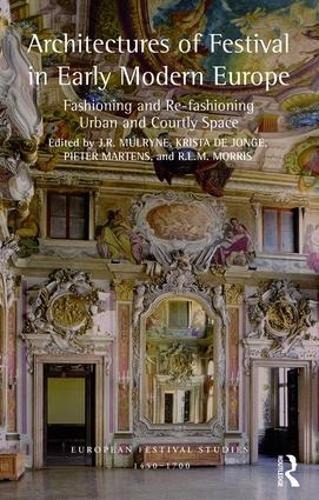
Architectures of festival in early modern Europe : Fashioning and re-fashioning urban and courtly space
Draws on up-to-date research by a Europe-wide group of academic scholars and museum and gallery curators to provide a unique, intellectually-stimulating and beautifully-illustrated account of temporary architecture created for festivals of the sixteenth and seventeenth centuries, together with permanent architecture pressed into service for festival occasions across major European locations including Italian, French, Austrian, Scottish and German.
