



الصفحة 1
الصفحة 1

Urban Transport Development : A Complex Issue
Urban Transport Development is a contribution to the ongoing global discussion on the future of urban transport. The main themes are how to cope with the complexity of urban transport development and the process of change including its determining factors. The role of leadership in the development process is the key issue. Main areas of discussion are the historical background, the diversity and complexity of present problems, and the outcome of attempts to promote positive future development in urban environments around the world.

Urban schools : Designing for high density
When space is tight how can a city provide the best education experience for children? Is a multi-storey school really a poor option? Can high-quality play opportunities be provided without playgrounds? This book explores the design of schools in urban settings, the increased challenges in meeting the typical expectations of school design, and what the successful new typology of a school in a city might be. A practical guide as well as a theoretical exploration of ideas, this book outlines successful international contemporary and historical case studies, providing much-needed guidance for architects and others working in education design in dense urban environments

Software-Intensive Systems and New Computing Paradigms : Challenges and Visions
The objective was to imagine the landscape in which next generations of software-intensive systems will operate and the challenges they present to computing, software engineering, cognition and intelligence. The volume starts with an overview of the current state of the art and the research missions in engineering software-intensive systems. The book is structured in three major parts: ensemble engineering, theory and formal methods, and novel computing paradigms. These papers cover a broad spectrum of relevant topics ranging from methods, languages and tools for ensemble engineering, socio-technical and cyber-physical systems, ensembles in urban environments, formal methods and mathematical foundations for ensembles, orchestration languages to disruptive paradigms such as molecular and chemical computing.

Reimagining sustainable cities : strategies for designing greener, healthier, more equitable communities
A cutting-edge, solutions-oriented analysis of how we can reimagine cities around the world to build sustainable futures. In recent years, cities have stepped up efforts to address climate and sustainability crises. But progress has not been fast enough or gone deep enough. If communities are to thrive in the future, we need to quickly imagine and implement an entirely new approach to urban development: one that is centered on equity and rethinks social, political, and economic systems as well as urban designs. With attention to this need for structural change, Reimagining Sustainable Cities advocates for a community-informed model of racially, economically, and socially just cities and regions.

Innovation Capacity and the City : The Enabling Role of Design
This book represents one of the key milestones of DESIGNSCAPES: value creation through design-enabled innovation”. The book demonstrates that adopting design allows us to embed innovation within the city so as to arrive at feasible answers to complex global challenges. In this way, innovation can become disruptive, while also sparking a dynamic of gradual change in the “urbanscape” it acts within. To explore this potential, the book puts forward the concept of “design enabled innovation in urban environments” and examines the part that the city can play in promoting and facilitating the adoption of design among public and private sector innovators. This leads to a potential evaluation framework in which a given urbanscape is assessed both in terms of its capacity for generating innovation, and of the nature (more or less design-dependent or design-prone) of the innovative initiatives it hosts. This thread of reasoning holds many promising implications, including a possible “third way” between those who dream of an alternative economic model where revenues and growth are sacrificed on the altar of social and environmental respect, and the supporters of the traditional market-based view, who feel it is enough to add a touch of responsibility and concern to a system that should continue rewarding the profitability of innovations.

Geo-Spatial Technologies in Urban Environments : Policy, Practice, and Pixels
This book expands the current frame of reference of remote sensing and geographic information specialists to include an array of socio-economic and related planning issues.

Geo-spatial technologies in urban environments : Policy, practice, and pixels
The purpose of this book is to investigate and develop alternate methodological approaches to understand urban environments and urban change. In particular, the study demonstrates the application of remote-sensing data and geographic information systems to the exploration of issues often ignored by the mainstream community of geo-technical specialists such as urban forestry, urban traffic, migration or quality of life in urban areas. Case studies show how disciplines like environmental science and planning, sociology, landscape ecology and architecture, regional science and policy design, and assessment can benefit from employing remote-sensing data and GIS.

Emergent architectural territories in east asian cities
Presents current developments in city planning and architecture in East Asia. It describes the many neighborhoods in which the region’s large cities are modernizing or expanding with innovative structures and advanced construction projects. It combines a typology of public structures with an analysis of the compositional principles of urban environments. Thus, it finally connects new developments in city planning with new developments in architecture, and considers examples such as CCTV, Lujiazui, Kansai Airport, Xinyi, Taipei 101, Chek Lap Kok, Cheonggyecheon, Roppongi Hills, Da Shanzi, Shahe, Omotesando, and Marina Bay from a new perspective.And the new perspectives presented here are not just theoretical: some forty full-page bird’s eye views prepared especially for this volume show these future urban settings in highly detailed images of breathtaking beauty.

Ecology, Planning, and Management of Urban Forests : International Perspective
Ecology, Planning, and Management of Urban Forests contains studies and perspectives on urban forests from a broad array of basic and applied scientific disciplines including ecosystem ecology, biogeochemistry, landscape ecology, plant community ecology, geography, and social science. The book contains contributions from experts in Asia, Europe, and North America, allowing the reader to evaluate methods and management that are appropriate for particular geographic, environmental, and socio-political contexts. Urban forests are also approached on regional and landscape scales to encompass more natural environments in and around cities, rather than within arbitrary municipal boundaries. The studies provided are intended to motivate scientists, planners, and managers to work together and to adopt a broader landscape ecology approach to urban forestry, and in so doing, better address the pressing needs for improving the quality of life in urban environments.
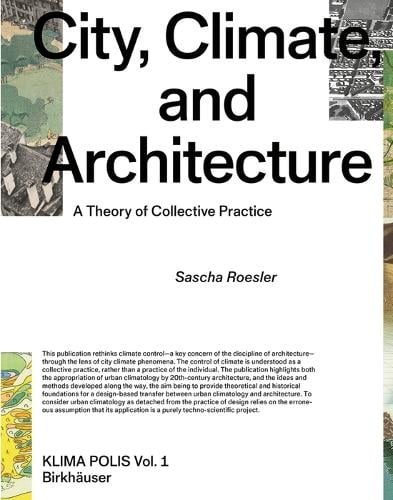
City, climate, and architecture : A theory of collective practice
Based on a history of climate control on urban scales, it promotes the integration of indoors and outdoors in order to reduce environmental and thermal loads in cities. Just as heating and cooling practices inside the buildings are affecting the (urban) climate outdoors, urban heat islands are influencing the energy requirements and thermal conditions inside the buildings. While the first part of the book focuses on the interwar period in Europe, the publication’s second part considers examples from all over the globe, tracing the growing significance of ecological thinking for the design of urban environments.
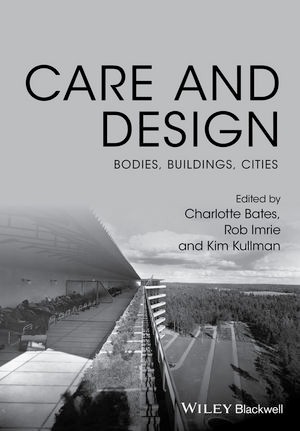
Care and Design: Bodies, Buildings, Cities
Connects the study of design with care, and explores how concepts of care may have relevance for the ways in which urban environments are designed. It explores how practices and spaces of care are sustained specifically in urban settings, thereby throwing light on an important arena of care that current work has rarely discussed in detail.
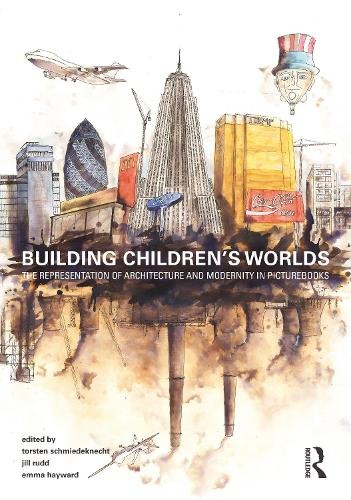
Building Children's Worlds : The Representation of Architecture and Modernity in Picturebooks
Children are the future architects, clients and users of our buildings. The kinds of architectural worlds they are exposed to in picturebooks during their formative years may be assumed to influence how they regard such architecture as adults. Contemporary urban environments the world over represent the various stages of modernism in architecture. This book reads that history through picturebooks and considers the kinds of national identities and histories they construct. Reveals what stories are told about modern architecture and shows how those stories affect future attitudes towards and expectations of the built environment.
