



الصفحة 1
الصفحة 1

The Role of Smallholder Farms in Food and Nutrition Security
Discusses the current role of smallholders in connection with food security and poverty reduction in developing countries. It addresses the opportunities they enjoy, and the constraints they face, by analysing the availability, access to and utilization of production factors.

The Climate-Smart Agriculture Papers : Investigating the Business of a Productive, Resilient and Low Emission Future
Shares new data relating to Climate-Smart Agriculture (CSA), with emphasis on experiences in Eastern and Southern Africa. The material is assembled to answer key questions on the following five topic areas: Climate impacts: What are the most significant current and near future climate risks undermining smallholder livelihoods?, Varieties: How can climate-smart varieties be delivered quickly and cost-effectively to smallholders?, Farm management: What are key lessons on the contributions from soil and water management to climate risk reduction and how should interventions be prioritized?, Value chains: How can climate risks to supply and value chains be reduced? and Scaling up: How can most promising climate risks reduction strategies be quickly scaled up and what are critical success factors?

Technological and institutional innovations for marginalized smallholders in agricultural development
Presents contributions in theory, policy and practice to the science and policy of sustainable intensification by means of technological and institutional innovations in agriculture. The research insights re from Sub-Saharan Africa and South Asia. The purpose of this book is to be a reference for students, scholars and practitioners inthe field of science and policy for understanding and identifying agricultural productivity growth potentials in marginalized areas.
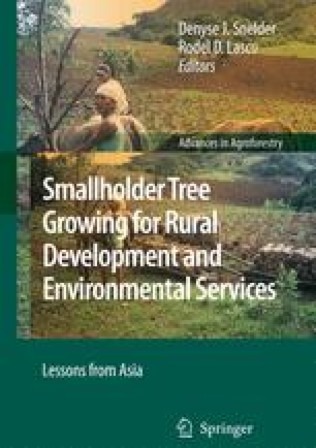
Smallholder Tree Growing for Rural Development and Environmental Services : Lessons from Asia
Recent history reveals both that the large-scale reforestation projects of the 20th century have often been less successful than anticipated, and that tree growing by smallholders – as an alternative means to combat deforestation and promote sustainable land use – has received relatively little attention from the scientific and development communities. Taking a first step to addressing that balance, this collection of peer-reviewed papers adopts a comparative approach to explore the potential role that tree growing by farmers can play in sustainable forest management. The goal of this approach is to identify common threads and to start to develop a framework for future research and practice.
Methods for measuring greenhouse Gas balances and evaluating mitigation options in smallholder agriculture
This book provides standards and guidelines for quantifying greenhouse gas emissions and removals in smallholder agricultural systems and comparing options for climate change mitigation based on emission reductions and livelihood trade-offs. Globally, agriculture is directly responsible for about 11% of annual greenhouse gas (GHG) emissions and induces an additional 17% through land use change, mostly in developing countries. Farms in the developing countries of sub-Saharan Africa and Asia are predominately managed by smallholders, with 80% of land holdings smaller than ten hectares. However, little to no information exists on greenhouse gas emissions and mitigation potentials in smallholder agriculture.
