



الصفحة 1
الصفحة 1

Values and Valuing in Mathematics Education : Scanning and Scoping the Territory
Discusses how a values and valuing perspective can facilitate a more effective mathematics pedagogical experience, and allows readers to explore multiple applications of the values perspective across different education systems. It also clearly shows that teaching mathematics involves not only reasoning and feelings.Addressing themes such as discovering hidden cultural values, a multicultural society and methodological issues in the investigation of values in mathematics, it stimulates readers to consider these topics in cross-cultural ways, and offers suggestions for research and classroom practice.

Software Product Lines ; Vol. 3714 ; 9th International Conference, SPLC 2005, Rennes, France, September 26-29, 2005, Proceedings
The technical program of SPLC 2005 included. – two keynotes from David Weiss (Avaya, USA) and Jan Bosch (Nokia, F- land), both leading experts with academic and industrial insights; – 17 full and 3 short research papers organized around the following themes: feature modeling, re-engineering, strategies, validation, scoping and architecture, and product derivation ; – eight experience reports describing commercial application of product line practices ; – two panels focused on special topics in product line practice and product line research ; – tool demonstrations ; – a Hall of Fame session that continued the SPLC tradition in as lightly revised format. In addition, the technical program was preceded by a tutorial and workshop day that included ten half-day tutorials presented by well-recognized experts and five workshops on specific areas of product line research.

Quantifying Environmental Impact Assessments Using Fuzzy Logic
The author places special emphasis on the types of issues that frequently arise in NEPA environmental assessments and environmental impact statements and in similar regulations that are used in jurisdictions regionally and internationally. The new methods are intended to reduce the time and cost of assessments, while producing justifiable and legally defensible results. First, issues related to current environmental impact assessment methods are discussed. Then the book discusses how lessons learned from computational intelligence can address these problems. It describes how a systematic, logical approach to environmental assessment can be applied to a variety of complex situations. Finally, the design and implementation of a more objective and powerful assessment is demonstrated through a worked example. Explanations of computational intelligence techniques and discussions of helpful software are intended to benefit those people actually preparing and using environmental assessments--in language that makes the process transparent and transferable to all types of systems.
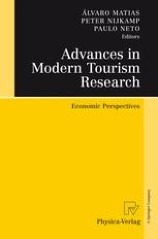
Advances in modern tourism research : Economic perspectives
Modern Advances in Tourism Research provides a thorough assessment of state-of-the-art academic research in this recent field of economic science. The authors start by scoping the scene of tourism research, evolving then to a comprehensive analysis of themes of particular interest for researchers and academics interested on the workings of the tourism markets. With a view to go beyond fundamental research, the book closes with a chapter dedicated to applied country and regional studies.
