


تحسين النتائح
ترتيب حسب
من
الى

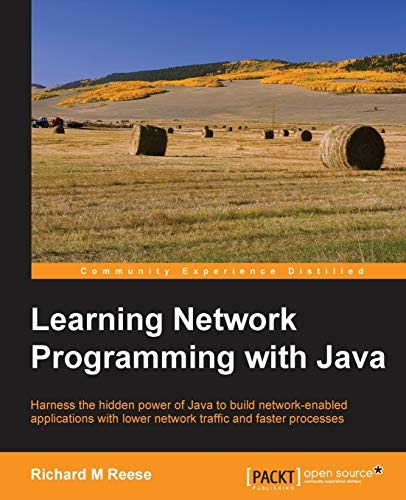
Learn to deliver superior server-to-server communication through the networking channels / Gain expertise of the networking features of your own applications to support various network architectures such as client/server and peer-to-peer Explore the issues that impact scalability, affect security, and allow applications to work in a heterogeneous environment
This followup to Jeni Tennison's Beginning XSLT has been updated to accomodate the revised XSLT standard. Part one of this book introduces XML and XSLT at a comfortable pace, and gradually demonstrates techniques for generating HTML (plus other formats), from XML. In part two, Tennison applies theory to real-life XSLT capabilities—including generating graphics. Each chapter includes step-by-step examples (with code available online), plus review questions at the end, to help you grasp the discussed features. In fact, all of the examples and exercises revolve around an interesting common theme: making TV listings available online. This book lives up to its name, and will definitely take you from a novice to a professional, in no time!
Introduces you to the Scala programming language, its object-oriented and functional programming characteristics, and then guides you through Scala constructs and libraries that allow you to assemble small components into high-performance, scalable systems. You will understand why Scala is judiciously used for critical business applications by leading companies such as Twitter, LinkedIn, Foursquare, the Guardian, Morgan Stanley, Credit Suisse, UBS, and HSBC – and you will be able to use it in your own projects. You will: Get started with Scala 3 or Scala language programming in general / Understand how to utilitze OOP in Scala / Perform functional programming in Scala / Master the use of Scala collections, traits and implicits / Leverage Java and Scala interopability / Employ Scala for DSL programming / Use patterns and best practices in Scala

Beginning ASP.NET 2.0 Databases: From Novice to Professional is a comprehensive introduction to connecting a website to many different data sourcesnot just databases. You'll learn how to build a relational database, use SQL to communicate with it, and leverage both in your web applications. You'll also learn about the new features of ADO.NET and ASP.NET in .NET 2.0. The authors cover mission-critical issues, such as design, transactions, error handling, optimization, and scalability. They examine SQL Server, Jet, and MySQL databases, and highlight the differences among them.
Membrane computing is a branch of natural computing which investigates computing models abstracted from the structure and functioning of living cells and from their interactions in tissues or higher-order biological structures. The models considered, called membrane systems (P systems), are parallel, distributed computing models, processing multisets of symbols in cell-like compartmental architectures. In many applications membrane systems have considerable advantages – among these are their inherently discrete nature, parallelism, transparency, scalability and nondeterminism.
Analyzing computer system performance is often regarded by most system administrators, IT professionals and software engineers as a black art that is too time consuming to learn and apply. Finally, this book by acclaimed performance analyst Dr. Neil Gunther makes this subject understandable and applicable through programmatic examples. The means to this end is the open-source performance analyzer Pretty Damn Quick (PDQ) written in Perl As the epigraph in this book points out, Common sense is the pitfall of performance analysis. The performance analysis framework that replaces common sense is revealed in the first few chapters of Part I. The important queueing concepts embedded in PDQ are explained in a very simple style that does not require any knowledge of formal probability theory. Part II begins with a full specification of how to set up and use PDQ replete with examples written in Perl. Subsequent chapters present applications of PDQ to the performance analysis of multicomputer architectures, benchmark results, client/server scalability, and Web-based applications.

ADVANCED WIRED AND WIRELESS NETWORKS brings the reader a sample of recent research efforts representative of advances in the areas of recognized importance for the future Internet, In Part I, we bring ad-hoc networking closer to the reality of practical use. The focus is on more advanced scalable routing suitable for large networks, directed flooding useful in information dissemination networks, as well as self-configuration and security issues important in practical deployments. Part II illustrates the efforts towards development of advanced mobility support techniques (beyond traditional "mobile phone net") and Mobile IP technologies. The issues range from prediction based mobility support, through context transfer during Mobile IP handoff, to service provisioning platforms for heterogeneous networks. The focus of the final section concerns the performance of networks and protocols. Furthermore this section illustrates researchers’ interest in protocol enhancement requests for improved performance with advanced networks, reliable and efficient multicast methods in unreliable networks, and composite scheduling in programmable/active networks where computing resources equal network performance as transmission bandwidth.

Distributed and communicating objects are becoming ubiquitous. In global, Grid and Peer-to-Peer computing environments, extensive use is made of objects interacting through method calls. So far, no general formalism has been proposed for the foundation of such systems. Caromel and Henrio are the first to define a calculus for distributed objects interacting using asynchronous method calls with generalized futures, i.e., wait-by-necessity -- a must in large-scale systems, providing both high structuring and low coupling, and thus scalability. The authors provide very generic results on expressiveness and determinism, and the potential of their approach is further demonstrated by its capacity to cope with advanced issues such as mobility, groups, and components.
Covers topics in knowledge management and competence in strategy development, management techniques, collaboration mechanisms, knowledge sharing and learning, as well as knowledge capture and storage. Presented in accessible “chunks,” it includes more than 120 topics that are essential to high-performance organizations. The extensive use of quotes by respected experts juxtaposed with relevant research to counterpoint or lend weight to key concepts; “cheat sheets” that simplify access and reference to individual articles; as well as the grouping of many of these topics under recurrent themes make this book unique. In addition, it provides scalable tried-and-tested tools, method and approaches for improved organizational effectiveness.

This book provides a clear holistic conceptual framework of CISS-F (competitiveness, inclusiveness, sustainability, scalability and access to finance) to analyse the efficiency of value chains of high value agricultural commodities in India. It is based on the understanding that agriculture is an integrated system that connects farming with logistics, processing and marketing. Farmer’s welfare being central to any agricultural policy makes it very pertinent to study how a value chain works and can be strengthened further to realize this policy goal.
This book presents new adaptive solution methods for multiobjective optimization problems based on parameter dependent scalarizations. With the help of sensitivity results an adaptive parameter control is developed so that high-quality approximations of the efficient set are generated. These examinations are based on a general scalarization approach for arbitrary partial orderings defined by a closed pointed convex cone in the objective space. The application of the results to many other well-known scalarization methods is also presented. Background material of multiobjective optimization and scalarization approaches is concisely summarized at the beginning. The effectiveness of these new methods is demonstrated by test problems and a recent problem in intensity-modulated radiotherapy. The book concludes with a further application: a procedure for solving multiobjective bilevel optimization problems.

This book stresses the unity of electromagnetic theory with electric and magnetic fields developed in parallel. SI units are used throughout and considerable use is made of tensor notation and the Levi-Cevita symbol. To more closely display the parallelism, extensive use is made of the scalar magnetic potential particularly in dealing with the Laplace and Poisson equation. 85 worked problems illustrate the theory. Conformal mappings are dealt with in some detail. Relevant mathematical material is provided in appendices.

Contains a collection of exercises related to typical topics in a course on analytical and numerical methods offered in a degree program in Engineering or Mathematics. Starting with exercises in functional analysis and approximation theory, the text develops problems related to the numerical resolution of elliptic, parabolic, and hyperbolic partial differential equations, scalar or vector, in one or more spatial dimensions. Pure diffusion and pure convection problems are therefore addressed, alongside diffusion-transport problems and problems in compressible and incompressible fluid dynamics. Particular emphasis is given to the finite element method for the spatial discretization of the problems considered, although exercises on the finite difference and finite volume methods are also included.

The book integrates both classical and modern treatments of difference equations. It contains the most updated and comprehensive material, yet the presentation is simple enough for the book to be used by advanced undergraduate and beginning graduate students. This third edition includes more proofs, more graphs, and more applications. The author has also updated the contents by adding a new chapter on Higher Order Scalar Difference Equations, along with recent results on local and global stability of one-dimensional maps, a new section on the various notions of asymptoticity of solutions, a detailed proof of Levin-May Theorem, and the latest results on the LPA flour-beetle model

The goal of this book is to provide effective optimization algorithms for solving a broad class of problems quickly, accurately, and reliably by employing evolutionary mechanisms. In this regard, five significant issues have been investigated: Bridging the gap between theory and practice of GEAs, thereby providing practical design guidelines. Demonstrating the practical use of the suggested road map. Offering a useful tool to significantly enhance the exploratory power in time-constrained and memory-limited applications. Providing a class of promising procedures that are capable of scalably solving hard problems in the continuous domain. Opening an important track for multiobjective GEA research that relies on decomposition principle.
Ad Hoc Networks: Technologies and Protocols is a concise in-depth treatment of various constituent components of ad hoc network protocols. It reviews issues related to medium access control, scalable routing, group communications, use of directional/smart antennas, network security, and power management among other topics. The authors examine various technologies that may aid ad hoc networking including the presence of an ability to tune transmission power levels or the deployment of sophisticated smart antennae. Ad Hoc Networks: Protocols and Technologies will be immensely useful as a reference work to engineers and researchers as well as to advanced level students in the areas of wireless networks, and computer networks.

سوريا - اتستراد درعا - غباغب
+963-15 2050 - 15 860 380 /1/2/3 - 11 662 3900