



الصفحة 1
الصفحة 1

Integrated River Basin Management through Decentralization
Drawing upon a worldwide survey of river basin organizations and in-depth studies of eight river basins in a variety of locations around the globe, this book examines how institutional arrangements for managing water resources at the river-basin level have been designed and implemented, what the impetus for these arrangements has been, and what institutional features appear to be associated with greater or lesser success in river basin management.

Integrated Assessment of Water Resources and Global Change : A North-South Analysis
The key papers in this volume from the Bonn conference focus on the challenges of integrated assessment of water resources in the context of global change. The growing gap between North and South is also addressed, in terms not only of access to water and its quality, but also of the capacity to do research and implement solutions. The coverage of the papers is up-to-date and comprehensive. Highlights include emerging concepts such as blue and green water, virtual water, the water footprints of nations, multi-agent modelling, linkages between water and biodiversity, and social learning and adaptive management.

Hydrology and Water Resources of India
Divided into four sections the book provides a comprehensive overview of water resources of India. Beginning with a general description of the country, major hydrologic features, such as climate (precipitation, temperature, radiation, etc.), streamflow, groundwater, soil, etc. are discussed. A detailed treatment of all major river basins is provided, which includes description of catchments, tributaries, surface water and ground water, and important water resources projects. This is followed by a discussion on major uses of water in India, major projects, water related problems including environment and water quality, provisions of the constitution of India, interlinking of India rivers, and institutions dealing with water resources. Finally, the last chapter discusses some views on water management policy for India.

Forest Environments in the Mekong River Basin
Deforestation and forest degradation have continued over a long period of time, and the deterioration of forest environment management services is becoming one of the biggest concerns in the world. Especially in large continental river basins, sel? sh political attitudes and individual interests in some regions predispose other regions to problems downstream and bring about international issues. The Mekong is just such a river basin and its water is the most important resource, interdependent with the forest conditions in the region. The lives of millions of people are sustained by the water of the Mekong River, and mutual understanding on water resource mana- ment is essential in this region. Consequently, appropriate environment management to control water resources is required of each country along with scienti? c knowledge of forest management, including forest hydrology.

European water law and hydropolitics : An inquiry into the resilience of transboundary water governance in the European Union
provides the first comprehensive assessment of the various issues faced by countries in the European Union, where progressing climate change and urbanization pose significant cooperative challenges in a large number of river basins. Conducting a thorough analysis of the intricate web of EU water governance, it reveals that the hydropolitical stability of the European Union is already at risk. Further, given the structural nature of the shortcomings in EU water policy—e.g. the rigidity of the EU’s founding treaties or the institutional complacency of the European Commission— argues that these risks are likely to turn into sources of prolonged conflict, unless EU decision-making bodies take steps to address the new hydrological realities early on.
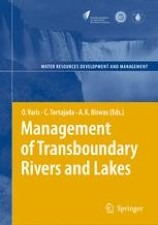
Management of Transboundary Rivers and Lakes
As it circulates in the atmosphere, in the rivers, lakes, soil, rock, and in the oceans, it is the major conveyer of va- ous chemical substances and of energy, and it can also be called as the blood of the ecosystems of this planet. But at the same time water is interwoven in the va- ous functions of the nature and the human society in countless ways which makes water one of the most complicated challenges of the mankind today.Human beings are exploiting and enjoying, but at the same time polluting and deteriorating, the waters in various ways and water is equally important to the - man socio-economic system as it is to the nature. It may sound a bit anecdotal to say that water obeys no borders, but that is true; the hydrologic cycle with its r- ers, river basins, lakes, aquifers, rainfalls, oceans, etc., cross administrational b- ders without any passport control. River and lake basins are in most cases very different from the administrational borders that the human beings have set up.
