



الصفحة 1
الصفحة 1

Philosophys Higher Education
In sociology it was the dualism of the individual and society. The question most asked in our classes was always regarding which aspect of the dualism dominated the other. The answer we always leaned towards was that both were mutually affected by the other. The answer seemed to lie somewhere in the middle. It was only at university, first as an undergraduate and then as a postgraduate, that I came across the idea of the dialectic. Slowly I began to recognise that the dualisms which plagued social theory—I and we, self and other, good and evil, modernity and post-modernity, autonomy and heteronomy, freedom and nature, truth and relativism, and so many more—were not only dialectical in being thought about, but also that the thought of them being dialectical had an even stranger quality. It was the same experience as being at school.

Moral Education : Beyond the Teaching of Right and Wrong
This volume is unique in providing a comprehensive discussion of moral education in the light of a range of ethical theories. In a balanced, thoughtful and penetrating account, all of these are shown to have a contribution to make to our moral understanding, and hence to moral education, even if none provides a definitive criterion of moral conduct. Though divine command is rejected as a source of moral justification, the possible contribution of some religious traditions to moral education is sympathetically considered. Fashionable relativism and recent moves towards inculcatory authoritarianism are both firmly rejected. The argument is philosophically rigorous throughout. Contemporary issues addressed include the links between personal morality and citizenship, including world citizenship, family values and sexual morality.

Diagrammatology : An investigation on the borderlines of phenomenology, ontology, and semiotics
Diagrammatology investigates the role of diagrams for thought and knowledge. Based on the general doctrine of diagrams in Charles Peirce's mature work, Diagrammatology claims diagrams to constitute a centerpiece of epistemology. The book reflects Peirce's work on the issue in Husserl's contemporanous doctrine of "categorial intuition" and charts the many unnoticed similarities between Peircean semiotics and early Husserlian phenomenology. Diagrams, on a Peircean account, allow for observation and experimentation with ideal structures and objects and thus furnish the access to the synthetic a priori of the regional and formal ontology of the Husserlian tradition.
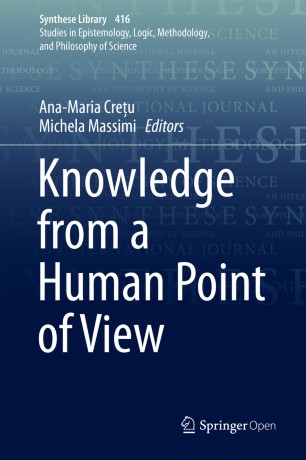
Knowledge from a Human Point of View
Explores some of the historical roots and epistemological ramifications of perspectivism. Perspectivism has recently emerged in philosophy of science as an interesting new position in the debate between scientific realism and anti-realism.
