



الصفحة 1
الصفحة 1

Vacation Queueing Models : Theory and Applications
A classical queueing model consists of three parts - arrival process, service process, and queue discipline. However, a vacation queueing model has an additional part - the vacation process which is governed by a vacation policy - that can be characterized by three aspects: 1) vacation start-up rule; 2) vacation termination rule, and 3) vacation duration distribution. Hence, vacation queueing models are an extension of classical queueing theory.

The self-taught computer scientist : The beginner's guide to data structures & algorithms
Introduces beginner and self-taught programmers to computer science fundamentals that are essential for success in programming and software engineering fields. Computer science is a massive subject that could cover an entire lifetime of learning. This book does not aim to cover everything you would learn about if you went to school to get a computer science degree. Instead, Cory’s goal is to give you an introduction to some of the most important concepts in computer science that apply to a programming career. With a focus on data structures and algorithms, The Self-Taught Computer Scientist helps you fill gaps in your knowledge, prepare for a technical interview, feel knowledgeable and confident on the job, and ultimately, become a better programmer.

Stochastic Processes, Optimization, and Control Theory : Applications in Financial Engineering, Queueing Networks, and Manufacturing Systems : A volume in Honor of Suresh Sethi
Presents stochastic processes, control theory, differential games, optimization, and their applications in finance, manufacturing, queueing networks, and climate control. One of the salient features is that the book is highly multi-disciplinary. It assembles experts from the fields of operations research, control theory and optimization, stochastic analysis, and financial engineering to review and substantially update the recent progress in these fields. Another distinct characteristic of the book is that all papers are motivated by applications in which optimization, control, and stochastics are inseparable. The book will be a timely addition to the literature and will be of interest to people working in the aforementioned fields.

Stochastic Learning and Optimization : A Sensitivity-Based Approach
Covers various disciplines in learning and optimization, including perturbation analysis (PA) of discrete-event dynamic systems, Markov decision processes (MDP)s), reinforcement learning (RL), and adaptive control, within a unified framework. (A simple approach to MDPs) This book introduces MDP theory through a simple approach based on performance difference formulas. This approach leads to results for the n-bias optimality with long-run average-cost criteria and Blackwell's optimality without discounting.

Stability of Queueing Networks : École d'Été de Probabilités de Saint-Flour XXXVI - 2006
Queueing networks constitute a large family of stochastic models, involving jobs that enter a network, compete for service, and eventually leave the network upon completion of service. Since the early 1990s, substantial attention has been devoted to the question of when such networks are stable. This volume presents a summary of such work. Emphasis is placed on the use of fluid models in showing stability, and on examples of queueing networks that are unstable even when the arrival rate is less than the service rate.

Retrial Queueing Systems : A Computational Approach
Retrial Queueing Systems: A Computational Approach also : Presents motivating examples in telephone and computer networks. / Establishes a comparative analysis of the retrial queues versus standard queues with waiting lines and queues with losses. / Integrates a wide range of techniques applied to the main M/G/1 and M/M/c retrial queues, and variants with general retrial times, finite population and the discrete-time case. / Surveys basic results of the matrix-analytic formalism and emphasizes the related tools employed in retrial queues. / Discusses a few selected retrial queues with QBD, GI/M/1 and M/G/1 structures.

Recent Advances in Modeling and Simulation Tools for Communication Networks and Services
This book contains a selection of papers presented at a Symposium organized under the aegis of COST Telecommunications Action 285. The main objective of the Action is to enhance existing modeling and simulation tools and to develop new tools for research in emerging multi-service telecommuncation networks in the areas of model performance improvement, multilayer traffic modeling, and the important issue of evaluation and validation of the new modeling tools.

Queueing Theory with Applications to Packet Telecommunication
Queueing Theory with Applications to Packet Telecommunication is an efficient introduction to fundamental concepts and principles underlying the behavior of queueing systems and its application to the design of packet-oriented electrical.

Premiers pas en simulation = First steps in simulation
Why simulation techniques? Simulation methods, designed for use in statistics and operations research, have experienced and continue to develop rapidly due to the extraordinary evolution of computers. Applications are found in industry and in economics, or even social sciences, in particle physics, in astronomy and in many other fields. In many situations, whether in everyday life or in scientific research, the researcher is faced with problems which he seeks solutions on the basis of certain initial assumptions and constraints. To solve this type of problem, there exist analytical methods applicable to situations where the model makes it possible to treat the di? Erent variables by mathematically manageable equations, and numerical methods where the complexity of the model imposes a fragmentation of the problem, in particular by the identification of the various variables which come into play and the study of their interactions. This last approach is often accompanied by a large mass of calculations. Simulation techniques are numerical techniques: to simulate a phenomenon essentially means to carefully reconstruct its evolution.

Power-Aware Computer Systems ; Vol.3471 : 4th International Workshop, PACS 2004, Portland, OR, USA, December 5, 2004, Revised Selected Papers
Welcome to the proceedings of the Power-Aware Computer Systems (PACS 2004) workshop held in conjunction with the 37th Annual International Sym- sium on Microarchitecture (MICRO-37). The continued increase of power and energy dissipation in computer systems has resulted in higher cost, lower re- ability, and reduced battery life in portable systems. Consequently, power and energy have become ?rst-class constraints at all layers of modern computer s- tems. PACS 2004 is the fourth workshop in its series to explore techniques to reduce power and energy at all levels of computer systems and brings together academic and industry researchers. The papers in these proceedings span a wide spectrum of areas in pow- aware systems. We have grouped the papers into the following categories: (1) microarchitecture- and circuit-level techniques, (2) power-aware memory and interconnect systems, and (3) frequency- and voltage-scaling techniques. The ?rst paper in the microarchitecture group proposes banking and wri- back ?ltering to reduce register ?le power. The second paper in this group - timizes both delay and power of the issue queue by packing two instructions in each issue queue entry and by memorizing upper-order bits of the wake-up tag. The third paper proposes bit slicing the datapath to exploit narrow width operations, and the last paper proposes to migrate application threads from one core to another in a multi-core chip to address thermal problems.

Point Process Theory and Applications : Marked Point and Piecewise Deterministic Processes
Offers a mathematically rigorous exposition of the basic theory of marked point processes developing randomly over time, and shows how this theory may be used to treat piecewise deterministic stochastic processes in continuous time. The focus is on point processes that generate only finitely many points in finite time intervals, resulting in piecewise deterministic processes with "few jumps". The point processes are constructed from scratch with detailed proofs and their distributions characterized using compensating measures and martingale structures. Piecewise deterministic processes are defined and identified with certain marked point processes, which are then used in particular to construct and study a large class of piecewise deterministic Markov processes, whether time homogeneous or not. The second part of the book addresses applications of the just developed theory. This analysis of various models in applied statistics and probability includes examples and exercises in survival analysis, branching processes, ruin probabilities, sports (soccer), finance and risk management (arbitrage and portfolio trading strategies), and queueing theory.

Multiaccess, Reservations & Queues
Reservation procedures constitute the core of many popular data transmission protocols. They consist of two steps: A request phase in which a station reserves the communication channel and a transmission phase in which the actual data transmission takes place. Such procedures are often applied in communication networks that are characterised by a shared communication channel with large round-trip times.In this book, we propose queuing models for situations that require a reservation procedure and validate their applicability in the context of cable networks.

Max-Plus Linear Stochastic Systems and Perturbation Analysis
This book provides a thorough treatment of the theory of stochastic max-plus linear systems. Max-plus algebra is an algebraic approach to discrete event systems (DES), like queuing networks that are prone to synchronization. Perturbation analysis studies the sensitivity of the performance of DES with respect to changes in a particular system parameter.

Introduction to Discrete Event Systems
Introduction to Discrete Event Systems is a comprehensive introduction to the field of discrete event systems, offering a breadth of coverage that makes the material accessible to readers of varied backgrounds. The book emphasizes a unified modeling framework that transcends specific application areas, linking the following topics in a coherent manner: language and automata theory, supervisory control, Petri net theory, Markov chains and queueing theory, discrete-event simulation, and concurrent estimation techniques

Hands-On Data Structures and Algorithms with Python : Store, manipulate, and access data effectively ; 3rd ed.
Expands your understanding of key structures, including stacks, queues, and lists, and also show you how to apply priority queues and heaps in applications. You'll learn how to analyze and compare Python algorithms, and understand which algorithms should be used for a problem based on running time and computational complexity. You will also become confident organizing your code in a manageable, consistent, and scalable way, which will boost your productivity as a Python developer. By the end of this Python book, you'll be able to manipulate the most important data structures and algorithms to more efficiently store, organize, and access data in your applications

Formal techniques for computer systems and business processes ; European performance engineering workshop, EPEW 2005 and International workshop on web services and formal methods, WS-FM 2005, Versailles, France, September 1-3, 2005, Proceedings
This book constitutes the refereed proceedings of two colocated international workshops EPEW 2005 (European Performance Engineering Workshop) and WS-FM 2005 (Web Services and Formal Methods) held in Versailles, France in September 2005. The 20 revised full papers presented were carefully reviewed and selected from 59 submissions. For EPEW 2005 only 10 papers - of the 32 submitted - were accepted for presentation; they deal with queueing theory, bounding techniques, stochastic model checking, communication schemes analysis for high-speed LAN, QOS analysis in wireless ad-hoc networks and optical networks analysis. The main topics of the 10 papers accepted for WS-FM 2005 - from 27 submissions - include: protocols and standards for WS (SOAP, WSDL, UDDI, etc.); languages and description methodologies for Choreography/Orchestration/Workflow (BPML, XLANG and BizTalk, WSFL, WS-BPEL, etc.); coordination techniques for WS (transactions, agreement, coordination services, etc.); semantics-based dynamic WS discovery services (based on Semantic Web/Ontology Techniques or other semantic theories); security, performance evaluation and quality of service of WS; semi-structured data and XML related technologies; comparisons with different related technologies/approaches.

Formal Methods and Stochastic Models for Performance Evaluation ; 3rd European Performance Engineering Workshop, EPEW 2006, Budapest, Hungary, June 21-22, 2006, Proceedings
This volume contains the proceedings of the third EPEW workshop held at the Technical University of Budapest, Budapest, Hungary, June 21-22, 2006. These proceedings comprise the 16 accepted contributed papers of EPEW 2006.Toensurethehigh-qualityevaluationofthesubmittedpapersweextended the ProgramCommittee of EPEW 2006 with international experts from all over the world. The ?nal workshop program, as well as this volume, are made up of ?ve thematic sessions: – Stochastic process algebra – Workloads and benchmarks – Theory of stochastic processes – Formal dependability and performance evaluation – Queues, theory and practice These sessions cover a wide range of performance evaluation methods and c- pose an overview of the current research directions in performance evaluation.

Fluctuation Theory for Lévy Processes : Ecole d'Eté de Probabilités de Saint-Flour XXXV - 2005
Lévy processes, i.e. processes in continuous time with stationary and independent increments, are named after Paul Lévy, who made the connection with infinitely divisible distributions and described their structure. They form a flexible class of models, which have been applied to the study of storage processes, insurance risk, queues, turbulence, laser cooling, ... and of course finance, where the feature that they include examples having "heavy tails" is particularly important. Their sample path behaviour poses a variety of difficult and fascinating problems

Computer Performance Engineering ; 5th European Performance Engineering Workshop, EPEW 2008, Palma de Mallorca, Spain, September 24-25, 2008. Proceedings
This book constitutes the proceedings of the Fifth European Performance Engineering Workshop, EPEW 2008, held in Palma de Mallorca, Spain, in September 24-25, 2008.
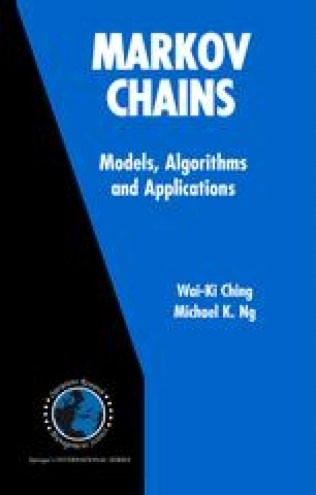
Markov Chains : Models, Algorithms and Applications
Markov chains are a particularly powerful and widely used tool for analyzing a variety of stochastic (probabilistic) systems over time. This monograph will present a series of Markov models, starting from the basic models and then building up to higher-order models. Included in the higher-order discussions are multivariate models, higher-order multivariate models, and higher-order hidden models. In each case, the focus is on the important kinds of applications that can be made with the class of models being considered in the current chapter. Special attention is given to numerical algorithms that can efficiently solve the models. Therefore, Markov Chains: Models, Algorithms and Applications outlines recent developments of Markov chain models for modeling queueing sequences, Internet, re-manufacturing systems, reverse logistics, inventory systems, bio-informatics, DNA sequences, genetic networks, data mining, and many other practical systems.
