



الصفحة 1
الصفحة 1

Numerical Solution of Partial Differential Equations on Parallel Computers
The scientific fields of Ma- ematics and Physics provide a powerful vehicle for such descriptions in terms of Partial Differential Equations (PDEs). Formulated as such equations, physical laws can become subject to computational and analytical studies. In the computational setting, the equations can be discreti ed for ef?cient solution on a computer, leading to valuable tools for simulation of natural and man-made processes. Numerical so- tion of PDE-based mathematical models has been an important research topic over centuries, and will remain so for centuries to come. In the context of computer-based simulations, the quality of the computed results is directly connected to the model’s complexity and the number of data points used for the computations. Therefore, computational scientists tend to ?ll even the largest and most powerful computers they can get access to, either by increasing the si e of the data sets, or by introducing new model terms that make the simulations more realistic, or a combination of both. Today, many important simulation problems can not be solved by one single computer, but calls for parallel computing.

Numerical partial differential equations for environmental scientists and engineers : A first practical course
This book concerns the practical solution of Partial Differential Equations (PDEs). It reflects an interdisciplinary approach to problems occurring in natural environmental media: the hydrosphere, atmosphere, cryosphere, lithosphere, biosphere and ionosphere. It assumes the reader has gained some intuitive knowledge of PDE solution properties and now wants to solve some for real, in the context of practical problems arising in real situations. The practical aspect of this book is the infused focus on computation. It presents two major discretization methods - Finite Difference and Finite Element. The blend of theory, analysis, and implementation practicality supports solving and understanding complicated problems. It is divided into three parts. Part I is an overview of Finite Difference Methods. Part II focuses on Finite Element Methods, including an FEM tutorial. Part III deals with Inverse Methods, introducing formal approaches to practical problems which are ill-posed.

Numerical Analysis and Its Applications ; 3rd International Conference, NAA 2004, Rousse, Bulgaria, June 29 - July 3, 2004, Revised Selected Papers
Constitutes the refereed post-proceedings of the Third International Conference on Numerical Analysis and Its Applications, held in Bulgaria in June/July 2004. This book addresses various aspects of numerical analysis. It covers the application fields such as computational sciences and engineering, chemistry, physics, economics, and simulation.

Nonlinear Oscillations of Hamiltonian PDEs
After introducing the reader to classical finite-dimensional dynamical system theory, including the Weinstein–Moser and Fadell–Rabinowitz resonant center theorems,the author develops the analogous theory for completely resonant nonlinear wave equations. Within this theory, both problems of small divisors and infinite bifurcation phenomena occur, requiring the use of Nash–Moser theory as well as minimax variational methods. These techniques are presented in a self-contained manner together with other basic notions of Hamiltonian PDEs and number theory.

Mathematical Problems in Image Processing : Partial Differential Equations and the Calculus of Variations
The goals of this book are to present a variety of image analysis applications, the precise mathematics involved and how to discretize them. Thus, this book is intended for two audiences. The first is the mathematical community by showing the contribution of mathematics to this domain. It is also the occasion to highlight some unsolved theoretical questions. The second is the computer vision community by presenting a clear, self-contained and global overview of the mathematics involved in image processing problems. This work will serve as a useful source of reference and inspiration for fellow researchers in Applied Mathematics and Computer Vision, as well as being a basis for advanced courses within these fields.

Instability in Models Connected with Fluid Flows II
Instability in Models Connected with Fluid Flows II presents chapters from world renowned specialists. The stability of mathematical models simulating physical processes is discussed in topics on control theory, first order linear and nonlinear equations, water waves, free boundary problems, large time asymptotics of solutions, stochastic equations, Euler equations, Navier-Stokes equations, and other PDEs of fluid mechanics. Fields covered include: the free surface Euler (or water-wave) equations, the Cauchy problem for transport equations, irreducible Chapman--Enskog projections and Navier-Stokes approximations, randomly forced PDEs, stability of equilibrium figures of uniformly rotating viscous incompressible liquid, Navier-Stokes equations in cylindrical domains, Navier-Stokes-Poisson flows in a vacuum.

Instability in Models Connected with Fluid Flows I
Instability in Models Connected with Fluid Flows I presents chapters from world renowned specialists. The stability of mathematical models simulating physical processes is discussed in topics on control theory, first order linear and nonlinear equations, water waves, free boundary problems, large time asymptotics of solutions, stochastic equations, Euler equations, Navier-Stokes equations, and other PDEs of fluid mechanics. Fields covered include: controllability and accessibility properties of the Navier- Stokes and Euler systems, nonlinear dynamics of particle-like wavepackets, attractors of nonautonomous Navier-Stokes systems, large amplitude monophase nonlinear geometric optics, existence results for 3D Navier-Stokes equations and smoothness results for 2D Boussinesq equations, instability of incompressible Euler equations, increased stability in the Cauchy problem for elliptic equations.

Homotopy-Based Methods in Water Engineering
Exploring the concept of homotopy from topology, different kinds of homotopy-based methods have been proposed for analytically solving nonlinear differential equations, given by approximate series solutions. Homotopy-Based Methods in Water Engineering attempts to present the wide applicability of these methods to water engineering problems. It solves all kinds of nonlinear equations, namely algebraic/transcendental equations, ordinary differential equations (ODEs), systems of ODEs, partial differential equations (PDEs), system of PDEs, and integro-differential equations using the homotopy-based methods

Homogenization of Partial Differential Equations
Homogenization is a method for modeling processes in microinhomogeneous media, which are encountered in radiophysics, filtration theory, rheology, elasticity theory, and other domains of mechanics, physics, and technology. These processes are described by PDEs with rapidly oscillating coefficients or boundary value problems in domains with complex microstructure. From the technical point of view, given the complexity of these processes, the best techniques to solve a wide variety of problems involve constructing appropriate macroscopic (homogenized) models. The present monograph is a comprehensive study of homogenized problems, based on the asymptotic analysis of boundary value problems as the characteristic scales of the microstructure decrease to zero. The work focuses on the construction of nonstandard models: non-local models, multicomponent models, and models with memory.

Hamiltonian Dynamics - Theory and Applications : Lectures given at the C.I.M.E. Summer School held in Cetraro, Italy, July 1-10, 1999
This volume collects three series of lectures on applications of the theory of Hamiltonian systems, contributed by some of the specialists in the field. The aim is to describe the state of the art for some interesting problems, such as the Hamiltonian theory for infinite-dimensional Hamiltonian systems, including KAM theory, the recent extensions of the theory of adiabatic invariants and the phenomena related to stability over exponentially long times of Nekhoroshev's theory. The books may serve as an excellent basis for young researchers, who will find here a complete and accurate exposition of recent original results and many hints for further investigation.

Fuchsian Reduction : Applications to Geometry, Cosmology, and Mathematical Physics
Fuchsian reduction is a method for representing solutions of nonlinear PDEs near singularities. The technique has multiple applications including soliton theory, Einstein's equations and cosmology, stellar models, laser collapse, conformal geometry and combustion. Developed in the 1990s for semilinear wave equations, Fuchsian reduction research has grown in response to those problems in pure and applied mathematics where numerical computations fail.

Forward-backward stochastic differential equations and their applications
This volume is a survey/monograph on the recently developed theory of forward-backward stochastic differential equations (FBSDEs). Basic techniques such as the method of optimal control, the "Four Step Scheme", and the method of continuation are presented in full. Related topics such as backward stochastic PDEs and many applications of FBSDEs are also discussed in detail. The volume is suitable for readers with basic knowledge of stochastic differential equations, and some exposure to the stochastic control theory and PDEs. It can be used for researchers and/or senior graduate students in the areas of probability, control theory, mathematical finance, and other related fields.

Finite Elements III : First-Order and Time-Dependent PDEs
Volume III is divided into 28 chapters. The first eight chapters focus on the symmetric positive systems of first-order PDEs called Friedrichs' systems. This part of the book presents a comprehensive and unified treatment of various stabilization techniques from the existing literature. It discusses applications to advection and advection-diffusion equations and various PDEs written in mixed form such as Darcy and Stokes flows and Maxwell's equations. The remainder of Volume III addresses time-dependent problems: parabolic equations (such as the heat equation), evolution equations without coercivity (Stokes flows, Friedrichs' systems), and nonlinear hyperbolic equations (scalar conservation equations, hyperbolic systems). It offers a fresh perspective on the analysis of well-known time-stepping methods. The last five chapters discuss the approximation of hyperbolic equations with finite elements. Here again a new perspective is proposed.

Finite element methods and their applications
This book serves as a text for one- or two-semester courses for upper-level undergraduates and beginning graduate students and as a professional reference for people who want to solve partial differential equations (PDEs) using finite element methods. The author has attempted to introduce every concept in the simplest possible setting and maintain a level of treatment that is as rigorous as possible without being unnecessarily abstract. Quite a lot of attention is given to discontinuous finite elements, characteristic finite elements, and to the applications in fluid and solid mechanics including applications to porous media flow, and applications to semiconductor modeling. An extensive set of exercises and references in each chapter are provided.
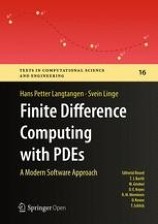
Finite Difference Computing with PDEs : A Modern Software Approach
This easy-to-read book introduces the basics of solving partial differential equations by means of finite difference methods. Unlike many of the traditional academic works on the topic, this book was written for practitioners. Accordingly, it especially addresses: the construction of finite difference schemes, formulation and implementation of algorithms, verification of implementations, analyses of physical behavior as implied by the numerical solutions, and how to apply the methods and software to solve problems in the fields of physics and biology.

Digital Simulation in Electrochemistry
The book shows how to numerically solve the parabolic partial differential equations (pdes) encountered in electroanalytical chemistry. It does this in a didactic manner, by first introducing the basic equations to be solved and some model systems as text cases, for which solutions exist. Then it treats basic numerical approximation for derivatives and techniques for the numerical solution of ordinary differential equations, from which the more complicated methods for pdes can be derived. The major implicit methods are described in detail, and the handling of homogeneous chemical reactions, including coupled and nonlinear cases, is detailed. More advanced techniques are presented briefly, as well as some commercially available program packages.
Mathematical modeling of the human brain : From magnetic resonance images to finite element simulation
This book bridges common tools in medical imaging and neuroscience with the numerical solution of brain modelling PDEs. The connection between these areas is established through the use of two existing tools, FreeSurfer and FEniCS, and one novel tool, the SVM-Tk, developed for this book. The reader will learn the basics of magnetic resonance imaging and quickly proceed to generating their first FEniCS brain meshes from T1-weighted images.
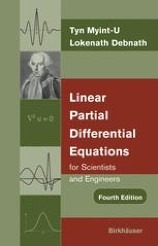
Linear Partial Differential Equations for Scientists and Engineers
This significantly expanded fourth edition is designed as an introduction to the theory and applications of linear PDEs. The authors provide fundamental concepts, underlying principles, a wide range of applications, and various methods of solutions to PDEs. In addition to essential standard material on the subject, the book contains new material that is not usually covered in similar texts and reference books, including conservation laws, the spherical wave equation, the cylindrical wave equation, higher-dimensional boundary-value problems, the finite element method, fractional partial differential equations, and nonlinear partial differential equations with applications.
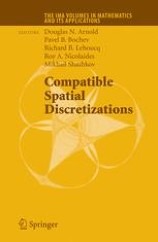
Compatible Spatial Discretizations
Compatible spatial discretizations are those that inherit or mimic fundamental properties of the PDE such as topology, conservation, symmetries, and positivity structures and maximum principles. It offer a snapshot of the current trends and developments in compatible spatial discretizations. The reader will find valuable insights on spatial compatibility from several different perspectives and important examples of applications compatible discretizations in computational electromagnetics, geosciences, linear elasticity, eigenvalue approximations and MHD. The contributions collected in this volume will help to elucidate relations between different methods and concepts and to generally advance our understanding of compatible spatial discretizations for PDEs.
