



الصفحة 1
الصفحة 1

WALCOM: Algorithms and Computation ; 2nd International Workshop, WALCOM 2008, Dhaka, Bangladesh, February 7-8, 2008. Proceedings
This book features original research in the areas of algorithms and data structures, combinatorial algorithms, graph drawings and graph algorithms, parallel and distributed algorithms, string algorithms, computational geometry, graphs in bioinformatics and computational biology. The book is organized in topical sections on bioinformatics algorithms, computational geometry and graph drawing, graph algorithms, and algorithm engineering.

Understanding Planning Tasks : Domain Complexity and Heuristic Decomposition
Action planning has always played a central role in Artificial Intelligence. Given a description of the current situation, a description of possible actions and a description of the goals to be achieved, the task is to identify a sequence of actions, i.e., a plan that transforms the current situation into one that satisfies the goal description. The book contains an exhaustive analysis of the computational complexity of the benchmark problems that have been used in the past decade, namely the standard benchmark domains of the International Planning Competitions (IPC). At the same time, it contributes to the practice of solving planning tasks by presenting a powerful new approach to heuristic planning. The author also provides an in-depth analysis of so-called routing and transportation problems.

Theory of Evolutionary Computation : Recent Developments in Discrete Optimization
Reports on recent developments in the theory of evolutionary computation, or more generally the domain of randomized search heuristics. It starts with two chapters on mathematical methods that are often used in the analysis of randomized search heuristics, followed by three chapters on how to measure the complexity of a search heuristic: black-box complexity, a counterpart of classical complexity theory in black-box optimization; parameterized complexity, aimed at a more fine-grained view of the difficulty of problems; and the fixed-budget perspective, which answers the question of how good a solution will be after investing a certain computational budget. The book then describes theoretical results on three important questions in evolutionary computation: how to profit from changing the parameters during the run of an algorithm; how evolutionary algorithms cope with dynamically changing or stochastic environments; and how population diversity influences performance. Finally, the book looks at three algorithm classes that have only recently become the focus of theoretical work: estimation-of-distribution algorithms; artificial immune systems; and genetic programming.

Theory of Computation
Theory of Computation is a unique textbook that serves the dual purposes of covering core material in the foundations of computing, as well as providing an introduction to some more advanced contemporary topics. This innovative text focuses primarily, although by no means exclusively, on computational complexity theory: the classification of computational problems in terms of their inherent complexity. It incorporates rigorous treatment of computational models, such as deterministic, nondeterministic, and alternating Turing machines; circuits; probabilistic machines; interactive proof systems; automata on infinite objects; and logical formalisms.

Theory and Applications of Models of Computation ; 16th International Conference, TAMC 2020, Changsha, China, October 18–20, 2020, Proceedings
This book constitutes the refereed proceedings of the 16th Annual Conference on Theory and Applications of Models of Computation, TAMC 2020, held in Changsha, China, in October 2020. The 37 full papers were carefully reviewed and selected from 83 submissions. The main themes of the selected papers are computability, complexity, algorithms, information theory and their extensions to machine learning theory and foundations of artificial intelligence.

Theoretical Computer Science ; Vol. 3701 ; 9th Italian Conference, ICTCS 2005, Siena, Italy, October 12-14, 2005, Proceedings
This book constitutes the refereed proceedings of the 9th International Conference on Theoretical Computer Science, ICTCS 2005, held at the Certosa di Pontignano, Siena, Italy, in October 2005. The 29 revised full papers presented together with an invited paper and abstracts of 2 invited talks were carefully reviewed and selected from 83 submissions. The papers address all current issues in theoretical computer science and focus especially on analysis and design of algorithms, computability, computational complexity, cryptography, formal languages and automata, foundations of programming languages and program analysis, natural computing paradigms (quantum computing, bioinformatics), program specification and verification, term rewriting, theory of logical design and layout, type theory, security, and symbolic and algebraic computation.

Techniques virales avancées = Advanced viral techniques
Deals with advanced techniques of computer virology from a double perspective: the analysis of antiviral defense and the different phases of an attack using malicious code.The point of view adopted is that of the attacker insofar as it is the only one which really allows the one who has the responsibility to defend a system, to understand what can happen and to consider the solutions to be implemented. artwork. The chosen approach involves the use of original Boolean systems, complexity theory and computability theory. Using general models, studying and identifying the most complex instances of the detection problem helps to determine how a near-undetectable attack can be designed.

Structural Theory of Automata, Semigroups, and Universal Algebra ; Proceedings of the NATO Advanced Study Institute on Structural Theory of Automata, Semigroups and Universal Algebra, Montreal, Quebec, Canada, 7-18 July 2003
Several of the contributions to this volume bring forward many mutually beneficial interactions and connections between the three domains of the title. Developing them was the main purpose of the NATO ASI summerschool held in Montreal in 2003. Although some connections, for example between semigroups and automata, were known for a long time, developing them and surveying them in one volume is novel and hopefully stimulating for the future. Another aspect is the emphasis on the structural theory of automata that studies ways to contstruct big automata from small ones. The volume also has contributions on top current research or surveys in the three domains. One contribution even links clones of universal algebra with the computational complexity of computer science. Three contributions introduce the reader to research in the former East block.

Soft Computing for Complex Multiple Criteria Decision Making
There are numerous books on Multiple Criteria Decision Making. Soft Computing for Complex Multiple Criteria Decision Making concentrates on providing technical (meaning formal, mathematical, algorithmical) tools to make the user of Multiple Criteria Decision Making methodologies independent of bulky optimization computations. These bulky computations up to now have been a necessary, but limiting, characteristic of interactive MCDM methodologies and algorithms. This book removes these limitations of MCDM problems by reducing a problem's computational complexity. The book systematically applies the approximate — soft — treatments to major MCDM solving methodologies. As a result, it provides a wider and more functional general framework for presenting, teaching, implementing and applying a wide range of MCDM methodologies. The book seeks to provide a stimulus for a broader development and application of MCDM methods.

Rational Algebraic Curves : A Computer Algebra Approach
Algebraic curves and surfaces are an old topic of geometric and algebraic investigation. They have found applications for instance in ancient and m- ern architectural designs, in number theoretic problems, in models of b- logical shapes, in error-correcting codes, and in cryptographic algorithms. Recently they have gained additional practical importance as central objects in computer-aided geometric design. Modern airplanes, cars, and household appliances would be unthinkable without the computational manipulation of algebraic curves and surfaces. Algebraic curves and surfaces combine fas- nating mathematical beauty with challenging computational complexity and wide spread practical applicability. In this book we treat only algebraic curves, although many of the results and methods can be and in fact have been generalized to surfaces. Being the solution loci of algebraic, i. e. , polynomial, equations in two variables, plane algebraiccurvesarewellsuited forbeing investigatedwith symboliccomputer algebra methods.

Randomized Algorithms for Analysis and Control of Uncertain Systems
The main objective of this book is to introduce the reader to the fundamentals of probabilistic methods in the analysis and design of uncertain systems. Using so-called "randomized algorithms", this emerging area of research guarantees a reduction in the computational complexity of classical robust control algorithms and in the conservativeness of methods like H-infinity control.

Parameterized and exact computation ; 3rd International Workshop, IWPEC 2008, Victoria, Canada, May 14-16, 2008. Proceedings
Constitutes the refereed proceedings of the Third International Workshop on Parameterized and Exact Computation, IWPEC 2008, held in Victoria, Canada ,The 17 revised full papers presented together with 3 invited lectures were carefully reviewed and selected from 32 submissions. The topics addressed cover research in all aspects of parameterized and exact computation and complexity, including but not limited to new techniques for the design and analysis of parameterized and exact algorithms, parameterized complexity theory, relationship between parameterized complexity and traditional complexity classifications, applications of parameterized computation, implementation and experiments, high-performance computing and fixed-parameter tractability.

Parameterized and Exact Computation ; 2nd International Workshop, IWPEC 2006, Zürich, Switzerland, September 13-15, 2006, Proceedin
IWPEC events are intended to cover research in all aspects of parameterizedand exact computation and complexity, including but not limited to new techniques for the design and analysis of parameterized and exact al- rithms, parameterized complexity theory, relationships between parameterized complexity and traditional complexity, applications of parameterized and exact computation, implementation issues and high-performance computing. A major goal is to disseminate the latest research results, including signi?cant work-- progress, and to identify, define and explore directions for future study. The papers accepted for presentation and printed in these proceedings rep- sent a diverse spectrum of the latest developments on parameterized and exact algorithm design, analysis, application and implementation.

Nonlinear Integer Programming
It is not an exaggeration that much of what people devote in their hfe re solves around optimization in one way or another. On one hand, many decision making problems in real applications naturally result in optimization problems in a form of integer programming. On the other hand, integer programming has been one of the great challenges for the optimization research community for many years, due to its computational difficulties: Exponential growth in its computational complexity with respect to the problem dimension. This book addresses the topic of the general nonlinear integer programming (NLIP). The overall goal of the book is to bring the state of the art of the theoretical foundations and solution methods of NLIP to readers who are interested in optimization, operations research and computer science. This book investigates the theory and solution methodologies for the general NLIP and provides the developments

Modern cryptography ; Vol.1 : A classical introduction to informational and mathematical principle
This book systematically explores the statistical characteristics of cryptographic systems, the computational complexity theory of cryptographic algorithms and the mathematical principles behind various encryption and decryption algorithms. The theory stems from technology. Based on Shannon's information theory, this book systematically introduces the information theory, statistical characteristics and computational complexity theory of public key cryptography, focusing on the three main algorithms of public key cryptography, RSA, discrete logarithm and elliptic curve cryptosystem.
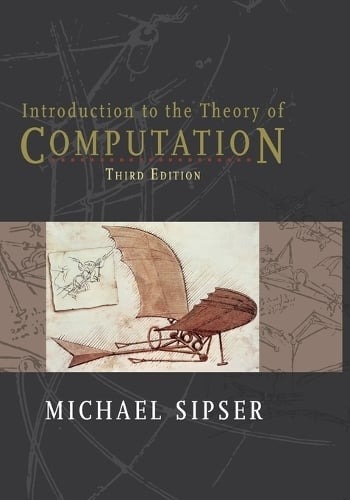
Introduction to the theory of computation
Gain a solid understanding of the fundamental mathematical properties of computer hardware, software, and applications with a blend of practical and philosophical coverage and mathematical treatments, including advanced theorems and proofs.
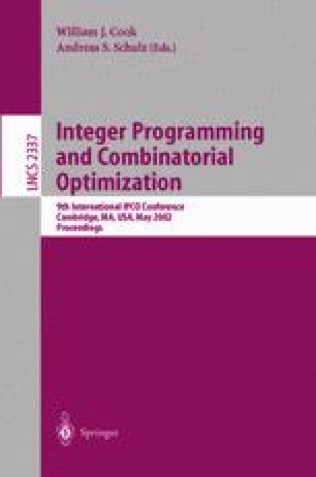
Integer programming and combinatorial optimization ; 9th International IPCO Conference, Cambridge, MA, USA, May 27-29, 2002. Proceedings
This volume contains the papers selected for presentation at IPCO 2002, the NinthInternationalConferenceonIntegerProgrammingandCombinatorial- timization, Cambridge, MA (USA), May 27–29, 2002. The IPCO series of c- ferences highlights recent developments in theory, computation, and application of integer programming and combinatorial optimization. IPCO was established in 1988 when the ?rst IPCO program committee was formed. IPCO is held every year in which no International Symposium on Ma- ematical Programming (ISMP) takes places. The ISMP is triennial, so IPCO conferences are held twice in every three-year period. The eight previous IPCO conferences were held in Waterloo (Canada) 1990, Pittsburgh (USA) 1992, Erice (Italy) 1993, Copenhagen (Denmark) 1995, Vancouver (Canada) 1996, Houston (USA) 1998, Graz (Austria) 1999, and Utrecht (The Netherlands) 2001. In response to the call for papers for IPCO 2002, the program committee received 110 submissions, a record number for IPCO. The program committee met on January 7 and 8, 2002, in Aussois (France), and selected 33 papers for inclusion in the scienti?c program of IPCO 2002. The selection was based on originality and quality, and re?ects many of the current directions in integer programming and combinatorial optimization research.

Integer Programming and Combinatorial Optimization ; 11th International IPCO Conference, Berlin, Germany, June 8-10, 2005, Proceedings
Since its start in 1990, the IPCO conference series (held under the auspices of theMathematicalProgrammingSociety)hasbecomeanimportantforumforthe presentation of recent results in Integer Programming and Combinatorial Op- mization. This volume compiles the papers presented at IPCO XI, the eleventh conference in this series, held June 8–10, 2005, at the Technische Universit¨ at Berlin. The high interest in this conference series is evident in the large number of submissions. For IPCO XI, 119 extended abstracts of up to 10 pages were submitted. During its meeting on January 29–30, 2005, the Program Committee carefully selected 34 contributions for presentation in non-parallel sessions at the conference. The ?nal choices were not easy at all, since, due to the limited number of time slots, many very good papers could not be accepted. During the selection process the contributions were refereed according to the standards of refereed conferences. As a result of this procedure, you have in your hands a volume that contains papers describing high-quality research e?orts. The page limit for contributions to this proceedings volume was set to 15. You may ?nd full versions of the papers in scienti?c journals in the near future. We thank all the authors who submitted papers. Furthermore, the Program Committee is indebted to the many reviewers who, with their speci?c expertise, helped a lot in making the decisions.

Inconsistency tolerance
Inconsistency arises in many areas in advanced computing. Often inconsistency is unwanted, for example in the specification for a plan or in sensor fusion in robotics; however, sometimes inconsistency is useful. Whether inconsistency is unwanted or useful, there is a need to develop tolerance to inconsistency in application technologies such as databases, knowledge bases, and software systems. To address this situation, inconsistency tolerance is being built on foundational technologies for identifying and analyzing inconsistency in information, for representing and reasoning with inconsistent information, for resolving inconsistent information, and for merging inconsistent information. The idea for this book arose out of a Dagstuhl Seminar on the topic held in summer 2003. The nine chapters in this first book devoted to the subject of inconsistency tolerance were carefully invited and anonymously reviewed. The book provides an exciting introduction to this new field.

Identification of nonlinear systems using neural networks and polynomial models : A block-oriented approach
The book gives a comparative study of their gradient approximation accuracy, computational complexity, and convergence rates and furthermore presents some new and original methods concerning the model parameter adjusting with gradient-based techniques. "Identification of Nonlinear Systems Using Neural Networks and Polynomal Models".
