


تحسين النتائح
ترتيب حسب
من
الى

This book covers automata in depth, providing good intuitions along the way, and culminating with applications that are used every day in the field. In this respect, it is a departure from the conventional textbooks on complexity and computability, although these 'tradtional' aspects remain well represented.
This book constitutes the refereed proceedings of the 15th International Conference on Analytical and Stochastic Modeling Techniques and Applications, ASMTA 2008, held in Nicosia, Cyprus, in June 2008.
Probabilistic techniques are increasingly being employed in computer programs and systems because they can increase efficiency in sequential algorithms, enable otherwise nonfunctional distribution applications, and allow quantification of risk and safety in general. This makes operational models of how they work, and logics for reasoning about them, extremely important. Abstraction, Refinement and Proof for Probabilistic Systems presents a rigorous approach to modeling and reasoning about computer systems that incorporate probability. Its foundations lie in traditional Boolean sequential-program logic—but its extension to numeric rather than merely true-or-false judgments takes it much further, into areas such as randomized algorithms, fault tolerance, and, in distributed systems, almost-certain symmetry breaking. The presentation begins with the familiar "assertional" style of program development and continues with increasing specialization: Part I treats probabilistic program logic, including many examples and case studies; Part II sets out the detailed semantics; and Part III applies the approach to advanced material on temporal calculi and two-player games.
Model checking technology is among the foremost applications of logic to computer science and computer engineering. The model checking community has achieved many breakthroughs, bridging the gap between theoretical computer science and hardware and software engineering, and it is reaching out to new challenging areas such as system biology and hybrid systems. Model checking is extensively used in the hardware industry and has also been applied to the verification of many types of software. Model checking has been introduced into computer science and electrical engineering curricula at universities worldwide and has become a universal tool for the analysis of systems.
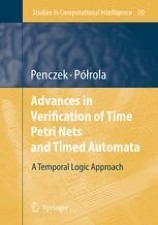
This monograph presents a comprehensive introduction to timed automata (TA) and time Petri nets (TPNs) which belong to the most widely used models of real-time systems. Some of the existing methods of translating time Petri nets to timed automata are presented, with a focus on the translations that correspond to the semantics of time Petri nets, associating clocks with various components of the nets. "Advances in Verification of Time Petri Nets and Timed Automata – A Temporal Logic Approach" introduces timed and untimed temporal specification languages and gives model abstraction methods based on state class approaches for TPNs and on partition refinement for TA. Moreover, the monograph presents a recent progress in the development of two model checking methods, based on either exploiting abstract state spaces or on application of SAT-based symbolic techniques.
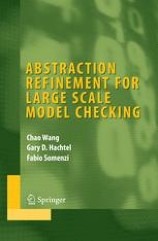
This book describes recent research developments in automatic abstraction refinement techniques. The authors address the main challenge in abstraction refinement, i.e., the ability to efficiently reach or come close to the optimum abstraction (the smallest abstract model that proves or refutes the given property). A suite of fully automatic abstraction techniques are proposed to improve the overall computation efficiency. The suite of algorithms presented in this book has demonstrated significant improvement over the prior art; some of them have already been adopted by the EDA companies in their commercial/in-house verification tools.

سوريا - اتستراد درعا - غباغب
+963-15 2050 - 15 860 380 /1/2/3 - 11 662 3900