



الصفحة 1
الصفحة 1

Modeling of metal forming and machining processes : By finite element and soft computing methods
The physics of metal forming and metal removing is normally expressed using non-linear partial differential equations which can be solved using the finite element method (FEM). However, when the process parameters are uncertain and/or the physics of the process is not well understood, soft computing techniques can be used with FEM or alone to model the process.

Metal Forming Practise : Processes - Machines - Tools
Economical and flexible, advanced metal-forming processes form the core of modern industrial production. This professional sourcebook presents the most important metal-working and shearing processes and the related machines and tooling - in a concise form that is supplemented by ample illustrations, tables and flow charts. Practical examples show how to calculate the forces and strain energy of the processes and the specific parameters of the machines, while exercises enable readers to check their comprehension.

Computational Contact Mechanics
This is the second edition of the valuable reference source for numerical simulations of contact mechanics suitable for many fields like civil engineering, car design, aeronautics, metal forming, or biomechanics. Boundary value problems involving contact are of great importance in industrial applications in engineering such as bearings, metal forming processes, rubber seals, drilling problems, crash analysis of cars, rolling contact between car tires and the road, cooling of electronic devices... Other applications are related to biomechanical engineering design where human joints, implants or teeth are of consideration. Due to this variety, contact problems are today combined either with large elastic or inelastic deformations including time dependent responses. Thermal coupling also might have to be considered. Even stability behaviour has to be linked to contact.

Cold Micro Metal Forming : Research Report of the Collaborative Research Center “Micro Cold Forming” (SFB 747), Bremen, Germany
This book contains the research report of the Collaborative Research Center “Micro Cold Forming” (SFB 747) of the University of Bremen, Germany. The topical research focus lies on new methods and processes for a mastered mass production of micro parts which are smaller than 1mm (by forming in batch size higher than one million). The target audience primarily comprises research experts and practitioners in production engineering, but the book may also be of interest to graduate students alike.
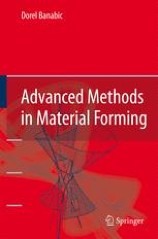
Advanced Methods in Material Forming
The book contains the most relevant papers presented in the International Conference on Materials Forming, ESAFORM 2005. The list below presents some of the most successful minisymposia of the conference: - New and advanced numerical strategies in forming process simulation; - Sheet metal forming technologies and modeling; - Anisotropy and formability of materials; - Polymer processing and modeling; - Composite forming technologies and modeling; - Superplastic forming. This volume gathers selected plenary and keynote papers presented in the conference, offering an up-to-date synthesis of the academic and industrial research in the fields of physical and numerical modeling of materials forming processes. The book is useful for the doctoral fellows, scientists and engineers involved in various domains of materials processing technology.
