



الصفحة 1
الصفحة 1

Mathematics of Financial Markets
This book presents the mathematics that underpins pricing models for derivative securities, such as options, futures and swaps, in modern financial markets. The idealized continuous-time models built upon the famous Black-Scholes theory require sophisticated mathematical tools drawn from modern stochastic calculus. However, many of the underlying ideas can be explained more simply within a discrete-time framework. This is developed extensively in this substantially revised second edition to motivate the technically more demanding continuous-time theory, which includes a detailed analysis of the Black-Scholes model and its generalizations, American put options, term structure models and consumption-investment problems. The mathematics of martingales and stochastic calculus is developed where it is needed.

Mathematical Models of Financial Derivatives
Mathematical Models of Financial Derivatives is a textbook on the theory behind modeling derivatives using the financial engineering approach, focussing on the martingale pricing principles that are common to most derivative securities. A wide range of financial derivatives commonly traded in the equity and fixed income markets are analyzed, emphasizing on the aspects of pricing, hedging and their risk management. Starting from the renowned Black-Scholes-Merton formulation of option pricing model, readers are guided through the text on the new advances on the state-of-the-art derivative pricing models and interest rate models. Both analytic techniques and numerical methods for solving various types of derivative pricing models are emphasized.

Isomorphisms Between H¹ Spaces
Presents a thorough and self-contained presentation of H¹ and its known isomorphic invariants, such as the uniform approximation property, the dimension conjecture, and dichotomies for the complemented subspaces. The necessary background is developed from scratch. This includes a detailed discussion of the Haar system, together with the operators that can be built from it (averaging projections, rearrangement operators, paraproducts, Calderon-Zygmund singular integrals). Complete proofs are given for the classical martingale inequalities of C. Fefferman, Burkholder, and Khinchine-Kahane, and for large deviation inequalities. Complex interpolation, analytic families of operators, and the Calderon product of Banach lattices are treated in the context of H^p spaces. Througout the book, special attention is given to the combinatorial methods developed in the field, particularly J. Bourgain's proof of the dimension conjecture, L. Carleson's biorthogonal system in H¹, T. Figiel's integral representation, W.B. Johnson's factorization of operators, B. Maurey's isomorphism, and P. Jones' proof of the uniform approximation property. An entire chapter is devoted to the study of combinatorics of colored dyadic intervals."

Introduction to Stochastic Integration
The theory of stochastic integration, also called the Ito calculus, has a large spectrum of applications in virtually every scientific area involving random functions, but it can be a very difficult subject for people without much mathematical background. The Ito calculus was originally motivated by the construction of Markov diffusion processes from infinitesimal generators. Previously, the construction of such processes required several steps, whereas Ito constructed these diffusion processes directly in a single step as the solutions of stochastic integral equations associated with the infinitesimal generators. Moreover, the properties of these diffusion processes can be derived from the stochastic integral equations and the Ito formula. This introductory textbook on stochastic integration provides a concise introduction to the Ito calculus

Introduction to Stochastic Calculus for Finance : A New Didactic Approach
The justifcation is mainly pedagogical. These lecture notes start with an elementary approach to stochastic calculus due to Föllmer, who showed that one can develop Ito's calculus "pathwise" as an exercise in real analysis. The text opens to students interested in finance a quick (but by no means "dirty") road to the tools required for advanced finance in continuous time, including option pricing by martingale methods, term structure models in a HJM-framework and the Libor market model.

In Memoriam Paul-André Meyer - Séminaire de Probabilités XXXIX
The 39th volume of Séminaire de Probabilités is a tribute to the memory of Paul André Meyer. His life and achievements are recalled in this book, and tributes are paid by his friends and colleagues. This volume also contains mathematical contributions to classical and quantum stochastic calculus, the theory of processes, martingales and their applications to mathematical finance and Brownian motion. These contributions provide an overview on the current trends of stochastic calculus.

From Stochastic Calculus to Mathematical Finance : The Shiryaev Festschrift
The Festschrift is a collection of papers, including several surveys, written by his former students, co-authors and colleagues. These reflect the wide range of scientific interests of the teacher and his Moscow school. The topics range from the disorder problems to stochastic calculus and their applications to mathematical economics and finance. A full biobibliography of Shiryaev's works is included. The book represents the modern state of art of many aspects of a quickly maturing theory and will be an essential source and reading for researchers in this area.

Dynamic Asset Allocation with Forwards and Futures
DYNAMIC ASSET ALLOCATION WITH FORWARD AND FUTURES is an advanced text on the theory of forward and futures markets which aims at providing readers with a comprehensive knowledge of how prices are established and evolve over time, what optimal strategies one can expect from the participants, what characterizes such markets, and what major theoretical and practical differences distinguish futures from forward contracts. The book proposes an approach of these markets from the perspective of dynamic asset allocation and asset pricing theory within an inter-temporal framework. The main ingredients that are used are the assumed absence of frictions and arbitrage opportunities in financial and real markets, the uniqueness of the economic general equilibrium, when such an equilibrium is required and the tools of continuous time finance, namely martingale theory and stochastic dynamic programming. The scope of DYNAMIC ASSET ALLOCATION WITH FORWARD AND FUTURES is essentially theoretical, with emphasis on economic meaning and financial interpretation. Regarding investment and/or hedging, focus is on optimal strategies rather than on actual practice. Simulations, however, are performed when important insights can be delivered as to the practical relevance of some theoretical results. Also, optimal strategies using futures are shown to differ markedly from those using forwards. The following issues are examined: pure hedging, investment and hedging in complete or incomplete markets, currency risk, optimal spreading, presence of stochastic dividend or convenience yields, pricing of non-redundant futures or forwards by means of general equilibrium analysis, and revisiting of existing Capital Asset Pricing Models.

Dependence in Probability and Statistics
This book gives a detailed account of some recent developments in the field of probability and statistics for dependent data. The book covers a wide range of topics from Markov chain theory and weak dependence with an emphasis on some recent developments on dynamical systems, to strong dependence in times series and random fields. A special section is devoted to statistical estimation problems and specific applications. The book is written as a succession of papers by some specialists of the field, alternating general surveys, mostly at a level accessible to graduate students in probability and statistics, and more general research papers mainly suitable to researchers in the field. The first part of the book considers some recent developments on weak dependent time series, including some new results for Markov chains as well as some developments on new notions of weak dependence. This part also intends to fill a gap between the probability and statistical literature and the dynamical system literature. The second part presents some new results on strong dependence with a special emphasis on non-linear processes and random fields currently encountered in applications. Finally, in the last part, some general estimation problems are investigated, ranging from rate of convergence of maximum likelihood estimators to efficient estimation in parametric or non-parametric time series models, with an emphasis on applications with non-stationary data.
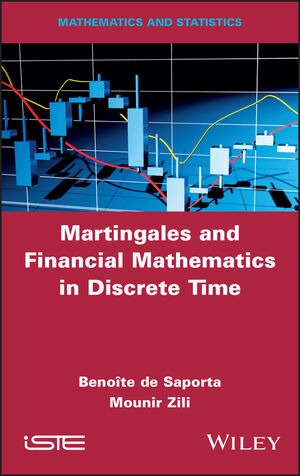
Martingales and financial mathematics in discrete time
This book is entirely devoted to discrete time and provides a detailed introduction to the construction of the rigorous mathematical tools required for the evaluation of options in financial markets. Both theoretical and practical aspects are explored through multiple examples and exercises, for which complete solutions are provided. Particular attention is paid to the Cox, Ross and Rubinstein model in discrete time.
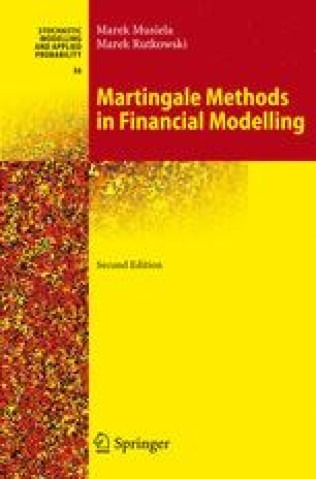
Martingale Methods in Financial Modelling
This book provides a comprehensive, self-contained and up-to-date treatment of the main topics in the theory of option pricing. The first part of the text starts with discrete-time models of financial markets, including the Cox-Ross-Rubinstein binomial model. The passage from discrete- to continuous-time models, done in the Black-Scholes model setting, assumes familiarity with basic ideas and results from stochastic calculus. However, an Appendix containing all the necessary results is included. This model setting is later generalized to cover standard and exotic options involving several assets and/or currencies. An outline of the general theory of arbitrage pricing is presented. The second part of the text is devoted to the term structure modelling and the pricing of interest-rate derivatives. The main emphasis is on models that can be made consistent with market pricing practice.
Market-Conform Valuation of Options
we will investigate the 'market-conform' pricing of newly issued contingent claims. A contingent claim is a derivative whose value at any settlement date is determined by the value of one or more other underlying assets, e. g. , forwards, futures, plain-vanilla or exotic options with European or American-style exercise features. Market-conform pricing means that prices of existing actively traded securities are taken as given, and then the set of equivalent martingale measures that are consistent with the initial prices of the traded securities is derived using no-arbitrage arguments.
Aspects of Brownian motion
Stochastic calculus and excursion theory are very efficient tools to obtain either exact or asymptotic results about Brownian motion and related processes. The emphasis of this book is on special classes of such Brownian functionals as: - Gaussian subspaces of the Gaussian space of Brownian motion; - Brownian quadratic funtionals; - Brownian local times, - Exponential functionals of Brownian motion with drift; - Winding number of one or several Brownian motions around one or several points or a straight line, or curves; - Time spent by Brownian motion below a multiple of its one-sided supremum.

An Introduction to the Theory of Point Processes ; Vol. II : General Theory and Structure
Point processes and random measures find wide applicability in telecommunications, earthquakes, image analysis, spatial point patterns and stereology, to name but a few areas. The authors have made a major reshaping of their work in their first edition of 1988 and now present An Introduction to the Theory of Point Processes in two volumes with subtitles Volume I: Elementary Theory and Methods and Volume II: General Theory and Structure.
