


تحسين النتائح
ترتيب حسب
من
الى

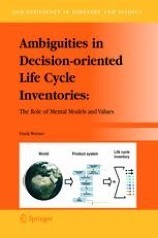
Shows for the first time how mental models and values influence this attribution in the life cycle inventory step of LCA. One of the key findings is that the different management rules for a sustainable use of materials must be taken into account for the attribution of material and energy flows to a product. Otherwise, improvement options recommended by an LCA might turn out to even worsen the environmental situation if reassessed from a meta-perspective. As a consequence of this book, the claim of unambiguitiy (‘objectivity’) of the life cycle inventory must be abandoned. A group-model building process for LCA is developed that allows one to grasp the decision makers' mental models and values in the inventory analysis on a case- and situation-specific basis. Only by this, LCA results will become relevant in a decision-making process. Two case studies on the modelling of recycling and other end-of-life options of aluminium windows and beech wood railway sleepers in LCA complement the methodological part.

This book provides insight into the Life Cycle Management (LCM) concept and the progress in its implementation. LCM is a management concept applied in industrial and service sectors to improve products and services, while enhancing the overall sustainability performance of business and its value chains. In this regard, LCM is an opportunity to differentiate through sustainability performance on the market place, working with all departments of a company such as research and development, procurement and marketing, and to enhance the collaboration with stakeholders along a company’s value chain. LCM is used beyond short-term business success and aims at long-term achievements by minimizing environmental and socio-economic burden, while maximizing economic and social value.
Life cycle engineering deals with technologies for shifting the industry from mass production and mass consumption paradigm to closed loop manufacturing paradigm, in which required functions are provided for customers with the minimum amount of production. This subject is discussed from the various aspects, such as life cycle design, design for environment, reduce/reuse/recycle, life cycle assessment, and sustainable business models.Advances in Life Cycle Engineering for Sustainable Manufacturing Businesses gathers together papers from the 14th CIRP Life Cycle Engineering Conference. This conference is the longest running annual meeting in the field, in which papers are presented regarding developments of leading edge technologies, proposals of new concepts, and prominent industry case studies.

سوريا - اتستراد درعا - غباغب
+963-15 2050 - 15 860 380 /1/2/3 - 11 662 3900