



الصفحة 1
الصفحة 1

Norwegian Shipping in the 20th Century : Norway's Successful Navigation of the World's Most Global Industry
This open access book discusses how Norwegian shipping companies played a crucial role in global shipping markets in the 20th century, at times transporting more than ten per cent of world seaborne trade. Chapters explore how Norway managed to remain competitive, despite being a high labour-cost country in an industry with global competition. Among the features that are emphasised are market developments, business strategies and political decisions The Norwegian experience was shaped by the main breaking points in 20th century world history, such as the two world wars, and by long-term trends, such as globalization and liberalization. The shipping companies introduced technological and organizational innovations to build or maintain a competitive advantage in a rapidly changing world. The growing importance of offshore petroleum exploration in the North Sea from the 1970s was both a threat and an opportunity to the shipping companies. By adapting both business strategies and the political regime to the new circumstances, the Norwegian shipping sector managed to maintain a leading position internationally.

International Finance in Emerging Markets : Issues, Welfare Economics Analyses and Policy Implications
The book "International Finance in Emerging Markets" reviews contemporary issues in international monetary and financial economics in an emerging financial market using the example of Thailand. The book adopts the elements of new welfare economics and asymmetric information paradigms in analyzing those issues including financial liberalization, crisis, exchange rate determination, and domestic capital market reform. The book suggests for the first time a normative social approach for addressing the contemporary issues in international monetary and financial economics. It provides an example of cutting edge research in international finance and monetary economics within a welfare economics framework. It also suggests some policy implications of the welfare economic analysis of international financial issues in an emerging market.

Economic Liberalization and Integration Policy : Options for Eastern Europe and Russia
The authors of this book analyze the dynamics of macroeconomic and structural developments in Eastern Europe and Russia, with special attention paid to problems of international and national integration, "Dutch disease" and natural resource dependency, and distortions in institutional reforms. The analysis also sheds light on how these problems have implications for cooperation among OECD-countries. A critical focus is on institutional adjustment and learning, human capital formation, trade and foreign investment.

Digital Economic Dynamics : Innovations, Networks and Regulations
This book analyzes the dynamics and impacts of software development and discusses new institutional and economic changes in the context of digital market economies.The book furthermore examines telecommunications regulation of fixed line networks, cable TV and mobile communications.

Competition Policies in Emerging Economies : Lessons and Challenges from Central America and Mexico
Do small developing economies, or SDEs, need a specific competition policy to create competitive markets? Against the backdrop of globalization, protectionist policies that promote state ownership and heavy regulation of key industries are proving increasingly ineffective for driving growth. Countries around the world are instituting reforms to promote competition and business creation, yet the economic and political concentration of power, feeble judicial systems, and the scarcity of human and financial resources pose special challenges to SDEs. Competition Policies in Emerging Economies features an in-depth analysis of two strategic industries — telecommunications and banking — in several Central American nations which sheds light on the dynamics of the transition to deregulation and trade liberalization. Examining the lessons learned from these experiences and presenting discussion of political, legal, economic, financial, cultural, and organizational issues, the book provides unique perspectives on competition policy and economic development.
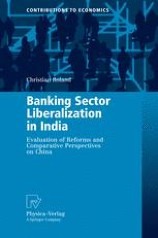
Banking Sector Liberalization in India : Evaluation of Reforms and Comparative Perspectives on China
Banking Sector Liberalization in India explores in detail the changes in the Indian banking sector over the last 20 years, and puts them into a comparative perspective with the Chinese banking sector. For this purpose, the author develops a detailed indicator-based framework for assessing the liberalization of a banking sector along various process steps based on financial liberalization and transformation studies. This framework, along with the indicators for the process and the results of liberalization, is applied to the banking sectors in India and China to test for the effects of liberalization on the sector and the macro level. The key finding is that while liberalization has improved the sectoral performance, it has so far had no effect on the macro level. The book features a detailed description of recent reforms in the Indian banking sector, a set of indicators for evaluating banking sector reforms, and a large number of graphs with key figures for the banking sectors in India and China.
