



الصفحة 1
الصفحة 1

Multiple Integrals in the Calculus of Variations
From the reviews: "…the book contains a wealth of material essential to the researcher concerned with multiple integral variational problems and with elliptic partial differential equations. The book not only reports the researches of the author but also the contributions of his contemporaries in the same and related fields. The book undoubtedly will become a standard reference for researchers in these areas. …The book is addressed mainly to mature mathematical analysts. However, any student of analysis will be greatly rewarded by a careful study of this book."

Multiple Criteria Decision Analysis :State of the Art Surveys
The handbook presents the most up-to-date discussions on well-established methodologies and theories in the field, while systematically surveying emerging fields in MCDA such as conjoint measurement, fuzzy preferences, fuzzy integrals, rough sets, etc. MULTIPLE CRITERIA DECISION ANALYSIS is a valuable reference volume (more than 2000 references) for the field of decision analysis. It provides graduate students, researchers, and practitioners with a sweeping survey of MCDA theory, methodologies, and applications. It is a handbook that is particularly suitable for use in seminars in Decision Analysis, Decision Support, and Decision Theory.

Modern Hematology : Biology and Clinical Management
The first chapters of this book contain a self-contained introduction to path integrals in Euclidean quantum mechanics and statistical mechanics. The resulting high-dimensional integrals can be estimated with the help of Monte Carlo simulations based on Markov processes. The most commonly used algorithms are presented in detail so as to prepare the reader for the use of high-performance computers as an “experimental” tool for this burgeoning field of theoretical physics. Several chapters are then devoted to an introduction to simple lattice field theories and a variety of spin systems with discrete and continuous spins, where the ubiquitous Ising model serves as an ideal guide for introducing the fascinating area of phase transitions. As an alternative to the lattice formulation of quantum field theories, variants of the flexible renormalization group methods are discussed in detail. Since, according to our present-day knowledge, all fundamental interactions in nature are described by gauge theories, the remaining chapters of the book deal with gauge theories without and with matter.
Modeling decisions : Information fusion and aggregation operators
This book covers the underlying science and application issues related to aggregation operators, focusing on tools used in practical applications that involve numerical information. Starting with detailed introductions to information fusion and integration, measurement and probability theory, fuzzy sets, and functional equations.

Mathématiques de base pour économistes = Basic Mathematics for Economists
This book contains fundamental elements of mathematics and includes the following elements: notion of logic, propositions, theorems, sets, relations and functions; graphical representations of functions, economic applications of lines and functions, sequences, limits and first derivative, differential economic applications of derivatives; integrals: undefined and defined with economic applications; mathematical series; functions of several variables, partial derivatives, Lagrange multiplier with economic applications; linear algebra: matrix calculus, system of linear equations, vectors, differential calculus in matrix form.

Mathematics for enzyme reaction kinetics and Reactor performance ; 2 Volumes set
The second volume begins with an introduction to basic concepts in calculus, i.e. limits, derivatives, integrals and differential equations; limits, along with continuity, are further expanded afterwards, covering uni- and multivariate cases, as well as classical theorems. After recovering the concept of differential and applying it to generate (regular and partial) derivatives, the most important rules of differentiation of functions, in explicit, implicit and parametric form, are retrieved – together with the nuclear theorems supporting simpler manipulation thereof. The book then tackles strategies to optimize uni- and multivariate functions, before addressing integrals in both indefinite and definite forms.

Mathematical Theory of Feynman Path Integrals : An Introduction
Feynman path integrals, suggested heuristically by Feynman in the 40s, have become the basis of much of contemporary physics, from non-relativistic quantum mechanics to quantum fields, including gauge fields, gravitation, cosmology. Recently ideas based on Feynman path integrals have also played an important role in areas of mathematics like low-dimensional topology and differential geometry, algebraic geometry, infinite-dimensional analysis and geometry, and number theory.

Isomorphisms Between H¹ Spaces
Presents a thorough and self-contained presentation of H¹ and its known isomorphic invariants, such as the uniform approximation property, the dimension conjecture, and dichotomies for the complemented subspaces. The necessary background is developed from scratch. This includes a detailed discussion of the Haar system, together with the operators that can be built from it (averaging projections, rearrangement operators, paraproducts, Calderon-Zygmund singular integrals). Complete proofs are given for the classical martingale inequalities of C. Fefferman, Burkholder, and Khinchine-Kahane, and for large deviation inequalities. Complex interpolation, analytic families of operators, and the Calderon product of Banach lattices are treated in the context of H^p spaces. Througout the book, special attention is given to the combinatorial methods developed in the field, particularly J. Bourgain's proof of the dimension conjecture, L. Carleson's biorthogonal system in H¹, T. Figiel's integral representation, W.B. Johnson's factorization of operators, B. Maurey's isomorphism, and P. Jones' proof of the uniform approximation property. An entire chapter is devoted to the study of combinatorics of colored dyadic intervals."

Introduction to applied mathematics for environmental science
Introduction to Mathematics for Environmental Science evolved from the author’s 30 years’ experience teaching mathematics to graduate and advanced undergraduate students in the environmental sciences. Its basic purpose is to teach various types of mathematical structures and how they can be applied in a broad range of environmental science subfields. Derivatives and integrals, ordinary and partial differential equations, and linear and non-linear algebraic equations are the basic kinds of structures (types of mathematical models) discussed.

Geometric mechanics on riemannian manifolds : Applications to partial differential equations
This work presents a purely geometric treatment of problems in physics involving quantum harmonic oscillators, quartic oscillators, minimal surfaces, and Schrödinger's, Einstein's and Newton's equations. Historically, problems in these areas were approached using the Fourier transform or path integrals, although in some cases (e.g., the case of quartic oscillators) these methods do not work. New geometric methods are introduced in the work that have the advantage of providing quantitative or at least qualitative descriptions of operators, many of which cannot be treated by other methods. And, conservation laws of the Euler–Lagrange equations are employed to solve the equations of motion qualitatively when quantitative analysis is not possible. It includes : Lagrangian formalism on Riemannian manifolds; energy momentum tensor and conservation laws; Hamiltonian formalism; Hamilton–Jacobi theory; harmonic functions, maps, and geodesics; fundamental solutions for heat operators with potential; and a variational approach to mechanical curves.

Geometric and Topological Methods for Quantum Field Theory
This volume offers an introduction, in the form of four extensive lectures, to some recent developments in several active topics at the interface between geometry, topology and quantum field theory. The first lecture is by Christine Lescop on knot invariants and configuration spaces, in which a universal finite-type invariant for knots is constructed as a series of integrals over configuration spaces. This is followed by the contribution of Raimar Wulkenhaar on Euclidean quantum field theory from a statistical point of view. The author also discusses possible renormalization techniques on noncommutative spaces. The third lecture is by Anamaria Font and Stefan Theisen on string compactification with unbroken supersymmetry. The authors show that this requirement leads to internal spaces of special holonomy and describe Calabi-Yau manifolds in detail. The last lecture, by Thierry Fack, is devoted to a K-theory proof of the Atiyah-Singer index theorem and discusses some applications of K-theory to noncommutative geometry. These lectures notes, which are aimed in particular at graduate students in physics and mathematics, start with introductory material before presenting more advanced results. Each chapter is self-contained and can be read independently.

Fractional calculus—theory and applications
Fractional calculus has led to tremendous progress in various areas of science and mathematics. New definitions of fractional derivatives and integrals have been uncovered, extending their classical definitions in various ways. Moreover, rigorous analysis of the functional properties of these new definitions has been an active area of research in mathematical analysis. Systems considering differential equations with fractional-order operators have been investigated thoroughly from analytical and numerical points of view, and potential applications have been proposed for use in sciences and in technology. The purpose of this Special Issue is to serve as a specialized forum for the dissemination of recent progress in the theory of fractional calculus and its potential applications.

Feynman Integral Calculus
The problem of evaluating Feynman integrals over loop momenta has existed from the early days of perturbative quantum field theory. The goal of the book is to summarize those methods for evaluating Feynman integrals that have been developed over a span of more than fifty years. `Feynman Integral Calculus' characterizes the most powerful methods in a systematic way. It concentrates on the methods that have been employed recently for most sophisticated calculations and illustrates them with numerous examples, starting from very simple ones and progressing to nontrivial examples. It also shows how to choose adequate methods and combine them in a non-trivial way.

Evaluating Feynman Integrals
The problem of evaluating Feynman integrals over loop momenta has existed from the early days of perturbative quantum field theory. Although a great variety of methods for evaluating Feynman integrals has been developed over a span of more than fifty years, this book is a first attempt to summarize them. 'Evaluating Feynman Integrals' characterizes the most powerful methods, in particular those used for recent, quite sophisticated calculations, and then illustrates them with numerous examples, starting from very simple ones and progressing to nontrivial examples.

Essays in Constructive Mathematics
This book aims to promote constructive mathematics, not by defining it or formalizing it, but by practicing it, by basing all definitions and proofs on finite algorithms. The topics covered derive from classic works of nineteenth century mathematics---among them Galois' theory of algebraic equations, Gauss's theory of binary quadratic forms and Abel's theorem about integrals of rational differentials on algebraic curves. It is not surprising that the first two topics can be treated constructively---although the constructive treatments shed a surprising amount of light on them---but the last topic, involving integrals and differentials as it does, might seem to call for infinite processes. In this case too, however, finite algorithms suffice to define the genus of an algebraic curve, to prove that birationally equivalent curves have the same genus, and to prove the Riemann-Roch theorem. The main algorithm in this case is Newton's polygon, which is given a full treatment. Other topics covered include the fundamental theorem of algebra, the factorization of polynomials over an algebraic number field, and the spectral theorem for symmetric matrices.
Limit Cycles of Differential Equations
Contains the lecture series originally delivered at the "Advanced Course on Limit Cycles of Differential Equations" in the Centre de Recerca Matemàtica Barcelona in 2006.The topics covered are the center-focus problem for polynomial vector fields, and the application of abelian integrals to limit cycle bifurcations. Both topics are related to Hilbert's sixteenth problem. In particular, the book will be of interest to students and researchers working in the qualitative theory of dynamical systems.
Lie theory ; Vol.230 : Harmonic analysis on symmetric spaces, general Plancherel theorems
Van den Ban’s introductory chapter explains the basic setup of a reductive symmetric space along with a careful study of the structure theory, particularly for the ring of invariant differential operators for the relevant class of parabolic subgroups. Advanced topics for the formulation and understanding of the proof are covered, including Eisenstein integrals, regularity theorems, Maass–Selberg relations, and residue calculus for root systems. Schlichtkrull provides a cogent account of the basic ingredients in the harmonic analysis on a symmetric space through the explanation and definition of the Paley–Wiener theorem. Approaching the Plancherel theorem through an alternative viewpoint, the Schwartz space, Delorme bases his discussion and proof on asymptotic expansions of eigenfunctions and the theory of intertwining integrals.
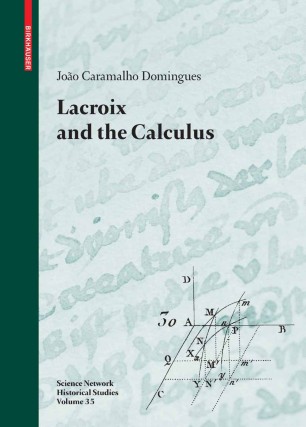
Lacroix and the Calculus
Lacroix and the Calculus is the first major study of Lacroix’s large Traité. It uses the unique and massive bibliography given by Lacroix to explore late 18th-century calculus, and the way it is reflected in Lacroix’s account. Several particular aspects are addressed in detail, including: the foundations of differential calculus, analytic and differential geometry, conceptions of the integral, and types of solutions of differential equations (singular/complete/general integrals, geometrical interpretations, and generality of arbitrary functions).
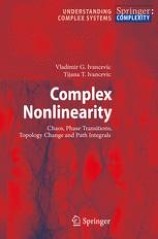
Complex Nonlinearity : Chaos, Phase Transitions, Topology Change and Path Integrals
The book starts with a textbook-like expose on nonlinear dynamics, attractors and chaos, both temporal and spatio-temporal, including modern techniques of chaos–control. Chapter 2 turns to the edge of chaos, in the form of phase transitions (equilibrium and non-equilibrium, oscillatory, fractal and noise-induced), as well as the related field of synergetics. While the natural stage for linear dynamics comprises of flat, Euclidean geometry (with the corresponding calculation tools from linear algebra and analysis), the natural stage for nonlinear dynamics is curved, Riemannian geometry (with the corresponding tools from nonlinear, tensor algebra and analysis). The extreme nonlinearity – chaos – corresponds to the topology change of this curved geometrical stage, usually called configuration manifold. Chapter 3 elaborates on geometry and topology change in relation with complex nonlinearity and chaos. Chapter 4 develops general nonlinear dynamics, continuous and discrete, deterministic and stochastic, in the unique form of path integrals and their action-amplitude formalism.

Cálculo científico con MATLAB y Octave = Scientific computing with MATLAB and Octave
This textbook is an introduction to Scientific Calculus, illustrating various numerical methods for the computer solution of certain classes of mathematical problems. The authors show how to compute the zeros or integrals of continuous functions, solve linear systems, approximate functions by polynomials, and construct precise approximations for the solution of differential equations. To make the presentation concrete and attractive, the MATLAB programming environment has been adopted as a faithful companion.
