



الصفحة 1
الصفحة 1

Neutrophil : Methods and Protocols
Neutrophils, the most abundant white cells in humans, serve as the primary cellular defense against infection. This volume provides a concise set of protocols for assessing basic neutrophil functions and investigating specialized areas in neutrophil biology. Each of the protocols is written by leading researchers in the field and includes hints for success, as well as guidance for troubleshooting. Part I contains overviews of neutrophil biology, function, and disorders. Part II describes commonly used methods to isolate neutrophils from humans and other animal species. Part III details methods for investigating chemotaxis, transmigration, phagocytosis, and bactericidal activity. Part IV includes protocols that measure neutrophil apoptosis, calcium signal transduction, degranulation and detection of cytoplasmic granules, gene expression, transcription factors, and apoptosis. Part V provides multiple assays for measuring production of intracellular and/or extracellular reactive oxygen species, and a method that details use of the cell-free NADPH oxidase assay, an iconic assay for studies of the neutrophil NADPH oxidase. Part VI provides chapters that describe how to analyze formation and function of neutrophil extracellular traps.

Inclusions in Prokaryotes
The new series "Microbiology Monographs" begins with two volumes on intracellular components in prokaryotes. In this first volume, "Inclusions in Prokaryotes", the components, labeled inclusions, are defined as discrete bodies resulting from synthesis of a metabolic product.

Granular dynamic theory and its applications
Granular Dynamic Theory and Its Applications introduces both theory and applications in detail, including differential dynamical models of granular shearing, dynamical strength characteristics and the excited response of granules subject to vibration, granular liquefaction properties and the mechanisms under vibration, granular flow theory and vibration-aided flow, propagation laws of waves in granular media and their mechanism, fractal properties of granules, the vibrating ore-drawing technologies, and so on
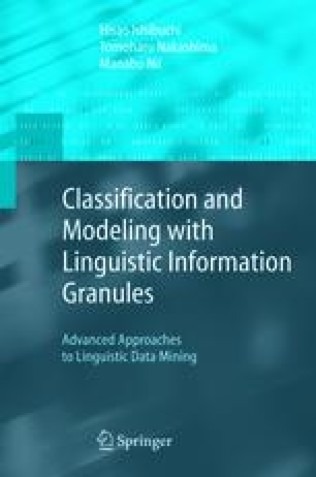
Classification and Modeling with Linguistic Information Granules : Advanced Approaches to Linguistic Data Mining
Many approaches have already been proposed for classification and modeling in the literature. These approaches are usually based on mathematical mod els. Computer systems can easily handle mathematical models even when they are complicated and nonlinear (e.g., neural networks). On the other hand, it is not always easy for human users to intuitively understand mathe matical models even when they are simple and linear. This is because human information processing is based mainly on linguistic knowledge while com puter systems are designed to handle symbolic and numerical information. A large part of our daily communication is based on words. We learn from various media such as books, newspapers, magazines, TV, and the Inter net through words. We also communicate with others through words. While words play a central role in human information processing, linguistic models are not often used in the fields of classification and modeling. If there is no goal other than the maximization of accuracy in classification and modeling, mathematical models may always be preferred to linguistic models. On the other hand, linguistic models may be chosen if emphasis is placed on interpretability.
