



الصفحة 1
الصفحة 1

Nonlinear Dynamics in Geosciences
Nonlinear Dynamics in Geosciences is comprised of the proceedings of "20 Years of Nonlinear Dynamics in Geosciences", held June 11-16, 2006 in Rhodes, Greece as part of the Aegean Conferences. The volume brings together the most up-to-date research from the atmospheric sciences, hydrology, geology, and other areas of geosciences, and discusses the advances made in the last two decades and the future directions of nonlinear dynamics. Topics covered include predictability, ensemble prediction, nonlinear prediction, nonlinear time series analysis, low-dimensional chaos, nonlinear modeling, fractals and multifractals, bifurcation, complex networks, self-organized criticality, extreme events, and other aspects of nonlinear science.

Natural Disasters and Extreme Events in Agriculture : Impacts and Mitigation
Agricultural production is highly dependent on weather, climate and water availability and is adversely affected by the weather and climate-related disasters. Droughts and natural disasters such as floods can result in crop failures, food insecurity, famine, loss of property and life, mass migration and negative national economic growth. It may not be possible to prevent the occurrence of these natural disasters, but the resultant disastrous effects can be reduced considerably through proper planning and effective preparation. Vulnerability associated with the hazards of natural disasters can be controlled to some extent by accurate and timely prediction and by taking counter-measures to reduce their impacts on agriculture. This book based on an expert meeting held in Beijing, China should be of interest to all organizations involved in disasters reduction and mitigation of extreme events.

Flood Risk Management : Hazards, Vulnerability and Mitigation Measures
Floods are of increasing public concern world-wide due to increasing damages and unacceptably high numbers of injuries. Previous approaches of flood protection led to limited success especially during recent extreme events. Therefore, an integrated flood risk management is required which takes into consideration both the hydrometeorogical and the societal processes. Moreover, real effects of risk mitigation measures have to be critically assessed. The book draws a comprehensive picture of all these aspects and their interrelations. It furthermore provides a lot of detail on earth observation, flood hazard modelling, climate change, flood forecasting, modelling vulnerability, mitigation measures and the various dimensions of management strategies. In addition to local and regional results of science, engineering and social science investigations on modelling and management, transboundary co-operation of large river catchments are of interest.

Extremes in Nature : An Approach Using Copulas
The study of the statistics of extreme events is an essential first step in the mitigation of natural catastrophies, that often cause severe economic losses worldwide. This book is about the theoretical and practical aspects of the statistics of Extreme Events in Nature. Most importantly, this is the first text in which Copulas are introduced and used in Geophysics. Several topics are fully original, and show how standard models and calculations can be improved by exploiting the opportunities offered by Copulas. In addition, new quantities useful for design and risk assessment are introduced. Practicioners in all research areas of Geosciences and extreme events (including Finance and Insurance, closely related to natural disasters) will definitely benefit from the new Copula-approach outlined in the book.

Extreme Events in Nature and Society
Significant, and usually unwelcome, surprises, such as floods, financial crisis, epileptic seizures, or material rupture, are the topics of Extreme Events in Nature and Society. The book, authored by foremost experts in these fields, reveals unifying and distinguishing features of extreme events, including problems of understanding and modelling their origin, spatial and temporal extension, and potential impact. The chapters converge towards the difficult problem of anticipation: forecasting the event and proposing measures to moderate or prevent it. Extreme Events in Nature and Society will interest not only specialists, but also the general reader eager to learn how the multifaceted field of extreme events can be viewed as a coherent whole.

Demystifying Climate Models : A Users Guide to Earth System Models
This book demystifies the models we use to simulate present and future climates, allowing readers to better understand how to use climate model results. In order to predict the future trajectory of the Earth’s climate, climate-system simulation models are necessary. When and how do we trust climate model predictions? The book offers a framework for answering this question. It provides readers with a basic primer on climate and climate change, and offers non-technical explanations for how climate models are constructed, why they are uncertain, and what level of confidence we should place in them. It presents current results and the key uncertainties concerning them. Uncertainty is not a weakness but understanding uncertainty is a strength and a key part of using any model, including climate models.
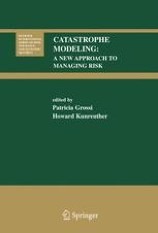
Catastrophe modeling : A new approach to managing risk
Catastrophe Modeling: A New Approach to Managing Risk is the first book that systematically analyzes how catastrophe models can be used for assessing and managing risks of extreme events. It focuses on natural disaster risk, but also discusses the management of terrorism risk. A unique feature of this book is the involvement of three leading catastrophe modeling firms, AIR Worldwide, EQECAT, and Risk Management Solutions, who examine the role of catastrophe modeling in rate setting, portfolio management and risk financing. Given the uncertainties associated with terrorism the book points out the opportunities for utilizing catastrophe models to set insurance rates and to examine public-private partnerships for providing financial assistance in the event of a terrorist attack. This book is strongly recommended for individuals who must make decisions regarding the management of impacts of catastrophe risks including those in both the public and private sector.
