



الصفحة 1
الصفحة 1

Moral Philosophy on the Threshold of Modernity
This volume investigates the paradigm changes which occurred in ethics during the early modern era (1350-1600). While many general claims have been made regarding the nature of moral philosophy in the period of transition from medieval to modern thought, the rich variety of extant texts has seldom been studied and discussed in detail. The present collection attempts to do this. It provides new research on ethics in the context of Late Scholasticism, Neo-Scholasticism, Renaissance Humanism and the Reformation. It traces the fate of Aristotelianism and of Stoicism, explores specific topics such as probabilism and casuistry, and highlights the connections between Protestant theology and early modern ethics. The book also examines how the origins of human rights, as well as different views of moral agency, the will and the emotions, came into focus on the eve of modernity.

Inessential Colors : Architecture on Paper in Early Modern Europe
Addresses color as a key player in the long history of rivalry and exchange between European traditions in architectural representation and practice.Featuring a wealth of previously unpublished drawings, Inessential Colors challenges the long-standing misreading of architectural drawings as illustrations rather than representations, pointing instead to their inherent qualities as independent objects whose beauty paved the way for the visual system architects use today.

Iberian World Empires and the Globalization of Europe 1415–1668
This book analyses Iberian expansion by using knowledge accumulated in recent years to test some of the most important theories regarding Europe’s economic development. Adopting a comparative perspective, it considers the impact of early globalization on Iberian and Western European institutions, social development and political economies. This book finds its impact decisive for institutional development, political economies, and processes of state-building in Iberia and Europe. The book engages current historiographies and revindicates the need to take the concept of composite monarchies as a point of departure in order to understand the period’s economic and social developments, analysing the institutions and societies resulting from contact with Iberian peoples in America and Asia. The outcome is a study that nuances and contests an excessively-negative yet prevalent image of the Iberian societies, explores the difficult relationship between empires and globalization and opens paths for comparisons to other imperial formations.

Heaven Upon Earth : Joseph Mede (1586-1638) and the Legacy of Millenarianism
THE HISTORY OF BRITISHAPOCALYPTICTHOUGHT The study of early modern Britain between the Reformation of the 1530s and the Wars of the Three Kingdoms of the 1640s has undergone a series of historiographical revisions. The dramatic events during that century were marked by a religious struggle that produced a Protestant nation, divided internally, yet clearly opposed to Rome. Likewise the political environment instilled a sense of responsible awareness regarding the administration of the realm and the defense 1 of constitutional liberty. Whig Historians from the nineteenth century described 2 these changes as a “Puritan Revolution.”

Harnessing the Power of the Criminal Corpse
This book is the culmination of many years of research on what happened to the bodies of executed criminals in the past. Focusing on the eighteenth and nineteenth centuries, it looks at the consequences of the 1752 Murder Act. These criminal bodies had a crucial role in the history of medicine, and the history of crime, and great symbolic resonance in literature and popular culture. Starting with a consideration of the criminal corpse in the medieval and early modern periods, chapters go on to review the histories of criminal justice, of medical history and of gibbeting under the Murder Act, and ends with some discussion of the afterlives of the corpse, in literature, folklore and in contemporary medical ethics. Using sophisticated insights from cultural history, archaeology, literature, philosophy and ethics as well as medical and crime history, this book is a uniquely interdisciplinary take on a fascinating historical phenomenon.

Global history with Chinese characteristics : Autocratic States along the Silk Road in the decline of the Spanish and Qing Empires 1680-1796
This book examines perceptions and dialogues between China and Europe by analysing strategic geopolitical sites which fostered commerce, consumption and socioeconomic networks between China and Europe through a particular case study: Macau, connecting with South China, and Marseille in Mediterranean Europe from 1680 to 1800

Forming the mind : Essays on the internal senses and the Mind/Body problem from avicenna to the medical enlightenment
The book collects essays from some of the foremost scholars in a relatively new and very promising field of research. It stresses how important and fruitful it is to see the time period between 1100 and 1700 as one continuous tradition, and brings together scholars working on the same issues in the Arabic, Jewish and Western philosophical traditions. In this respect, this collection opens up several new and interesting perspectives on the history of the philosophy of mind.

Executing magic in the modern era : Criminal bodies and the Gallows in popular medicine
This book explores the magical and medical history of executions from the eighteenth to the early twentieth century by looking at the afterlife potency of criminal corpses, the healing activities of the executioner, and the magic of the gallows site. The use of corpses in medicine and magic has been recorded back into antiquity. The lacerated bodies of Roman gladiators were used as a source of curative blood, for instance. In early modern Europe, a great trade opened up in ancient Egyptian mummies and the fat of executed criminals, plundered as medicinal cure-alls. However, this is the first book to consider the demand for the blood of the executed, the desire for human fat, the resort to the hanged man’s hand, and the trade in hanging rope in the modern era. It ends by look at the spiritual afterlife of dead criminals.

Early Modern Humans at the Moravian Gate : The Mladec Caves and their Remains
The Upper Paleolithic fossils of the Mladec caves, South Moravia, excavated at the end of the 19th century, hold a key position in the current discussion on modern human emergence within Europe and the fate of the Neanderthals. Although undoubtedly early modern humans - recently radio carbon dated to 31.000 years BP - their morphological variability and the presence of archaic features are indicative to some degree of regional Neanderthal ancestry. The beautifully illustrated monograph addresses - for the first time - the complete assemblage of the finds, including the human cranial.

Dissecting the Criminal Corpse : Staging Post-Execution Punishment in Early Modern England
Those convicted of homicide were hanged on the public gallows before being dissected under the Murder Act in Georgian England. Yet, from 1752, whether criminals actually died on the hanging tree or in the dissection room remained a medical mystery in early modern society. Dissecting the Criminal Corpse takes issue with the historical cliché of corpses dangling from the hangman’s rope in crime studies. Some convicted murderers did survive execution in early modern England. Establishing medical death in the heart-lungs-brain was a physical enigma. Criminals had large bullnecks, strong willpowers, and hearty survival instincts. Extreme hypothermia often disguised coma in a prisoner hanged in the winter cold. The youngest and fittest were capable of reviving on the dissection table. Many died under the lancet. Capital legislation disguised a complex medical choreography that surgeons staged. They broke the Hippocratic Oath by executing the Dangerous Dead across England from 1752 until 1832.

De sphaera of Johannes de Sacrobosco in the Early Modern Period : The Authors of the Commentaries
Explores commentaries on an influential text of pre-Copernican astronomy in Europe. It features essays that take a close look at key intellectuals and how they engaged with the main ideas of this qualitative introduction to geocentric cosmology.

Constructions of cancer in early Modern England : Ravenous natures
Cancer is perhaps the modern world's most feared disease. Yet, we know relatively little about this malady's history before the nineteenth century. This book provides the first in-depth examination of perceptions of cancerous disease in early modern England. Looking to drama, poetry and polemic as well as medical texts and personal accounts, it contends that early modern people possessed an understanding of cancer which remains recognizable to us today. Many of the ways in which medical practitioners and lay people imagined cancer – as a 'woman's disease' or a 'beast' inside the body – remain strikingly familiar, and they helped to make this disease a byword for treachery and cruelty in discussions of religion, culture and politics. Equally, cancer treatments were among the era's most radical medical and surgical procedures. From buttered frog ointments to agonizing and dangerous surgeries, they raised abiding questions about the nature of disease and the proper role of the medical practitioner.
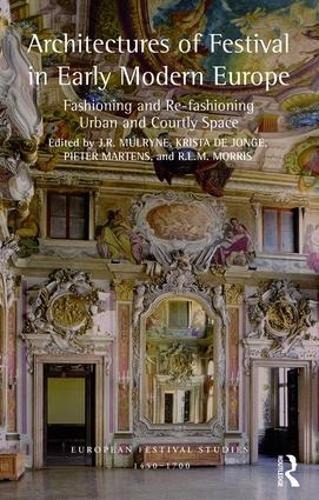
Architectures of festival in early modern Europe : Fashioning and re-fashioning urban and courtly space
Draws on up-to-date research by a Europe-wide group of academic scholars and museum and gallery curators to provide a unique, intellectually-stimulating and beautifully-illustrated account of temporary architecture created for festivals of the sixteenth and seventeenth centuries, together with permanent architecture pressed into service for festival occasions across major European locations including Italian, French, Austrian, Scottish and German.
